What Cisco's 2026 Exam Changes Mean for CCNA Subnetting Practice
By PrepHoot Editorial Team· (updated Sep 24, 2026)
If you are hunting for CCNA subnetting practice questions right now, you have probably noticed something odd: the study material keeps shifting under your feet. Cisco has spent 2026 reworking big parts of its certification portfolio, and candidates reasonably want to know whether the subnetting they are drilling still matches what the 200-301 exam actually tests. This piece separates what Cisco has confirmed from what is still analysis, so you can decide whether your current practice routine is safe or needs a reset before exam day.
What Cisco Has Actually Confirmed in 2026
Start with the verified part, because the rumor mill has been busy.
Cisco has been refreshing exam blueprints across its portfolio through 2026, and the certification industry as a whole is in a heavier-than-usual revision cycle. Microsoft retired AZ-204 on July 31, 2026, and AZ-500 on August 31, 2026, handing its security role to SC-500, according to Training Camp's September 2026 certification roundup. AWS has been running similar version transitions, with the Machine Learning Engineer Associate exam moving through a beta window that opened September 29, 2026 ahead of a general-availability target of January 14, 2027, per the AWS Builder Center's September 2026 update post.
That context matters for one reason: vendors do not revise exams in isolation. When one major certification body moves, the others tend to follow within the same planning cycle.
For the CCNA specifically, the exam you are preparing for is 200-301, and the current blueprint version is 200-301 v1.1. Cisco publishes the official exam topics document for each version, and that document is the only authoritative list of what can appear on your test. Third-party blogs, video courses, and question banks are interpretations of that document, not replacements for it.
Here is the practical consequence. Any subnetting resource you use should be traceable back to the 200-301 v1.1 objectives. If a question bank was written against an older blueprint and never updated, you cannot tell from the outside whether its coverage still lines up.
Where Subnetting Sits in the 200-301 Blueprint
Subnetting is not its own domain on the CCNA. It lives inside the IP connectivity and IP addressing material, and it shows up in questions that also test routing, VLANs, and address planning.
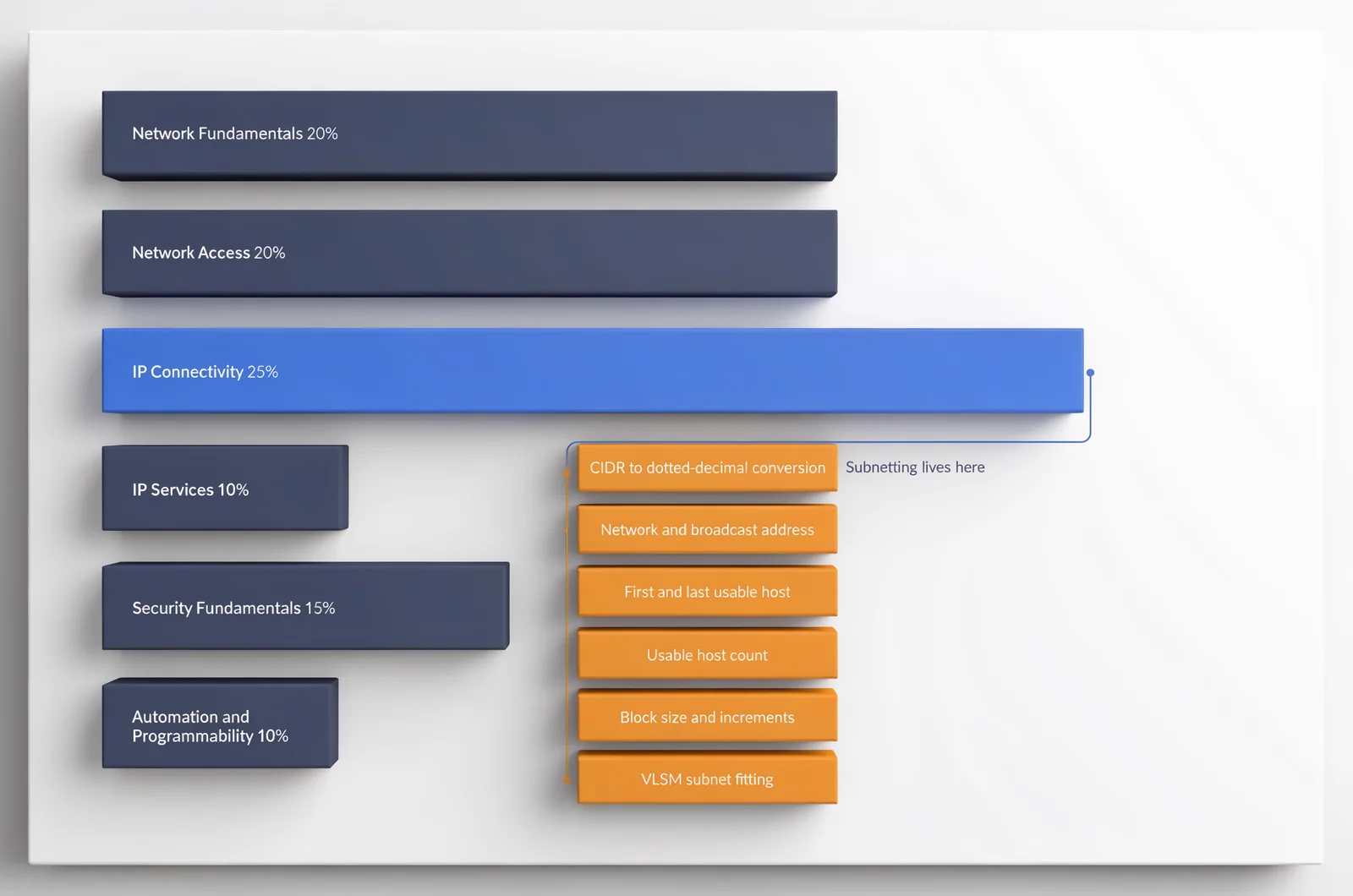
Cisco's exam topics break the exam into six domains, with IP Connectivity the largest single domain at 25% of the exam. That is where most failed attempts lose their marks, and it is also where routing and subnetting questions cluster. The practical reading: subnetting is not a side topic you can skip and compensate for elsewhere. It is load-bearing.
How much of your score rides on it? HowToNetwork puts IP subnetting at roughly 10% of your final marks for exams like the Cisco CCNA and CompTIA Network+, based on its published quiz breakdown. That figure is an estimate from a training provider rather than a Cisco statement, so treat it as a planning number, not gospel. Even at the low end, 10% is enough to move you between pass and fail.
The skills that actually get tested are narrower than "subnetting" as a general concept. Across the practice material Cisco's own learning community and independent quiz sites publish, the recurring question types are:
- Converting between CIDR prefix notation and dotted-decimal subnet masks
- Finding the network address and broadcast address for a given host
- Calculating the first and last usable host addresses in a subnet
- Counting usable hosts after subtracting the network and broadcast addresses
- Determining block size and subnet increments
- Applying VLSM to fit a host requirement into the smallest adequate subnet
- Working with wildcard masks for ACL and OSPF contexts
If your practice set does not cover all seven, you have a coverage gap regardless of how many questions you answer.
The Speed Problem Nobody Warns You About
Coverage is half the battle. The other half is time.
CCNA gives you roughly 60 to 90 seconds per question overall, and subnetting questions are not the only ones on the exam. That estimate comes from Networking Signal's August 2026 practice-question breakdown, which also lays out a useful three-stage progression: 2 to 3 minutes per question with a chart while you are learning the method, 45 to 60 seconds without a chart once you are competent, and under 30 seconds in your head to be genuinely exam ready.
That last tier is the one that matters. If a subnetting question takes you two minutes, it costs you elsewhere on the exam, and the cost compounds because subnetting questions often appear inside larger scenario items.
This is why timed practice is not optional. Answering 50 subnetting questions untimed teaches you the method. Answering them under a clock teaches you the exam. The two skills are related but not identical, and candidates who only do the first one are frequently surprised by how tight the real interface feels.
A useful self-check: work a /26 problem cold, no calculator, no cheat sheet, and time yourself. If you land the network address, broadcast address, and usable host count in under 45 seconds, you are on track. If it takes you 90 seconds or more, your bottleneck is speed, not knowledge, and more untimed drilling will not fix it.
What "Updated" Practice Material Should Look Like
Not all free question banks are equal, and the differences show up in ways that are easy to miss until exam day.
A well-built practice set does three things. It states which blueprint version it targets. It explains why each wrong answer is wrong, not just why the right one is right. And it randomizes questions so you cannot memorize the sequence.
The Free CCNA Subnetting Practice Test from Netest is a reasonable example of the format done properly. Each attempt pulls 10 random questions from a larger bank covering CIDR notation, subnet masks, network and broadcast addresses, usable host ranges, subnet size, VLSM, and wildcard masks. The answer key stays server-side, so you cannot inspect it, and you get explanations after submitting. The site also recommends a specific remediation loop: work without a calculator on your first attempt, and for every miss, write down the prefix length, interesting octet, block size, network boundary, broadcast address, and usable host range before retrying.
That written-out loop is the part most candidates skip, and it is the part that actually builds speed. Recognizing a mistake is cheap. Reconstructing the full calculation from scratch is what makes it stick.
For volume, the IP Subnetting Quiz offers a 50-question free exam that mixes question types, including matching addresses to their usage in a 192.168.10.64/26 network, identifying which subnet mask supports 30 networks from 171.16.0.0/17, and scenario items like choosing a mask for roughly 500 hosts. The variety is the point. Real exams do not ask the same question shape five times in a row.
If you want a bank that tracks your weak spots over time, Subnet Questions and Answers runs a scored format with a public leaderboard, which gives you a rough sense of where your accuracy sits relative to other candidates. The top scores listed there sit in the low 80s, which is a useful reality check: even strong candidates miss questions.
One caution that applies to all three. None of these sites is Cisco. They are independent practice resources, and their coverage is their own interpretation of the blueprint. Use them to build speed and pattern recognition, then verify the underlying rules against Cisco's official exam topics document.
How to Rebuild Your Subnetting Routine Around the Current Exam
If you have been drilling from an older question set, here is a sequence that accounts for the 2026 revision cycle without wasting the work you have already done.
Audit before you add. Pull up the 200-301 v1.1 exam topics and check your current question bank against the seven question types listed earlier. You are looking for gaps, not volume. A bank with 300 questions that never touches VLSM is worse than a bank with 80 that covers everything.
Separate accuracy from speed. Run one untimed pass to find your error patterns, then a timed pass to find your pacing problems. Fix them in that order. Chasing speed while you are still making calculation errors just makes you fast and wrong.
Drill the interesting octet. Most subnetting errors trace back to one step: converting the mask octet that is neither 255 nor 0. Practice that conversion in isolation until it is automatic, then reintegrate it into full problems.
Re-test missed questions on a delay. Answering a question correctly five minutes after you missed it proves nothing. Come back to it two days later. If you still get it right, it is learned.
Simulate the interface, not just the content. Knowing the math and performing under a timer in an exam-like interface are different skills. A timed simulator that mirrors the real question flow is worth more than another 100 static questions, because it trains the part of the exam that content review cannot reach.
That last point is where a lot of self-study plans quietly fall apart. Candidates build solid subnetting accuracy in a browser tab with no clock, then meet the real exam and discover they cannot sustain the pace across 100-plus questions. If you want to pressure-test your readiness, run a full-length timed attempt before you book the exam, not after.
Reading the 2026 Signals Without Overreacting
The honest position on Cisco's 2026 changes is this: the portfolio is moving, the CCNA's core networking content is stable, and the specific subnetting skills tested in 200-301 v1.1 have not been publicly announced as changing.
That is a narrower claim than some headlines suggest, and it is worth being precise about why.
Vendor exam revisions follow a pattern. A blueprint gets refreshed, the version number increments, and the topic list is republished with additions, removals, and reweighting. Candidates find out through the official exam topics document, not through blog speculation. When Microsoft retires an exam or AWS opens a beta window, those are discrete, dated, publicly documented events. Cisco operates the same way.
So the useful question is not "is the CCNA changing?" It is "has the published 200-301 exam topics document changed in a way that affects subnetting?" Until Cisco publishes a new version, the answer is no, and your existing practice material remains valid as long as it maps to v1.1.
What should change is your verification habit. Before you commit 40 hours to a study plan, spend 20 minutes confirming which blueprint version you are targeting and whether your resources name it. That single check protects you from the most common and most expensive prep mistake: grinding through material built for an exam that no longer exists.
For candidates studying around a full-time job, this matters more than it does for full-time students. You have limited hours. Spending them on outdated coverage is the one error you cannot recover from by working harder.
Questions Candidates Keep Asking About Subnetting Prep
Do I need to memorize a subnetting cheat sheet?
No, and relying on one during practice slows your progress. Charts are useful while you are learning the method, but the exam does not give you one. Build toward doing the calculation in your head, and use a chart only to check your work afterward.
How many subnetting questions should I practice before the exam?
Volume matters less than coverage and speed. A reasonable target is enough repetitions to hit the under-30-seconds tier consistently across all seven question types. For most candidates that lands somewhere in the low hundreds of questions, spread over several weeks rather than crammed into one weekend.
Is IPv6 subnetting on the CCNA?
IPv6 addressing appears in the blueprint, and prefix-length reasoning carries over from IPv4. The mechanics differ enough that you should practice them separately rather than assuming IPv4 fluency transfers automatically.
Can I pass without being fast at subnetting?
You can pass with imperfect speed if the rest of your exam performance is strong, but you are giving away points you do not need to give away. Subnetting is one of the few CCNA skills where speed is fully trainable through repetition, which makes it a poor place to accept a weakness.
How do I know if my practice questions are current?
Check whether the resource names the blueprint version it targets. If it does not, treat its coverage as unverified and cross-check the question types against Cisco's published exam topics before you rely on it.
Should I use a subnet calculator while studying?
Use it to verify, not to solve. Working the problem by hand and then confirming with a calculator builds both speed and confidence. Letting the calculator do the work builds neither.
Where to Take Your Subnetting Practice Next
The 2026 certification cycle is a good forcing function for one habit: verifying that your study material matches the exam you are actually sitting for. Subnetting is stable, well-documented, and highly trainable, which makes it one of the best places to convert study hours into exam points. The candidates who struggle with it are usually not missing knowledge. They are missing speed, coverage, or both.
If you want to test where you stand, start with free sample questions on the CCNA exam and work a timed set before you decide what to study next. Accuracy without a clock tells you only half the story.
Try the free sample questions, then create a free account or purchase full access or a membership for the exam they are preparing for. Get started |