Free ACE sample questions
Real questions from the Associate Cloud Engineer practice bank, with the correct answer and an explanation for each one. No junk, no filler.
Try them in the simulator Same questions, with study, timed and flashcard modes.
Showing 10 of 20 free sample questions.
Your company uses a large number of Google Cloud services centralized in a single project. All teams have specific projects for testing and development. The DevOps team needs access to all of the production services in order to perform their job. You want to prevent Google Cloud product changes from broadening their permissions in the future. You want to follow Google-recommended practices. What should you do?
Your finance team wants to view the billing report for your projects. You want to make sure that the finance team does not get additional permissions to the project. What should you do?
You need to set a budget alert for use of Compute Engineer services on one of the three Google Cloud Platform projects that you manage. All three projects are linked to a single billing account. What should you do?
You are operating a Google Kubernetes Engine (GKE) cluster for your company where different teams can run non-production workloads. Your Machine Learning (ML) team needs access to Nvidia Tesla P100 GPUs to train their models. You want to minimize effort and cost. What should you do?
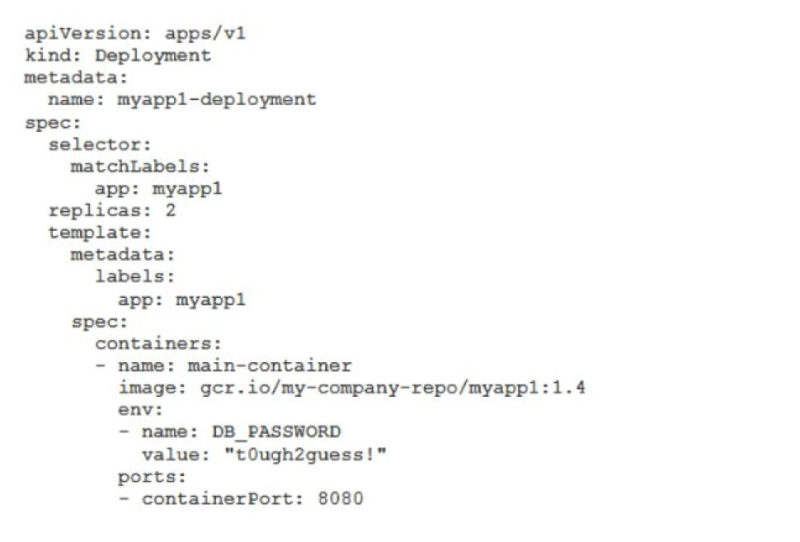
You’ve deployed a microservice called myappl to a Google Kubernetes Engine cluster using the YAML file specified below: You need to refactor this configuration so that the database password is not stored in plain text. You want to follow Google-recommended practices. What should you do?
You need to run an important query in BigQuery but expect it to return a lot of records. You want to find out how much it will cost to run the query. You are using on-demand pricing. What should you do?
You are running an application on multiple virtual machines within a managed instance group and have autoscaling enabled. The autoscaling policy is configured so that additional instances are added to the group if the CPU utilization of instances goes above 80%. VMs are added until the instance group reaches its maximum limit of five VMs or until CPU utilization of instances lowers to 80%. The initial delay for HTTP health checks against the instances is set to 30 seconds. The virtual machine instances take around three minutes to become available for users. You observe that when the instance group autoscales, it adds more instances then necessary to support the levels of end-user traffic. You want to properly maintain instance group sizes when autoscaling. What should you do?
Your company is moving from an on-premises environment to Google Cloud. You have multiple development teams that use Cassandra environments as backend databases. They all need a development environment that is isolated from other Cassandra instances. You want to move to Google Cloud quickly and with minimal support effort. What should you do?
You create a Deployment with 2 replicas in a Google Kubernetes Engine cluster that has a single preemptible node pool. After a few minutes, you use kubectl to examine the status of your Pod and observe that one of them is still in Pending status: What is the most likely cause?

10 more free samples are waiting
Create a free account to unlock the whole ACE sample bank, or get full access to all 440 practice questions in the simulator.