AHM 510 Exam Questions and Answers Candidates Miss Most
By PrepHoot Editorial Team· (updated Oct 9, 2026)

Preparing for AHM-510 with answer-only practice can leave you stuck when two options seem defensible. These eight original practice questions explain how to approach governance, legal, Medicare, Medicaid, pharmacy-benefit, and wellness scenarios. You’ll see the best answer, why the distractors are tempting, and which reasoning skill to practice afterward.
AHIP names the course Governance, Legal Issues, Medicare & Medicaid. Its published course description includes organizational formation and structure, strategic planning, reorganization, reengineering, and legal issues involving ERISA, pharmacy benefits, and wellness programs. Those topics provide the context for this list.
There is no verified item-level miss-rate evidence here. These questions are original teaching examples, and the ranking reflects study priority. I’ve placed scenarios requiring several distinctions first, followed by narrower questions and reading traps. It does not predict official exam frequency.
For a busy candidate, the useful test is whether you can explain your choice. Answer each question before reading its explanation. Then identify the exact fact that defeats the strongest distractor. A correct letter without that explanation can conceal a weak understanding.
1. Applying a legal rule before identifying the plan
Legal questions deserve early attention because a familiar law can tempt you into skipping the facts that determine its relevance.
Consider this hypothetical question:
An employer changes a health benefit arrangement. A colleague says ERISA automatically overrides every state requirement. The question provides no details about the arrangement or the specific requirement. What is the strongest first response?
- A. Accept the statement because the employer sponsors the benefit.
- B. Identify the arrangement and the specific legal issue before assessing the claim.
- C. Reject the statement because state requirements always control.
- D. Decide solely from the number of employees enrolled.
The best answer is B. The question asks you to evaluate a broad assertion with incomplete facts. Identifying the arrangement and issue gives you a basis for applying the relevant course material.
A sounds confident and uses a recognizable legal term. C makes an equally broad claim in the opposite direction. D picks one fact without establishing that it resolves the issue.
This item belongs first because it combines legal vocabulary, missing information, and absolute wording. It especially suits candidates who know definitions but choose answers too quickly when a law appears.
Its limitation is deliberate: the scenario cannot establish a real legal outcome. It practices recognizing what you still need to know.
Before choosing an answer, write down the arrangement, the disputed requirement, and the rule the question actually supplies.
2. Confusing board oversight with management execution
Governance questions become easier when you separate the person accountable for oversight from the person assigned to perform the work.
Here is an original scenario:
A health plan’s governance policy assigns policy approval and performance oversight to its board. Management handles daily operations. A report shows repeated processing delays. Which board response best matches those assigned responsibilities?
- A. Personally schedule each employee’s daily assignments.
- B. Require management to present a corrective plan and monitor its results.
- C. Stop reviewing performance because operations belong to management.
- D. Replace all operating procedures without consulting management.
The best answer is B. It follows both responsibilities stated in the question: management develops and executes the response, while the board monitors performance.
A is tempting because it appears decisive. It puts the board into daily execution, however. C correctly recognizes management’s operational role but ignores the board’s oversight responsibility. D assumes that immediate procedural replacement is justified by the report.
Prioritize this item if you often choose the most active-sounding response. Action alone does not make an answer appropriate for the named actor.
The limitation is organizational variation. A real organization’s governing documents may assign responsibilities differently. This answer follows the policy supplied in the vignette.
My recommendation is to label every option mentally as oversight, execution, or withdrawal. Then match it to the actor’s stated authority.
3. Treating disclosure as the complete answer to a conflict
Ethics scenarios can contain several required actions. Choosing the first sensible action may leave the rest of the policy unmet.
Consider this hypothetical selection process:
A committee member has a financial interest in a company bidding for a health plan contract. The committee’s policy requires disclosure and withdrawal from the selection decision. What should the member do?
- A. Disclose the interest, then vote because the bid appears competitive.
- B. Disclose the interest and withdraw from the selection decision.
- C. Reject the company automatically, regardless of the evaluation criteria.
- D. Keep the interest private because another committee member will review the bid.
The best answer is B. Both parts are stated in the policy.
A is the strongest distractor because disclosure is appropriate. Its second action contradicts the withdrawal requirement. C substitutes automatic rejection for the process described. D assumes another reviewer removes the member’s own obligation.
This item ranks high because it requires checking the entire answer. One correct clause can make a contradictory second clause easier to overlook.
It fits candidates who repeatedly select partially correct options. The limitation is that this hypothetical policy does not establish universal conflict-of-interest procedures or legal requirements.
Underline every required action in the stem. Then inspect each answer clause separately. Reject an option as soon as one clause conflicts with the stated policy.
4. Assuming Medicare and Medicaid eligibility must be exclusive
Questions involving both programs reward careful use of the eligibility facts provided in the scenario.
Try this original question:
A vignette states that an applicant satisfies Medicare eligibility criteria and the applicable state’s Medicaid eligibility criteria. It supplies no rule making those findings mutually exclusive. Which conclusion is supported?
- A. The Medicare finding automatically invalidates the Medicaid finding.
- B. Both findings must be considered when applying the scenario’s coverage and coordination rules.
- C. The Medicaid finding automatically invalidates the Medicare finding.
- D. The applicant’s preferred program determines whether the stated eligibility findings are valid.
The best answer is B. It preserves both facts and leaves the remaining coverage questions to the relevant rules.
A and C each discard an explicit eligibility finding. D introduces personal preference as an eligibility test, although the question does not support that step.
This question belongs above vocabulary drills because it separates eligibility from what happens afterward. Recognizing a program name does not resolve every coverage or coordination issue.
Spend time here if your notes reduce each program to a single population stereotype. Such shortcuts can replace the actual facts in a question.
The limitation is substantial: the scenario does not specify covered services, payment responsibility, or a state-specific outcome. Those require additional information.
Keep eligibility, coverage, and coordination in separate lines of your notes. Fill each line only with facts the question establishes.
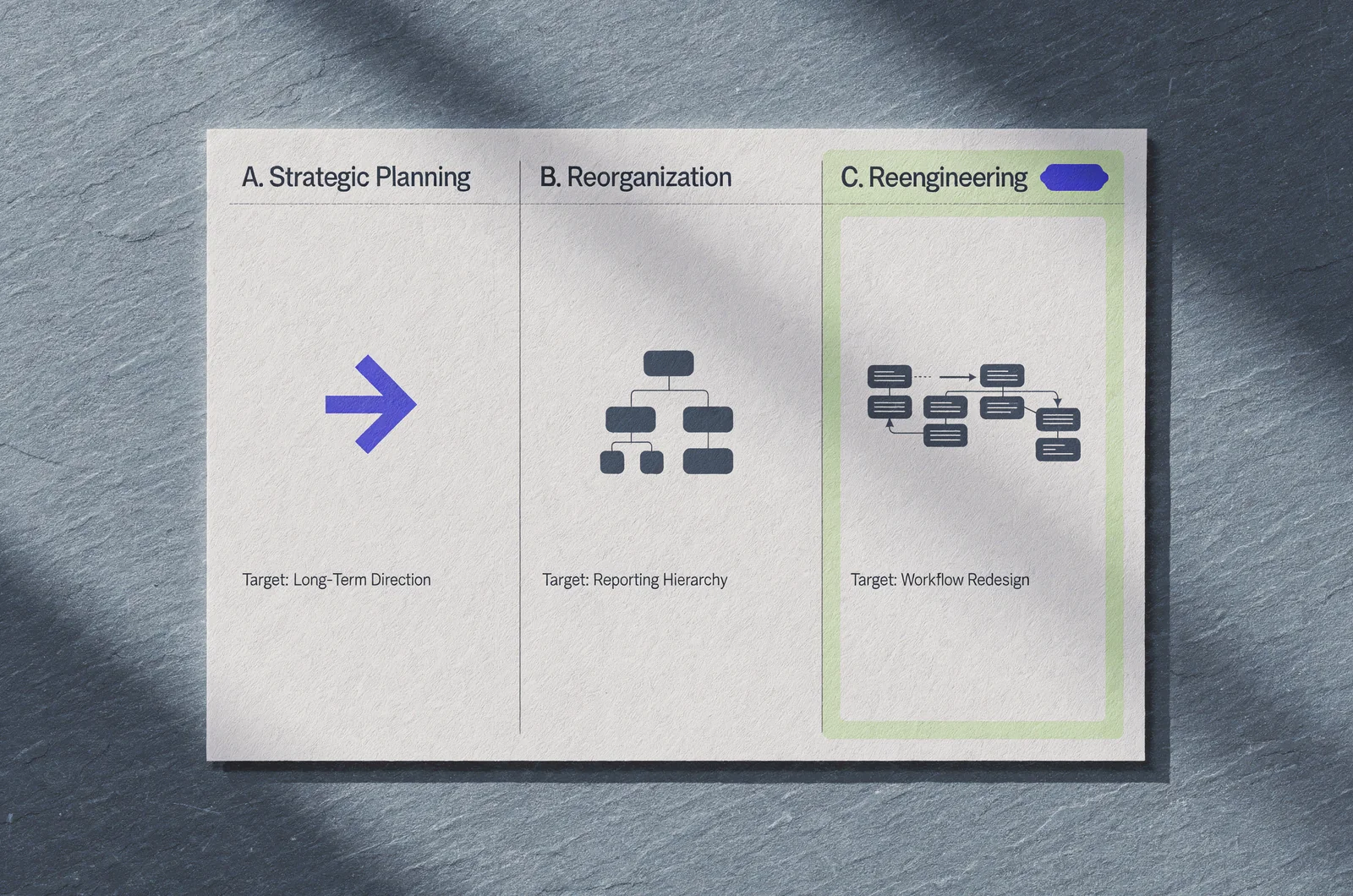
5. Mixing up strategic planning, reorganization, and reengineering
AHIP’s course description includes all three concepts, so practicing their differences is more useful than memorizing them as interchangeable improvement terms.
Consider this hypothetical question:
A health plan keeps its long-term goals and reporting structure unchanged. It redesigns an authorization workflow to remove duplicate handoffs and shorten processing time. In this exercise, strategic planning concerns long-term direction, reorganization concerns reporting structure, and reengineering concerns process redesign. Which term fits?
- A. Strategic planning.
- B. Reorganization.
- C. Reengineering.
- D. A change to eligibility rules.
The best answer is C. The changed object is the workflow.
A is attractive because the project has a business purpose. That alone does not make it a change in long-term direction. B borrows the language of organizational improvement, but the stem explicitly preserves the reporting structure. D introduces an unrelated change.
This item fits candidates who recognize the terms yet struggle to apply them to short business scenarios. It earns its position through a concrete distinction: what changed?
Its limitation is that real initiatives can combine several kinds of change. This exercise isolates one.
I’d practice with three separate prompts: changing direction, changing reporting relationships, and changing work steps. For each answer, name the changed object before naming the management concept.
6. Choosing the smallest pharmacy number instead of the stated objective
Pharmacy-benefit scenarios can test whether you select evidence that matches the decision being made.
Here is an original question:
A hypothetical health plan wants to reduce total spending while maintaining access to appropriate treatment. A proposal lowers prescription spending, but the report omits other medical spending and access measures. What should the reviewer request before judging whether the proposal meets the objective?
- A. Only the prescription-spending reduction.
- B. Total-spending information and the relevant access measures.
- C. The longest available list of excluded products.
- D. A decision based solely on the proposal’s title.
The best answer is B. It asks for evidence corresponding to both parts of the stated objective.
A is the strongest distractor because it gives a measurable improvement. Its scope is narrower than the decision. C substitutes the length of a restriction list for outcome evidence. D substitutes wording for analysis.
This item is useful if you tend to select the option with the clearest number. A precise metric can still answer the wrong question.
The limitation is that the scenario establishes no actual clinical effect or savings result. It identifies missing decision information.
My recommendation is to copy the objective into your scratch notes. Circle each required outcome, then check whether the proposed evidence measures every one.
7. Assuming a wellness program’s label proves compliance
Wellness questions can become misleading when a reassuring description replaces the details needed for analysis.
Consider this hypothetical scenario:
A wellness program is described as voluntary. The vignette also mentions participation incentives and collection of health information, but gives no further details. Which response is most defensible?
- A. Conclude that every applicable requirement is satisfied because participation is called voluntary.
- B. Examine the relevant participation, incentive, and information-handling rules.
- C. Conclude that every wellness program is prohibited.
- D. Ignore the information-handling question because the program concerns wellness.
The best answer is B. It identifies the issues that need examination without inventing a compliance result.
A turns a label into proof. C makes a blanket prohibition unsupported by the facts. D removes an issue that the stem expressly introduces.
This question fits candidates who let familiar positive terms settle a decision. Words such as voluntary, approved, or secure still need support from the scenario.
Its limitation is that no specific incentive threshold, privacy procedure, or legal outcome is supplied. An answer claiming one would exceed the evidence.
The practical recommendation is to separate descriptions from facts. List what participants do, what information is collected, and which requirements the question provides before reaching a conclusion.
8. Missing the exception in an otherwise familiar question
Qualifier questions rank last here because the main challenge is reading control. They still deserve focused practice when your explanation shows that you knew the content.
Try this original item:
A hypothetical governance policy assigns the board responsibility for approving organizational direction, reviewing performance, and monitoring management’s response to problems. Which activity is outside those stated responsibilities?
- A. Reviewing a performance report.
- B. Approving organizational direction.
- C. Scheduling individual employees’ daily breaks.
- D. Monitoring management’s corrective response.
The best answer is C. The other three options repeat responsibilities established in the stem.
A, B, and D become tempting if you answer the familiar question of what a board does. The actual task is to identify the exception.
This item especially fits candidates who miss questions containing except, least, incorrect, or outside. Its low position reflects its narrow reasoning demand, not a claim that such errors are harmless.
The limitation is that identifying a qualifier does not replace subject knowledge. You still need to evaluate every option.
Before reading the choices, restate the task in ordinary language: find the activity the policy does not assign. Keep that sentence visible while you compare the answers.
Turn the explanations into focused practice
For this course, reviewing why an answer fails can tell you more than repeating the same question until its letter feels familiar.
I’d use a short practice session like this:
- Answer a small set without opening the explanations.
- Mark any answer you chose with low confidence.
- Explain why the strongest competing option fails.
- Classify each miss by missing knowledge or misreading.
- Revisit the relevant course passage before attempting a fresh scenario.
Treat a correct guess as unfinished work. Change one fact in the scenario and ask whether your answer would change. For example, a different governance policy could change which actor should respond.
Before paying for a question bank, inspect the explanations. Study4exam describes its material as exam-style practice questions. That description addresses the practice format; check topic alignment and answer reasoning separately.
PrepHoot’s study, timed, and flashcard modes provide different practice formats. For any selected material, confirm its relevance to your course before judging simulator convenience.
An interactive error-log checklist could tag misses by actor, missing fact, qualifier, or incomplete answer, then prioritize your most frequent category. Record the exact phrase that caused each miss.
What to verify before choosing a question bank
Practice materials for this course should make their scope and limitations easy to understand.
Are these actual exam questions?
These are original teaching questions. They illustrate reasoning within the topic areas named in AHIP’s course description. They do not establish official wording, difficulty, question distribution, or answer keys.
Does a provider’s question count reveal the exam length?
A provider’s inventory count describes its practice material. It does not establish the number of items in the official assessment. Verify duration, question count, and passing requirements in the official instructions for your enrollment.
Should I study ethics instead of the broader course topics?
Use AHIP’s course description and your enrolled materials to organize your study. Ethics examples can help with policy interpretation, but this course also addresses organizational structure, legal issues, Medicare, and Medicaid. Give those topics their own review time.
What makes an explanation useful?
It identifies the decisive fact, applies the relevant concept, and explains why competing answers fail. A repeated answer statement gives you little to transfer to a new scenario. Inspect at least one explanation containing a plausible distractor before purchasing access.
Practice recall and timing together
Try the free sample questions, then create a free account or purchase full access or a membership for the exam they are preparing for. Get started |  |