Flashcards vs Timed Exams Train Recall and Pacing Differently
By PrepHoot Editorial Team· (updated Sep 27, 2026)

If you study for an IT certification after work, you've probably faced this exact choice at 9 p.m.: open the flashcards for a quick review, or sit down for a full timed practice exam? The flashcard mode vs timed exam question isn't really about which tool is better. It's about which skill you're training that night, because these two modes build genuinely different abilities. Flashcards train memory recall for discrete facts. A timed exam trains pacing, question triage, and decision-making under pressure. Confuse the two, and you end up knowing every port number by heart while running out of time on question 78 of 90.
This article breaks down what each mode actually does to your brain, what the research says, what real study communities report, and how to decide which mode deserves your limited study hours on any given night.
Two modes, two different skills
The reason this comparison matters is that flashcards and timed exams feel similar. Both are active recall. Both show you a prompt and make you produce an answer. But the cognitive demand is different in kind, not just degree.
A flashcard session isolates one fact at a time: What's the default port for HTTPS? Which AWS service handles object storage? You answer, you flip, you mark it known or unknown. There's no clock, no competing questions, no need to decide whether a hard item is worth three more minutes. The skill being built is retrieval speed for atomic knowledge, and a spaced-repetition scheduler resurfaces each card right before you'd forget it. A study published in PMC on spaced repetition flashcards found they can improve exam performance when used as a structured review layer, which matches what most candidates experience: cards are excellent at keeping facts alive.
A timed exam simulator does something else entirely. It forces you to sustain concentration across 60 to 100 questions, allocate a rough time budget per question, flag the ones you'll revisit, and make judgment calls on scenario items where two answers both look defensible. That's retrieval at exam scale, under the same pressure as the real thing. One analysis of the testing-effect literature put it plainly: a full-length mock is retrieval practice at exam scale, while a card deck is retrieval practice at trivia scale. Both are retrieval. The scale changes what transfers.
Here's the short version of the difference:
| Dimension | Flashcard mode | Timed exam mode |
|---|---|---|
| Primary skill trained | Fact recall and retention | Pacing, triage, stamina |
| Time pressure | None | Mirrors the real exam clock |
| Question format | Single fact, flip to answer | Full scenario items with distractors |
| Feedback style | Binary: knew it or didn't | Explanations plus pattern of weak domains |
| Best session length | 10-25 minutes | 60-120 minutes |
| Anxiety training | Low | High: rehearses test-day conditions |
That last row matters more than people expect. Exam anxiety and clock management are hard to practice without something that mirrors the real interface, which is exactly what a timed simulator gives you.
What the research says about each approach
The evidence base here is surprisingly consistent, and it doesn't crown a single winner.
A widely cited review of study techniques rated practice testing as the highest-utility method, while flashcards, as a form of simple self-testing, landed at moderate utility, with re-reading and highlighting at the bottom, as summarized in RaiseMyGrade's breakdown of practice tests vs. flashcards. The same source notes that practice exams tend to come with detailed feedback that identifies weak areas, while flashcard feedback is binary.
For timed, high-stakes exams specifically, the gap widens. QuizVerse reports that across 47 studies, quiz-format study produced 12-18% higher exam scores than flashcard-only study, with the largest gains on timed exams where time pressure mirrors quiz conditions, in its analysis of study quiz apps vs flashcards. Treat that 12-18% figure as one source's meta-analytic claim rather than settled science, but the direction matches the broader pattern.
Flashcards aren't without their own evidence, though. The spaced repetition flashcard study published in PMC evaluated instructor-made, spaced-repetition cards and measured their effect on student exam performance, finding a real benefit when the cards were built into a deliberate review structure. And one nuance worth keeping: for pure vocabulary and terminology memorization, flashcards are equal to or slightly better than quiz formats. If your exam has a heavy glossary load, and most IT exams do, cards earn their place.
The fair reading of all this: flashcards are a retention tool, timed exams are a performance tool, and the research supports both for different jobs.
What study communities actually report
Research tells you what works on average. Study forums tell you how people actually use these tools when the exam is in three weeks and the calendar is full. The search results for this topic are dominated by exactly those conversations, and each one adds a useful angle.
The r/GetStudying flashcard debate
The r/GetStudying flashcard debate website screenshot for flashcard mode vs timed exam
A long-running Reddit thread asking What's Your Opinion on Using Flashcards to Study? shows the community split you see everywhere: Anki and Quizlet loyalists who credit cards with saving their grades, and skeptics who found cards produced recognition without real understanding. The practical takeaway from threads like this is that flashcards polarize because people use them at the wrong stage. Candidates who lean on cards exclusively tend to hit a ceiling; candidates who use cards as a maintenance layer between deeper practice sessions report the best results.
The Facebook group question: are flashcards worth it?
In one certification study group, a member asked whether Are flashcards helpful for studying? before spending money on them. It's the budget-conscious version of the same question, and it's fair. Paid card decks only make sense when the deck maps to your exam's current objectives. A stale deck built on last year's blueprint actively costs you time. Whether the cards come from a paid set, a free tool, or your own notes matters less than whether they match the current exam version and whether you actually review them on a schedule.
Quizlet's timed flashcards: a hybrid worth noting
Quizlet's Timed Flashcards add a per-card clock to the flip-card format, which shows the market trying to blend the two modes. A timed card drills faster recall, and that's useful for shaving seconds off fact-heavy questions. But a five-second card timer doesn't rehearse the real exam skill, which is deciding how to spend 90 seconds on a scenario question with four plausible answers. Hybrid formats sit between the two modes; they don't replace either one.
Where each mode fits in your study calendar
The most useful way to settle flashcard mode vs timed exam is by study phase. Your needs change as exam day approaches, and the right mode changes with them.
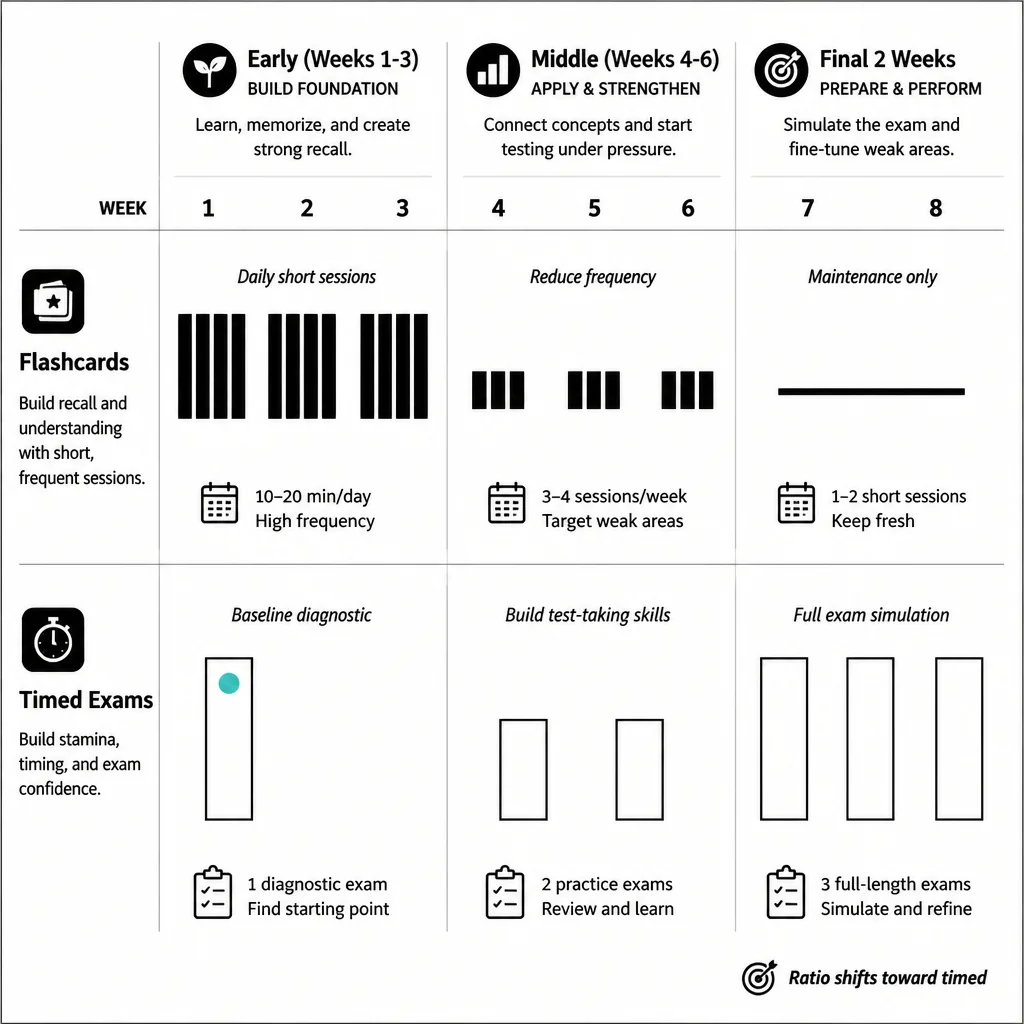
Early phase: building the knowledge base
When you're four to eight weeks out and working through material for the first time, flashcards do the heavy lifting for terminology, port numbers, service names, and process steps. Short sessions win here. Fifteen minutes of cards on a lunch break beats a zero-minute session you skipped because a full mock felt too heavy. Study mode and flashcard mode in a simulator serve this phase well: untimed, explanation-first, low stakes.
Middle phase: finding the gaps
Middle phase: finding the gaps website screenshot for flashcard mode vs timed exam
Once you've covered the blueprint, timed exams become diagnostic. One full timed run every week or two tells you which domains hold up under pressure and which collapse. The mistakes that only appear in timed conditions are the valuable ones: misreading stems when rushed, burning four minutes on a question worth skipping, second-guessing correct answers. Judgment Call's comparison of flashcards vs full-length tests makes the mechanism clear: practice and performance transfer best when they share retrieval routes, and the exam's retrieval route is a long, clocked, mixed-question session.
Final two weeks: shift the ratio
In the last stretch, the recall layer is mostly set, so timed mode takes over. A common pattern among retakers is two to three full timed exams per week, with short flashcard sessions in between only for the facts those exams exposed as shaky. Stop building new cards. Start rehearsing the day-of feel: same session length, same clock discipline, flag-and-return habits included.
A simple rule for any given study night:
- Fewer than 30 minutes available: flashcards, targeting facts you missed recently.
- 60-plus uninterrupted minutes: a timed exam or a timed domain block.
- You feel anxious about the real interface: timed mode, every time.
- You keep forgetting acronyms and ports: flashcards, on a spaced schedule.
What to look for in a tool that offers both
Since the two modes complement each other, the practical move is picking a platform where they share one question bank and one progress history. Switching between a separate card app and a separate exam simulator means your missed-question data lives in two places, and the gap between "facts I miss" and "questions I miss" stays invisible.
Three things worth checking before you pay for anything:
- Explanations on every answer, in both modes. A flashcard that just flips to "B" teaches nothing.
- A timed mode that mirrors the real exam's interface and question count, not a generic quiz with a countdown.
- Free sample questions you can actually try before paying, so you can judge question quality yourself.
On PrepHoot, for example, study, timed, and flashcard modes all run against the same exam bank, so a fact you miss on a card can resurface in your next timed run. If you want to feel the difference between the two modes rather than read about it, the free sample questions on PrepHoot practice modes take about ten minutes to try. Whatever tool you land on, the PrepHoot FAQ pattern is a good checklist: look for lifetime access or a membership model that lets you swap exam slots as your certification focus changes, because candidates rarely stop at one exam.
One tool idea worth building or looking for: a study-mode selector that asks three questions (days until exam, minutes available tonight, weakest domain) and tells you whether tonight is a card night or a clock night. It turns the decision table above into a ten-second habit.
Questions candidates ask about study modes
Is flashcard mode enough to pass a certification exam? For most IT exams, no. Cards build the fact layer, but exams like Security+ SY0-701 or AZ-104 test scenario judgment under time pressure, which only timed practice rehearses. Use cards as the retention layer, timed exams as the performance layer.
How many timed practice exams should I take before the real one? There's no universal number, but a workable floor is three full timed runs: one diagnostic early, one mid-prep, one in the final week. Repeat only if your scores are still climbing.
Should I do flashcards the day before the exam? Light review only. A short card session on your weakest facts is fine; a full timed exam the night before mostly costs you sleep and confidence.
Does timed mode help with exam anxiety? Yes, more than any other study activity. Familiarity with the clock, the interface, and the flag-and-return routine removes most of the day-of surprise, which is where a lot of anxiety lives.
Can I use timed flashcards instead of a timed exam? They drill faster recall, but they don't train pacing across 90 questions or triage between hard and easy items. Treat them as a supplement, not a substitute.
Keep practicing
- PrepHoot practice exams and simulator modes
- What Cisco's 2026 Exam Changes Mean for CCNA Subnetting Practice
- PrepHoot FAQ
Try the free sample questions, then create a free account or purchase full access or a membership for the exam they are preparing for. Get started |  |