How to Prepare for CSM-001 Around a Full-Time Schedule
By PrepHoot Editorial Team· (updated Oct 24, 2026)

Preparing for GAQM’s CSM-001 around a full-time job starts with protecting study time you can actually use. This three-week roadmap allocates six hours per week to syllabus review, targeted questions, and timed practice. You’ll build a topic checklist, repair weak areas, and assess whether your understanding holds up under time pressure.
You’ll need the current official syllabus, matching study material, practice questions with explanations, and a simple error log. Treat the 18-hour schedule as a planning example. Your starting knowledge and practice results should determine whether you need more time.
Match your materials to the GAQM exam
Start your preparation by checking that every resource matches the provider and exam code on your intended booking. Similar certification names can make an unrelated resource look suitable.
Create a one-page exam fact sheet from the current official information available to you. Record:
- The provider, certification title, and exam code shown on the booking page.
- The syllabus version or publication date, when one is supplied.
- The stated question format, duration, and passing requirement.
- Any eligibility, training, identification, or delivery requirements.
- The booking, cancellation, and rescheduling terms that affect your plans.
Keep this sheet beside your study checklist. Before paying for an appointment, check any conditions that could affect your eligibility or ability to change the date.
Next, compare your study material’s contents with the syllabus. Mark each objective as covered, partly covered, or missing. A long course or large question bank can still leave gaps.
For practice questions, check whether explanations connect the answer to a clear principle. Set aside questions whose answer keys conflict with your assigned material until you can resolve the difference.
Finish this setup with two usable documents: the exam fact sheet and a complete syllabus checklist. Every objective should have a study resource beside it, or a visible gap you still need to fill.
Protect six study hours each week
Build your Scrum study schedule around reliable openings in your week. I recommend reserving the calendar blocks before deciding how many chapters or questions to complete.
Give short sessions a fixed place
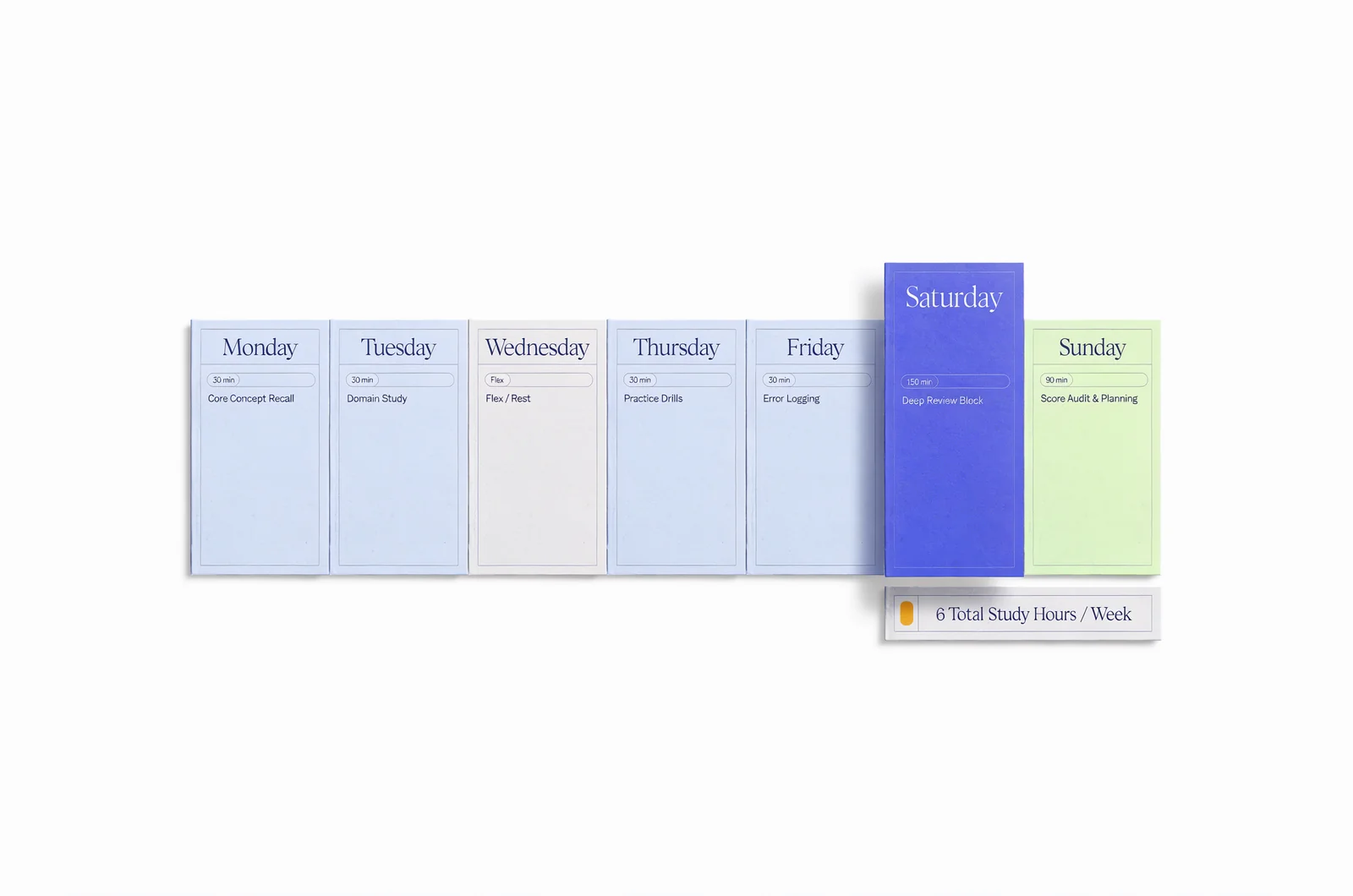
Use this six-hour weekly allocation as a starting point:
- Study for 30 minutes on Monday and Tuesday. Put these sessions before work or after a predictable evening routine.
- Keep Wednesday available for rest or a replacement session.
- Study for 30 minutes on Thursday and Friday. Assign each block a specific objective before the day begins.
- Reserve 150 minutes on Saturday for deeper review or a longer practice session.
- Reserve 90 minutes on Sunday to review results and prepare the following week.
The four weekday sessions total two hours. The weekend adds four hours, giving you six hours each week and 18 across three weeks.
Give each calendar entry a concrete task. Reviewing responsibility questions from one syllabus topic is easier to begin than studying Scrum generally.
Adjust the plan when work runs late
Move a missed session into Wednesday when possible. Otherwise, use part of Sunday’s block and reduce the amount of new material you attempt.
Keep track of minutes completed as well as tasks finished. If your calendar repeatedly provides four hours instead of six, extend the timeline. Repeatedly borrowing from sleep makes the schedule difficult to sustain.
An interactive study planner could total available weekday minutes and weekend hours, then flag weeks without enough uninterrupted time for a full mock and review.
At the end of each Sunday session, assign the next four weekday tasks and check that Saturday’s longer block remains available.
Week 1: turn the syllabus into a working checklist
Use the first week to establish coverage and identify what you can explain without help. The expected result is a complete topic map with visible weak areas.
Map each objective to a recall prompt
Copy the official objectives into a notebook or spreadsheet. Give each row space for your resource, a recall prompt, and your latest practice result.
Turn broad topics into questions you can answer aloud. Depending on what appears in your syllabus, prompts might ask:
- Who is accountable for a particular decision?
- What purpose does an event have?
- What information does an artifact make visible?
- How would the principle apply when a team encounters a problem?
These are study prompts, rather than a substitute for the official objectives. Keep each one attached to the relevant syllabus row.
If official weightings are published, record them beside the objectives. Otherwise, allocate time according to the gaps you uncover. Avoid inventing percentage weights from the number of questions in a practice bank.
Give each half-hour a clear sequence
Run weekday sessions in this order:
- Spend five minutes answering the previous session’s recall prompts with your notes closed.
- Spend ten minutes studying one narrow objective.
- Spend ten minutes answering a small set of matching practice questions.
- Spend five minutes recording errors and choosing the next review task.
Keep the question set small enough to review properly. When using PrepHoot’s study mode, commit to an answer before opening its explanation. Then write the supporting principle in your own words.
If you cannot explain why your choice fits, mark the topic for another pass even when the answer was correct. That gives you a more useful record than a score alone.
Use the weekend to check coverage
On Saturday, work through objectives that need more uninterrupted attention. Close the material periodically and reconstruct what you have learned from memory.
Use Sunday for a short mixed question set and a checklist review. Record topics you missed, topics you guessed correctly, and objectives you have barely studied.
Before ending the week, check every syllabus row. Give each untouched objective a place in the following week’s calendar. Carry forward a specific task for every gap.
Week 2: repair the reasoning behind missed questions
Make the second week about correcting weak reasoning. Keep the same study hours, but choose tasks from your error log rather than restarting the course.
Classify errors before reviewing them
For each missed or uncertain answer, record the objective and the reason you struggled. Use categories that lead to different actions:
- A knowledge gap means you could not recall the relevant concept.
- A distinction error means you confused two responsibilities, purposes, or terms.
- A reading error means you overlooked a condition in the question.
- A pacing problem means you rushed or spent too long deciding.
Write one corrective action beside each entry. A knowledge gap needs focused study. A reading error needs another attempt with deliberate attention to the wording.
Keep notes brief enough to revisit during a weekday session. Record the governing principle and one prompt that will test it later.
After reviewing an explanation, close it and explain the answer again. If you still need its wording, leave the error open.
Explain choices in context
For scenario questions, identify the decision before examining the answer options. Ask what happened, whose responsibility matters, and which condition limits the response.
Then explain why each plausible alternative fails. An option may sound reasonable while addressing a different responsibility or problem.
Consider a hypothetical question that asks who should make a particular decision. Write down the decision itself, then locate the relevant responsibility in your study material. Verify that the answer follows from that responsibility.
Change one detail in your own example afterward. Ask whether the same principle still applies. This provides another check on your reasoning without depending on familiar wording.
If an explanation seems inconsistent with the assigned material, keep the item separate from your readiness evidence until you resolve it.
Check transfer with a different question set
Use Saturday to combine targeted repair with mixed practice. Begin with the weak objectives, then move into questions from across the syllabus.
Review uncertain correct answers alongside incorrect ones. Both can reveal unfinished work.
On Sunday, attempt different questions where possible. Repeating a familiar set can check whether you remember a correction, but it gives limited evidence about handling unfamiliar wording.
Compare this result with the previous week’s log. Identify which misunderstandings have stopped recurring and assign the remaining ones to specific sessions in week three.
Week 3: rehearse the pace and assess readiness
Use the final week to check whether your knowledge remains usable during an uninterrupted attempt. Separate the mock from its review so both receive enough time.
Match the rehearsal to verified conditions
Schedule a full mock only after checking the current official duration and format. Configure practice as closely as your available materials allow.
Reserve enough uninterrupted time for the attempt. If the verified duration exceeds your usual Saturday block, rearrange the calendar in advance.
Use PrepHoot’s timed mode for uninterrupted practice when the available material matches your exam. Keep explanations closed until the attempt ends, and use only resources permitted by the conditions you are rehearsing.
For pacing, divide usable answering time by the verified question count. This gives you an initial average, which you can adjust for harder items.
Where the exam permits navigation and review, plan time for returning to uncertain answers. Practice that behavior during the mock. At the finish, record whether you attempted every question and how much time remained.
Review the causes behind the score
Review the mock in a separate block, preferably before the details fade. Record your score, unfinished questions, uncertain answers, and the objectives behind your errors.
Check whether time pressure changed your performance. Perhaps you understood a topic during weekday study but rushed its questions near the end.
Keep the provider’s published passing requirement distinct from any practice provider’s readiness recommendation. Neither a familiar question set nor a single strong result establishes readiness by itself.
For each recurring error, decide whether the next action is focused reading, a recall prompt, or another question set. Give every unresolved objective an action and a scheduled review time.
Make the booking decision from several checks
I would assess readiness against these practical checks:
- You have reviewed every official objective and addressed the gaps in your coverage map.
- You can explain the reasoning behind answers, including the plausible alternatives.
- You can complete unfamiliar mixed practice within the applicable time allowance.
- Recurring errors have decreased, and you can describe what you corrected.
- Your booking requirements and test-day arrangements are clear.
If a weak area remains, extend the plan with targeted sessions. A candidate who understands the material but struggles with pacing needs a different extension from someone missing several objectives.
Write down what remains unresolved and the evidence you need before committing to an exam date.
Use the final evening to remove test-day friction
Prepare your exam arrangements after the main study work is complete. Keep the last evening available for light review and the practical checks required by your delivery method.
For an online appointment, follow the provider’s current system-check and room instructions. For a test-center appointment, confirm the location, travel time, and required identification.
Check the appointment’s date, time zone, and check-in instructions against your confirmation. Save the permitted information somewhere you can access without searching through study notes.
Review a short set of previously troublesome concepts. Avoid starting a large new question bank when there is little time to investigate unfamiliar explanations.
Choose a stopping time for study and set out anything you need for the appointment. If unresolved requirements could prevent you from testing, contact the provider through its official support route before the appointment.
Finish with your confirmation, identification requirements, equipment or travel arrangements, and check-in time verified.
Questions that change your study schedule
Your remaining study time should reflect your starting point and the gaps still visible in practice.
Is three weeks enough if I’m new to Scrum?
Treat three weeks as an initial schedule. Begin with the syllabus map and a small diagnostic set before fixing your exam date.
If most objectives are unfamiliar, add a foundation period ahead of the practice-heavy weeks. Keep using the same coverage and reasoning checks. Extend the calendar until you can explain the required concepts and apply them to unfamiliar questions.
What if I only have 20 minutes after work?
Use a smaller study unit. Review one recall prompt, study one narrow point, and answer a few relevant questions.
Four 20-minute sessions provide 80 weekday minutes. With the same four weekend hours, your weekly total becomes five hours and 20 minutes. Recalculate the plan using that total, then add sessions or extend the timeline where needed.
Should I book after one strong practice score?
Review how you earned it first. Check whether the questions were familiar, whether explanations were visible, and whether you finished within the appropriate limit.
Attempt a different mixed set and explain your uncertain answers afterward. Use that evidence alongside syllabus coverage and your remaining error log when deciding whether to book.
Choose between recall drills and timed practice
Try the free sample questions, then create a free account or purchase full access or a membership for the exam they are preparing for. Get started |  |