What the HPE2 Exam Costs Before You Count Vouchers and Retakes
By PrepHoot Editorial Team· (updated Oct 15, 2026)

An hpe2 exam budget starts with the current registration price for the exact exam you intend to book. I can’t give you a verified dollar fee from that search term alone. What you can do is separate the base fee from vouchers, preparation, and a possible second attempt before committing money. The questions below explain which amounts to confirm and how to build a usable budget. Every dollar amount in the worked examples is hypothetical.
How much should you budget for the exam itself?
Use the current registration quote for your exact exam as the base fee, and keep that amount unconfirmed until you have it.
Record the full exam code and title beside the price. That gives you something specific to compare against a voucher, training bundle, or reimbursement request. A price attached to a different exam won’t establish what your booking costs.
Keep three amounts separate:
- The listed registration fee before any discount.
- The final amount payable after applicable adjustments and taxes.
- Your wider budget, including preparation and a retake reserve.
This distinction helps when someone asks how much the certification will cost. They might mean the exam booking or everything you expect to spend preparing for it.
I’d also save the date of the quote. A screenshot without the exam name, currency, and date gives you little to work with later. For a budget that someone else must approve, attach those details to the amount you request.
Where should you check the official fee?
Start with HPE’s official information for the exact exam, then follow its registration instructions to the appropriate booking service.
Avoid assuming that a search result, reseller listing, or another candidate’s receipt establishes your price. Those can provide context, but your budget needs a quote that matches your intended booking.
Use this sequence:
- Confirm the complete exam title and code.
- Check that the exam matches the certification requirement you’re trying to meet.
- Follow the official registration route.
- Select the correct country and any relevant delivery options.
- Review the currency, adjustments, and total before submitting payment.
If the official instructions direct you to Pearson VUE, use the corresponding registration flow to check the amount. Don’t transfer a fee from another testing program simply because it uses the same booking company.
You may need to reach a checkout review screen to see the total. Stop before payment if you’re only collecting a quote.
When the exam listing and checkout appear inconsistent, resolve the difference through the official support channel before buying a voucher. Keep the exam code and screenshots available so the question concerns one identifiable booking.
Can a price from another country tell you the US cost?
An overseas price can provide context, but I wouldn’t use a currency conversion as the confirmed US registration fee.
For a US budget, seek the price attached to your intended US booking. Record the displayed currency explicitly. A dollar sign alone is an incomplete note when you’re comparing listings from different markets.
If you’re considering a voucher advertised outside the US, check its permitted country or region before comparing prices. Also confirm whether it applies to your exact exam and registration route. Treat those as questions for the seller’s written terms.
Separate any card conversion or payment charges from the exam fee. If your payment method could add a charge, include that amount only after checking the applicable terms.
For an employer expense request, use the currency you expect to pay and identify any amount that remains uncertain. Keep a converted estimate labeled as an estimate until you have the booking total.
Does a voucher actually reduce what you pay?
A voucher reduces your expense only when its purchase price plus any remaining checkout charge is below the comparable direct booking total.
The word voucher tells you too little about the saving. You need to know what the code pays for and what it costs to obtain.
Compare both routes on the same basis. Include taxes where applicable, and check whether the voucher covers the full registration charge or leaves an amount payable.
Before purchasing, ask:
- Does it apply to the exact exam you intend to take?
- Is it valid for your country and registration route?
- When must it be redeemed, and when must the exam be taken?
- What happens if your plans change?
- Does it include anything beyond the first attempt?
Read the distinction between redemption and appointment deadlines carefully if the terms contain both. Your study schedule must fit whichever deadlines apply.
A bundle needs a separate calculation. Divide its value into components you would otherwise buy: exam registration, preparation, and any expressly included additional attempt. Give unwanted materials no assumed saving.
Save the voucher terms with the receipt. A short product description is a weak substitute for the conditions attached to the purchase.
Where can you check for discounts or employer support?
Check official promotions and your employer’s education policy, while treating every discount or reimbursement as unconfirmed until eligibility is clear.
If you have access to a partner, employee, student, or training program, ask whether it has an applicable exam benefit. This is a place to investigate; it doesn’t establish that you qualify for a reduced price.
For employer support, clarify approval before making the purchase. Useful questions include:
- Must the exam receive approval before booking?
- Does reimbursement cover preparation as well as registration?
- Is reimbursement conditional on passing?
- Can a second attempt be claimed?
- Which receipts or results must you submit?
Distinguish the amount you pay upfront from the amount you expect to recover. A reimbursed exam can still require enough cash to cover the initial transaction.
Avoid counting a possible promotion in your minimum funding plan. Build the plan using the confirmed price, then revise it when the reduction appears in writing or at checkout. Keep pending reimbursement on a separate line until approval arrives.
What should you set aside for a retake?
For a conservative budget, reserve enough for another attempt at the applicable fee unless you have written terms confirming a different arrangement.
That is a planning choice, not a statement of HPE’s current retake policy. A full-fee reserve gives you a clear amount to fund while you verify the actual rules.
Check the conditions for your exact exam before assuming that a voucher, promotion, or training package includes another attempt. Confirm any eligibility requirements, deadlines, waiting periods, and steps needed to redeem that benefit.
A hypothetical example shows the arithmetic. If registration costs $100, reserving another $100 gives you $200 available for exam attempts. Passing the first time leaves the reserve unspent.
Keep that reserve separate from your predicted spending. Otherwise, a budget can appear to claim that everyone pays for two attempts.
For someone studying after work, the funding question also affects timing. If another attempt would be difficult to afford immediately, consider allowing more preparation time before the first booking. Assess unfamiliar practice questions against the exam objectives, review weak areas, and confirm the real retake conditions before choosing a date.
Could canceling or rescheduling add to the bill?
Include a possible appointment-change cost only after checking the terms attached to your booking.
There is no verified cancellation deadline or change fee stated here. Don’t borrow a deadline from another vendor’s exam or assume that a voucher follows the same refund rules as a direct payment.
Look for the applicable cancellation window, rescheduling window, refund conditions, and treatment of a missed appointment. If a voucher funds the booking, check what happens to that voucher when the appointment changes.
You should also know where to make the change. Keep the booking confirmation and its instructions somewhere accessible outside your work email if you’ll need them during personal study time.
An appointment can affect other budget lines too. List any travel, parking, or unpaid leave you personally expect to incur. These are candidate-specific expenses, so use your own amounts.
If your work schedule is uncertain, check the change terms before choosing a date that depends on getting time off.
How much should you add for study materials?
Add the resources you intend to use, after separating any confirmed requirements from optional study purchases.
Begin with the exam objectives and the materials you already have access to. Then identify the gap: explanations, practical work, structured lessons, or practice under time pressure. Buy against that gap.
For example, PrepHoot’s free sample questions can help you assess its question-and-explanation format before including paid practice access in your budget. Confirm that any resource you consider matches your exact exam.
A sensible preparation budget records each purchase separately:
- Courses or books you expect to complete.
- Practice questions that address a specific study need.
- Lab access or equipment you actually require.
- Subscription renewals that could fall before your exam date.
Avoid assigning value to resources simply because a bundle contains many items. With limited evening study time, overlapping courses can leave you paying for material you won’t finish.
The certification prep spend breakdown provides a companion discussion of registration and study expenses.
Put an expected use date beside each paid resource. If you can’t identify when it fits into your study schedule, leave its cost outside the committed budget.
Is a one-time purchase cheaper than a prep subscription?
Compare the one-time price with the subscription cost across your realistic study period, including any likely delay.
A low monthly charge can look attractive when you assume a short preparation window. The calculation changes if work commitments extend that window.
For a hypothetical comparison, suppose a resource costs $25 monthly or $60 as a one-time purchase. Two months cost $50; three months cost $75. Those figures illustrate the calculation and are not PrepHoot prices.
When comparing PrepHoot’s one-time exam access with its monthly membership, use the actual plan terms and the number of exams you expect to study. Check the access included in each option before calculating the total.
Also account for how you’ll use the resource. Study, timed, and flashcard modes support different sessions, but your budget should reflect the access you expect to use.
Write down an estimated finish date and a later fallback date. Calculate subscription spending for both. If the longer period exceeds your budget, choose a different access arrangement or a specific date to review whether you still need the subscription.
What does a complete exam budget look like?
A complete budget separates expected purchases, optional expenses, and money reserved for another attempt.
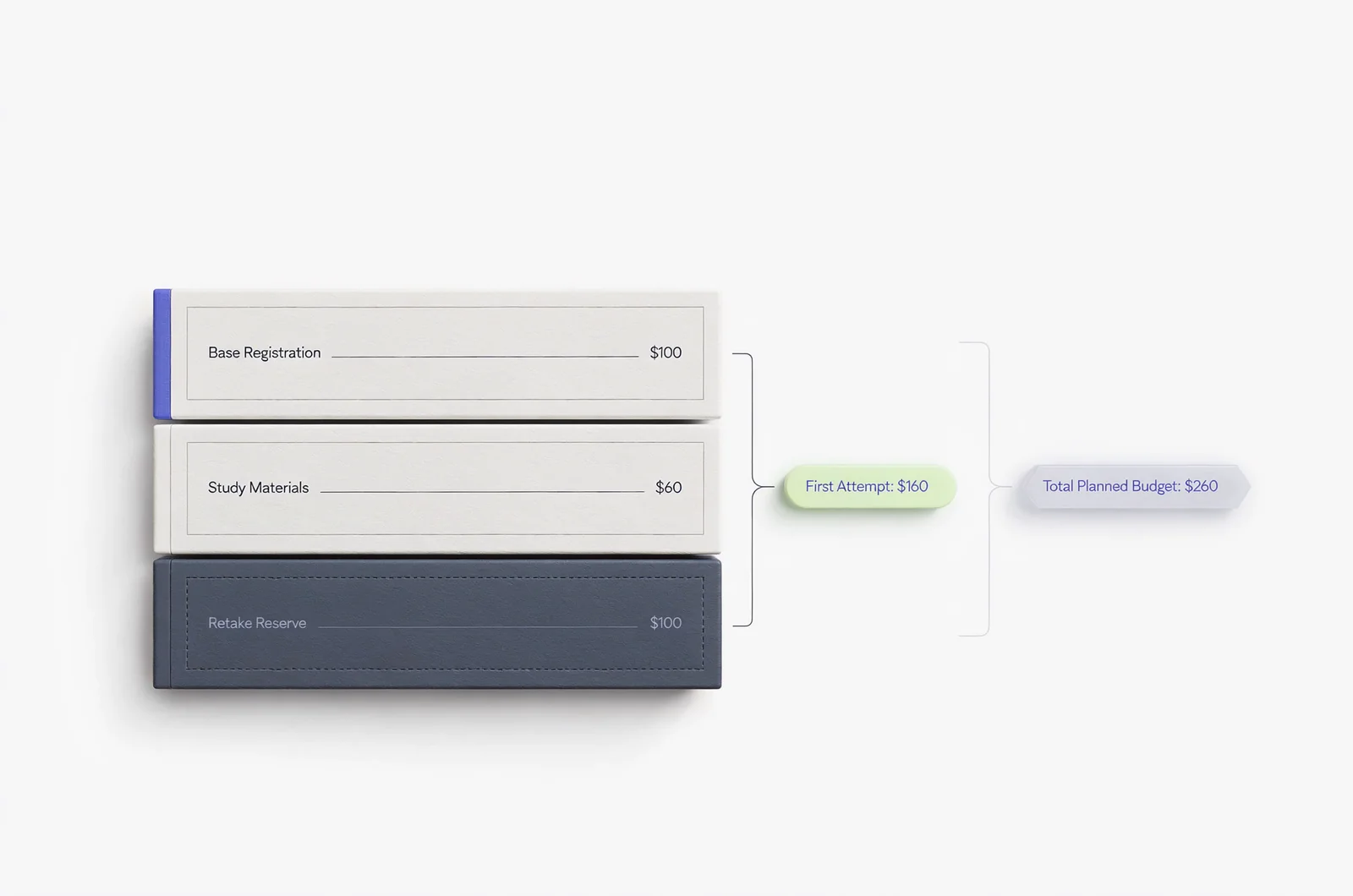
The following example uses a hypothetical $100 registration fee and $60 paid preparation purchase. It excludes taxes, payment charges, travel, and appointment changes. Replace every amount with your confirmed figures.
| Hypothetical study plan | Registration | Paid preparation | Retake reserve | Amount to fund |
|---|---|---|---|---|
| First attempt using existing resources | $100 | $0 | $0 | $100 |
| First attempt with paid preparation | $100 | $60 | $0 | $160 |
| Paid preparation plus another-attempt reserve | $100 | $60 | $100 | $260 |
The $260 figure includes $100 held in reserve. If the candidate passes on the first attempt, the example’s registration and preparation spending remains $160.
Apply a voucher saving only after confirming it, and add any applicable charges separately. Record employer reimbursement as a separate recovery so you can still see the cash needed upfront.
A useful interactive budget calculator would accept the booking total, voucher cost, preparation purchases, subscription months, and retake reserve, then display expected spending beside required funds.
A spreadsheet can use the same structure. Give uncertain entries their own column, and replace each estimate when you obtain a confirmed amount.
What should you confirm before paying?
Confirm the exam identity, final payable amount, purchase conditions, and study schedule before completing the transaction.
Your final review should answer these questions:
- Does the full exam code match the requirement you intend to meet?
- Is the country and currency correct?
- Have applicable taxes and adjustments appeared in the total?
- Has any discount actually been applied?
- Does a voucher fit the intended booking and date?
- Are cancellation, rescheduling, and retake conditions clear?
- Can you fund the purchase before any reimbursement arrives?
Keep preparation purchases outside the registration total unless you’re deliberately evaluating a bundle. That makes it easier to see whether an apparent saving comes from the exam fee or from included study access.
I’d also check the calendar once more. A lower price has limited practical value if its conditions require an appointment you cannot prepare for or attend.
Save the confirmation, receipt, applicable terms, and approval documents together. Update your budget with the actual payment, and keep any unused retake reserve separate from money already spent.
Which other exam guide explains fee verification?
Try the free sample questions, then create a free account or purchase full access or a membership for the exam they are preparing for. Get started |  |