PCES-30 Exam Cost vs Prep Spend: Where the Money Goes
By PrepHoot Editorial Team· (updated Oct 4, 2026)

If you're budgeting for the PCES-30 — the Certified Entry-Level Security Specialist with Python credential from the OpenEDG Python Institute — the exam fee is only one line item. Retake exposure, vouchers, training bundles, and practice material all change what you'll actually spend before you hold the certification. This article breaks the total into parts, compares the realistic spending paths, and flags the numbers you should verify on the official page before you pay, because PCES is a young, small-market exam and published details shift.
One warning up front: searching this exam code returns a lot of noise. Before we get to real costs, it's worth understanding why the results look the way they do, because bad information is itself a budget risk.
Why "PCES-30 exam cost" searches return the wrong answers
The PCES-30-01 is a niche, recently launched entry-level security exam. Search demand is thin, so Google fills the results page with whatever loosely matches the string "PCES" — and almost none of it is about your exam. Three of the most visible results right now illustrate the problem.
The Instagram "student spotlight" result
The Instagram "student spotlight" result website screenshot for pces-30
One top result for cost-adjacent queries is an ✨STUDENT SPOTLIGHT✨ Celie Anderson 🏠 about affordable education at "a fraction of the cost of many comparable private institutions" — for a Doctor of Physical Therapy program. It has nothing to do with the Python Institute. If you clicked it expecting a fee schedule, you got a university marketing post instead.
The ScienceDirect "PCE" paper
The ScienceDirect "PCE" paper website screenshot for pces-30
Another ranking result is a geophysics paper on H/V measurements as an effective tool for the reliable, which mentions "20/30 measures per day" as a realistic parameter for budget estimation. That's seismic survey methodology, not exam pricing. The acronym collision is pure coincidence.
The Michigan pharmacists fee page
A third result, from the Innovative Practice Models, lists a $600 or $900 examination fee depending on membership, plus a $350 initial certification fee. Those are real pharmacist credentialing numbers — for a completely different certification in a completely different field. Do not anchor your PCES budget to them.
The Michigan pharmacists fee page website screenshot for pces-30
The takeaway: for this exam, the only trustworthy price source is the vendor itself. Everything else you find ranking today is noise, and budgeting off the wrong page is how candidates overpay for training they don't need or underbudget for retakes.
The exam fee itself: what PCES-30-01 costs to sit
The authoritative starting point is the official PCES page at pythoninstitute.org, which lists the current exam version, delivery channel, and price. Because the Python Institute treats PCES as a small-market trial track, the listed fee and even the exam's availability can change between versions — verify the number on that page the week you plan to schedule, not the month you started studying.
A few structural facts that shape the fee conversation:
- The exam is the PCES-30-01 version. The EDUSUM syllabus breakdown confirms the 30-01 code and the four-domain structure, which matters because any voucher or bundle you buy must match that version code.
- Python Institute entry-level exams have historically sat in the low-to-mid hundreds of dollars per attempt, far below associate and professional tracks. Treat any exact figure you see on a third-party site as verify-before-publish until you've confirmed it on the vendor page.
- Delivery is through the OpenEDG testing network, so there is no separate proctoring surcharge in most cases — the fee you see is the fee you pay, unlike some vendors that split exam and proctor costs.
For budgeting, assume one full-price attempt as your baseline and treat everything below as modifiers to that number.
Retake exposure: the cost line most candidates ignore
The single biggest swing in total spend is whether you pass on the first attempt. One retake roughly doubles the exam-fee portion of your budget, and entry-level candidates fail more often than they expect — usually not on knowledge but on pacing and question-format surprises.
This is where practice spend earns its keep. A modest amount spent on realistic, exam-style questions before test day is insurance against a second full exam fee. The math is simple: if a question bank costs a fraction of one attempt and cuts your retake odds meaningfully, it's the cheapest money in the whole budget.
Two habits reduce retake risk more than raw study hours:
- Take at least two full timed simulations before you schedule, not after. If you can't finish comfortably inside the time limit twice in a row, you're not ready to pay for a seat.
- Review every miss with a written explanation, not just a score. Our guide on a practice test review process walks through how to turn wrong answers into a retake-proof weak-spot list.
Candidates who skip step two are the ones who pay the fee twice.
Vouchers, bundles, and training packages: when they save money
Third-party training providers sell PCES preparation bundled with a voucher, and this is where the spending paths genuinely diverge.
Voucher-inclusive training packages
Voucher-inclusive training packages website screenshot for pces-30
Providers like Webasha market a PCES-30-01 preparation package that combines practice tests, mock exams, and a voucher in one purchase. The appeal is obvious: one transaction covers prep and the seat. The caution is equally obvious — confirm the voucher is valid for the current 30-01 version and check its expiry window. A discounted voucher that expires before you're ready is worse than paying full price later.
Classroom courses with the exam included
Classroom courses with the exam included website screenshot for pces-30
In some markets, training companies bundle the exam into a multi-day course. Logitrain, for example, advertises a PCES certification course with the exam included in Australia. Instructor-led packages like this cost several times the bare exam fee. They make sense if you learn poorly from self-study or your employer is paying. They make little sense for a disciplined self-studier targeting an entry-level exam, where the course premium can exceed the exam fee itself several times over.
The self-study path
The cheapest path is vendor documentation plus a quality question bank. The official PCES syllabus defines four weighted domains — Security Essentials at 22%, IT Systems Security, Python for Security Operations at 29%, and Secure Development — so free and low-cost study material can be mapped directly to the objectives without paying for a course to interpret them.
Here's how the three paths compare on what you actually get:
| Spending path | What you pay for | Best fit | Main risk |
|---|---|---|---|
| Exam fee only | One attempt, self-study materials | Experienced IT pros with Python basics | Underpreparing on security domains, retake fee |
| Voucher + question bank bundle | Attempt plus realistic practice | Budget-conscious self-studiers | Voucher expiry, version mismatch |
| Instructor-led course with exam | Multi-day training plus attempt | Employer-funded, classroom learners | Highest total cost for an entry-level credential |
Practice-material spend: what actually moves your score
Prep material is the one budget line you control fully, and it's where candidates most often waste money — usually by buying redundant question banks or outdated ones that don't match the 30-01 objectives.
A sensible prep stack for an entry-level security-with-Python exam has three components:
- Concept review. Free documentation and the official syllabus cover this. Spend time, not money.
- Timed simulation. Pacing is the top failure cause at this level. A simulator that mirrors the real single-select, multiple-select, and input-based item formats is worth paying for because it rehearses the exact skill the exam grades.
- Targeted drilling. Flashcards or domain-filtered question sets for your two weakest areas. Our breakdown of flashcards vs timed exams explains why these train different skills and why you need both, not two of one.
This is also where PrepHoot fits naturally as a low-cost option: the catalog includes free sample questions on every exam and a timed simulator with study, timed, and flashcard modes, so you can validate readiness with real question volume before committing to a full purchase. Before booking anything, run through a set of free practice test checks to confirm a question bank actually covers the domains you're weak in.
A practical tool idea for this article's exact problem: a simple budget estimator that takes the current official exam fee, your chosen prep path, and your self-assessed retake probability, then outputs your expected total spend. Plugging in a 30% retake chance usually shows that a small practice investment lowers expected cost, which reframes prep spend from an expense into insurance.
A realistic total-budget worksheet
Putting it together, here's how to build your number:
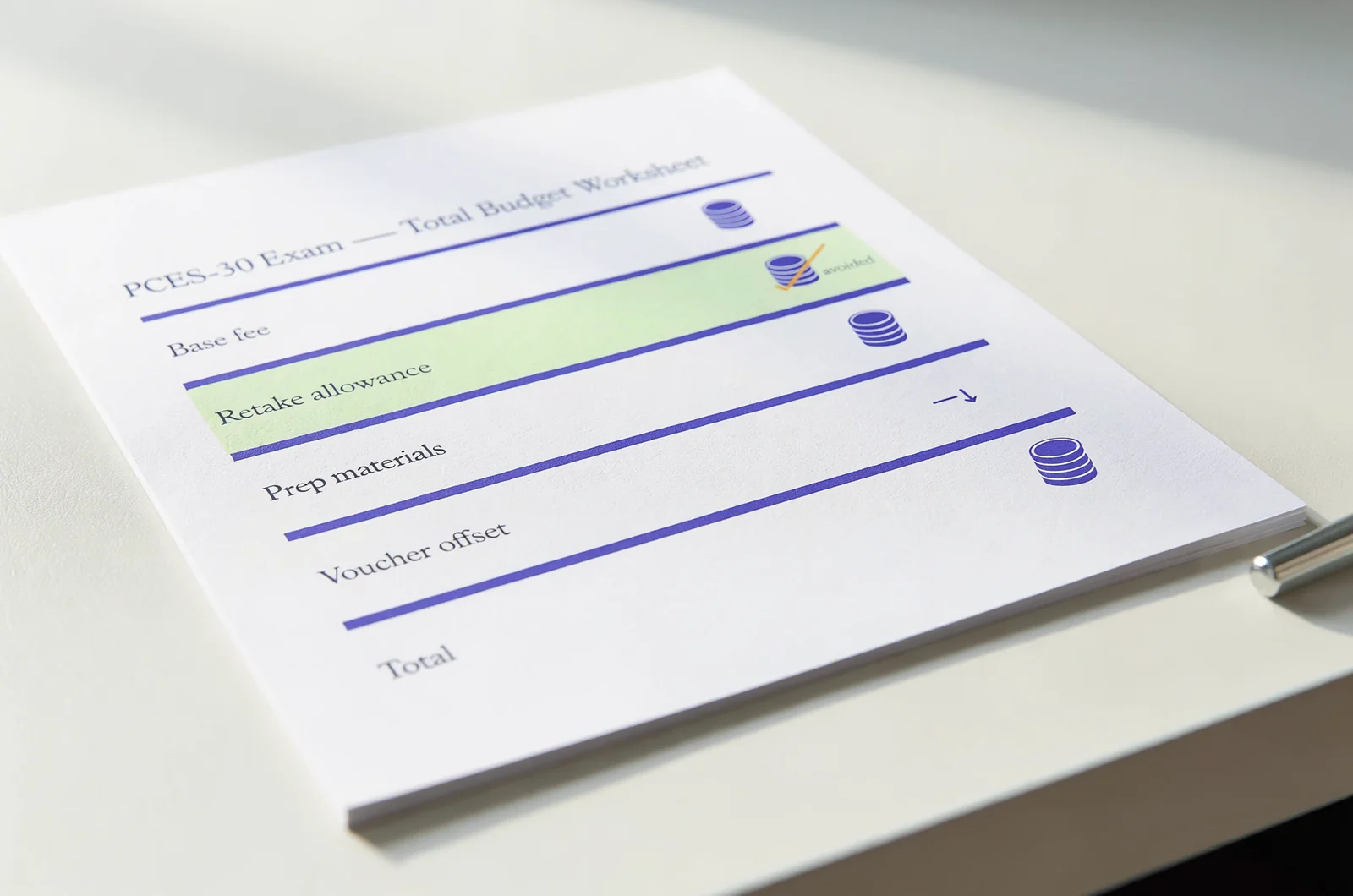
- Base fee: confirm the current price on the official PCES page. This is your anchor.
- Retake allowance: add 0.3 to 0.5 times the base fee as an expected-value buffer. If your timed practice scores are comfortably above the passing threshold, use the low end.
- Prep materials: $0 if you self-study with free resources and free sample questions; up to roughly a third of the exam fee for a focused question bank with explanations; multiples of the exam fee for instructor-led training.
- Voucher offsets: subtract any verified discount, but only after confirming version match and expiry.
For most working candidates on the self-study path, the honest total lands at the exam fee plus a modest practice spend — and the practice spend is what keeps the retake buffer theoretical instead of real.
Questions candidates ask about PCES-30 costs
Is the PCES-30 fee the same everywhere? The vendor sets the base price, but regional testing partners and currency conversion can shift what you actually pay. Confirm the checkout price in your region before assuming a figure from a forum post applies to you.
Are third-party "PCES cost" pages reliable? Mostly not, as the SERP noise above shows. Pages about pharmacist credentialing, geophysics papers, and unrelated programs currently rank for this query. The vendor page is the only source worth trusting for the fee.
Is a training bundle worth it for an entry-level exam? Rarely at classroom prices. A voucher-plus-practice bundle can be worth it if the discount is real and the voucher matches PCES-30-01 with a comfortable expiry window.
What's the cheapest safe total? One verified exam fee, free official syllabus study, free sample questions to gauge the format, and one affordable timed question bank for the final two weeks. That combination addresses both failure causes — knowledge gaps and pacing — without paying for either twice.
Keep building your exam budget plan
- How to Review Practice Test Results Before You Retake the Exam
- Free Security+ Practice Test by Domain: Checks Before You Book
- Flashcards vs Timed Exams Train Recall and Pacing Differently
Try the free sample questions, then create a free account or purchase full access or a membership for the exam they are preparing for. Get started |  |