How to Review CISA Practice Tests So Missed Questions Stick
By PrepHoot Editorial Team· (updated Oct 1, 2026)

Most CISA candidates finish a practice set, glance at the score, skim the explanations for the questions they missed, and move on to the next set. Two weeks later they miss the same question again, worded slightly differently, and wonder why nothing stuck. The problem isn't effort. It's that checking an answer and learning from an answer are two different activities, and only one of them changes what you do on exam day. A good CISA practice exam review method closes that gap with a repeatable loop: log every miss, write out why each wrong option was wrong, re-attempt the miss after a delay, then re-test the whole domain. This walkthrough shows you how to run that loop after every practice set, in about 45 minutes of review per 50 questions.
What you need before the first review session
The loop works with any decent question source, but a few things make it much easier. Get them in place once and every session after that runs the same way.
First, you need practice questions with explanations for every answer choice, including the wrong ones. The explanation for the correct answer tells you what ISACA wanted. The explanations for the distractors tell you how ISACA thinks, and that's the part you can reuse on questions you've never seen. The official ISACA QAE database is built this way, and several third-party guides make the same point: PrepClubs' CISA practice question guide argues that reading why wrong answers are wrong matters more for auditor judgment than raw question volume.
Second, you need somewhere to log misses that isn't your memory. A spreadsheet works. A notebook works. What matters is that each entry has a few fixed fields, which we'll set up in the first step.
Third, you need a timer and a way to re-attempt questions in exam-like conditions. Scoring 85% in untimed study mode tells you very little about a 150-question, four-hour exam. The real exam gives you roughly 96 seconds per question, and pacing is a skill you have to train separately from knowledge. A simulator with a timed mode, like the one PrepHoot runs for its ISACA CISA practice tests, handles this without any manual clock-watching.
One constraint to accept up front: this method is slow per question. Reviewing 10 misses properly takes longer than answering 50 new questions. That's the trade. You're converting questions you've already paid for, in time or money, into durable learning instead of burning through fresh banks.
Set up a miss log you will actually maintain
Open your spreadsheet and create exactly six columns. Keep it this simple; elaborate logging systems die by week two.
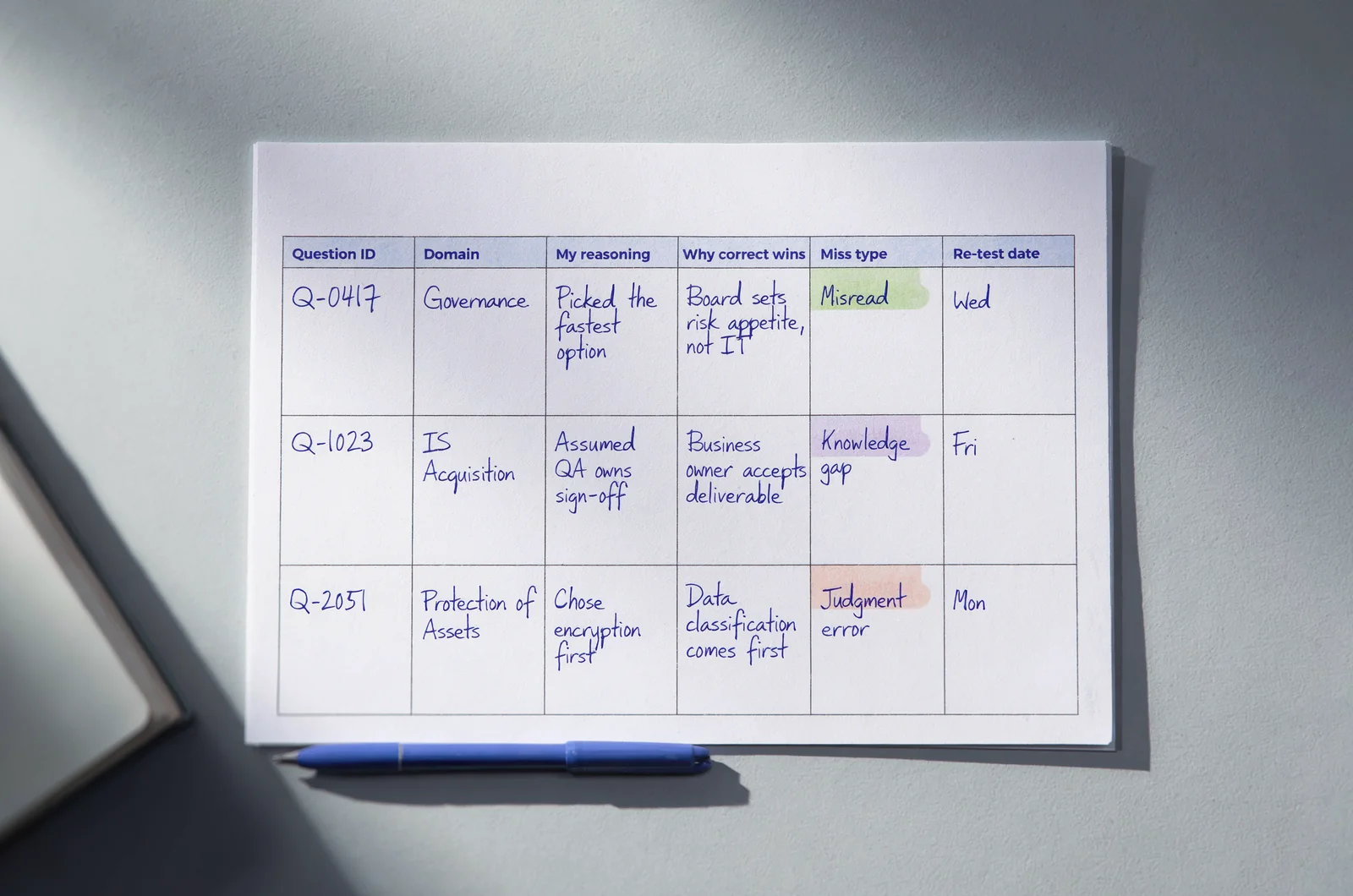
- Question ID or short label. Enough to find it again. "Domain 3, backup tape rotation" is fine.
- Domain. Which of the five CISA job practice domains it belongs to.
- What I chose and why. One sentence, written in your own words at the moment of review.
- Why the correct answer wins. One sentence, also in your own words. Do not paste the explanation.
- Miss type. One of four categories: knowledge gap, misread, judgment error, or pacing/rush.
- Re-test date. Today plus 48 hours, and today plus 7 days.
The miss type column does the heavy lifting later. A knowledge gap means you didn't know the concept; you fix it by reading the source material. A misread means you knew it and answered a different question than the one asked; you fix it by slowing down on qualifiers like FIRST, BEST, and MOST. A judgment error means you picked the technically-correct answer instead of the auditor-correct answer; you fix it by studying ISACA's reasoning patterns. One candidate who passed the CISA on the first try with a 488 credited exactly this kind of categorization for turning a scattered 14-week prep into a focused one.
Verification cue: after your first logged session, you should be able to sort the log by miss type and immediately see which category dominates. If most of your entries are judgment errors, more flashcards won't help you. If most are knowledge gaps, more practice questions won't help you either. The log tells you where your next study hour goes.
Run the review pass immediately after each set
Do the review the same day you take the set, while your reasoning is still fresh. Waiting until the weekend means you've forgotten why you picked what you picked, and the log entry becomes a guess.
Read the explanation for every option, not just the right one
For each miss, read all four explanations. Then cover them up and write column 4 of your log from memory. If you can't explain why the correct answer wins without looking, you haven't learned it yet; you've only recognized it. Recognition fails on the exam, where the same concept shows up in a scenario you've never seen.
This is also where you handle the questions you got right by guessing. If you flagged a question, hesitated between two options, or picked one because "it sounded the most audit-y," treat it as a miss. Log it the same way. A lucky correct answer is a wrong answer that hasn't happened yet, and the ExamCert study plan makes the same argument: review every wrong answer by understanding why you picked it, not just by reading the provided explanation.
Write the "why wrong options are wrong" sentence
For each distractor, finish this sentence in your log notes: "A candidate picks this because..." ISACA distractors aren't random. They're built from predictable traps: the answer that a technician would pick instead of an auditor, the answer that's correct but not FIRST, the answer that skips a step in the audit lifecycle. When you name the trap out loud, you start spotting it in new questions. The classic example is the "what should the auditor do FIRST?" family, where three options are reasonable actions and only one respects the sequence of the audit process.
Expected result and verification
After a 50-question set, expect 8 to 15 logged misses early in your prep, dropping over the weeks. The session's done when every miss and every guessed-right question has a complete log row. If you finish in five minutes, you skimmed. A real review of 10 misses takes 30 to 45 minutes.
Re-attempt misses after a 48-hour gap
This is the step everyone skips, and it's the one that makes the method work. Answering a question right five minutes after reading its explanation proves nothing. Answering it right two days later proves the explanation survived contact with your memory.
On your re-test date, open only the logged questions from that session. Don't reread the log first. Attempt each one cold, at exam pace, and record the result. Three outcomes are possible:
- Correct with confidence. Close the item after the second scheduled re-test (the 7-day one) also goes clean.
- Correct but hesitant. Keep it in rotation. Hesitation means the underlying concept is still fragile.
- Wrong again. This is the valuable case. Don't just re-read the same explanation. Go back to the source material for that concept, then rewrite your log entry from scratch. A repeated miss means your first review treated the symptom, not the gap.
Spaced repetition tools automate this scheduling, and some prep platforms build it in. In PrepHoot's simulator you can filter to previously missed questions and rerun just those in flashcard or timed mode, which turns the 48-hour re-test into a five-minute task instead of a manual hunt through old sets. Whatever tool you use, the rule is the same: no miss leaves the log until it's been answered correctly twice, on separate days, without help.
Re-test the full domain before moving on
Individual re-attempts fix individual questions. They don't tell you whether the domain itself is safe. The final step of the loop is a domain-level check: once you've cleared a batch of misses from one domain, run a fresh timed set of 30 to 50 questions from that domain only.
The five CISA domains weight differently on the exam, so interpret your scores with that in mind. Information Systems Auditing Process, Governance and Management of IT, Information Systems Acquisition Development and Implementation, Information Systems Operations and Business Resilience, and Protection of Information Assets each carry their own share of the 150 questions, and your weakest domain by score deserves the next block of study time regardless of how much time you've already put into it. Practice-test guides like the one at PracticeTestGeeks recommend exactly this: review your weakest domain by score, not by familiarity or comfort.
Set a clear bar for passing a domain. Scoring 70% or better consistently on timed domain sets is the commonly cited readiness threshold, because the CISA's scaled scoring (200 to 800, with 450 to pass) tends to reward consistent performers. Below 65% on a domain, send that domain back through the loop: new questions, fresh log entries, 48-hour re-tests. The EduDelphi first-attempt study plan structures its final prep weeks the same way, alternating full mocks with targeted weak-domain review.
Verification cue: you're done with a domain when you hit your target score on a timed set where most questions are new to you. Hitting 90% on a set of questions you've already reviewed twice only proves the log works, which is good, but it isn't the same as domain readiness.
Fit the loop into a working week
The method above assumes you have unlimited evenings. You don't. Here's how it compresses into a realistic week for someone studying after a full-time job:
- Monday and Wednesday: one 50-question timed set each evening, followed immediately by the review pass (about 90 minutes total).
- Tuesday and Thursday: 48-hour re-tests from Monday and Wednesday, plus source-material reading for any repeated misses (30 to 45 minutes).
- Saturday: one full or half-length timed mock, then the review pass split across Saturday and Sunday if the miss count is high.
- Sunday: 7-day re-tests, a domain-level timed set for the current focus domain, and 20 minutes updating the log and choosing next week's domain.
That's roughly eight hours a week, which lines up with the 12-to-16-week study plans most current CISA guides describe. The log is what makes those hours compound instead of evaporate. One small idea if you like checklists: a printable "miss log card" with the six columns and the 48-hour and 7-day date boxes pre-printed turns each review session into a fill-in exercise rather than a blank page.
Two failure modes to watch for. First, taking new sets faster than you review old ones. If your backlog of unreviewed misses passes about 40 questions, stop taking new sets entirely until the log is clean. Second, reviewing only your weakest domain forever. Rotate. A domain you passed three weeks ago decays, and the 7-day re-test column exists to catch that decay before the exam does.
Where this method transfers next
The loop is exam-agnostic. The same log, delay, and re-test structure works on CompTIA Security+ SY0-701 sets, Cisco CCNA questions, or PMP situational items, because the miss types are universal: knowledge gaps, misreads, judgment errors, and pacing. If CISA is one stop on a longer certification path, build the habit now and carry the spreadsheet with you. The only thing that changes per exam is what counts as a "judgment error," since each vendor has its own version of the auditor-correct answer.
Questions candidates ask about reviewing CISA practice tests
How many times should I retake the same practice exam? Retake individual missed questions until you answer them correctly twice on separate days. Retake a full exam no more than once, and only after several weeks; on a second sitting you're measuring memory of that specific exam, not readiness.
Is reviewing wrong answers enough, or should I review correct ones too? Review every question you guessed on or answered slowly, even if you got it right. A correct answer you're confident about needs nothing. A correct answer that took three minutes of agonizing is a pacing liability and belongs in the log.
What score on practice tests means I'm ready for the real CISA? Consistent 70% or better on timed sets of mostly unseen questions is the widely used readiness signal. Below 65%, keep the loop running and delay booking.
Should I review by domain or by the order questions appeared? By domain. The log's domain column lets you sort misses into clusters, and a cluster of five misses in one domain points to a knowledge gap in the source material, which is a different fix than scattered one-off errors.
Keep building your review habit
- How to Review Practice Test Results Before You Retake the Exam
- Flashcards vs Timed Exams Train Recall and Pacing Differently
- 050 733 Practice Tests Ranked by Exam Realism and Cost
Try the free sample questions, then create a free account or purchase full access or a membership for the exam they are preparing for. Get started |  |