How to Review Practice Test Results Before You Retake the Exam
By PrepHoot Editorial Team· (updated Sep 30, 2026)

You just finished a timed practice exam and the score came back below where you wanted it. Now what? Most candidates glance at the percentage, feel either relieved or discouraged, and either book the real exam or start another full-length run. Both reactions waste the most useful thing the simulator just gave you: a detailed map of exactly why you lost points. A proper exam simulator performance review turns one disappointing score into a specific fix list, and it usually takes less time than the practice exam itself did.
This checklist walks through the audit I run after every simulated attempt: pulling the missed-question log, sorting misses by domain objective, separating knowledge gaps from pacing mistakes, and converting all of it into the next study block. Whether you're preparing for SY0-701, 200-301 CCNA, AZ-104, or the PMP, the workflow is the same. Run it after every full-length attempt, and each practice test starts paying for the next one.
Why a score alone tells you almost nothing
A 72% on a timed run is a single number that hides at least three different problems. You might have missed ten questions in one weak domain and aced everything else. You might know the material cold but burn four minutes per scenario question and guess on the last fifteen. Or you might have flagged the right answer and talked yourself out of it. Each of those needs a completely different fix, and "study more" addresses none of them.
This is the core argument behind structured review methods used across test prep. The team at Sketchy, writing about MCAT practice test review, makes the same point for medical students: categorize every wrong answer by its actual cause before you touch new material, because a content gap and a reasoning slip look identical in the final score. The principle transfers directly to IT certification exams, where a mistyped subnet mask question and a genuinely unknown SD-WAN concept both cost you one point.
The other reason to review properly is time. If you're studying around a full-time job, you maybe have eight to ten hours a week. Spending two of those hours re-reading material you already know feels productive and changes nothing. A disciplined post-exam audit points your limited hours at the questions you actually got wrong, which is the only study time that moves the score.
The ten-point post-exam audit
Here is the core checklist. Run it in order, within a day of finishing the simulated exam, while your reasoning on each question is still fresh. The whole pass takes 45 to 90 minutes depending on how many questions you missed.
- Record the headline numbers: overall score, time used versus time allowed, and score by domain if your simulator reports it.
- Export or write out every missed and flagged question into an error log with the question topic, not just the question number.
- Tag each miss with one cause: knowledge gap, misread question, pacing pressure, changed answer, or careless error.
- Group the misses by official exam domain and objective code from the vendor's exam blueprint.
- Rank domains by points lost, weighted by how heavily the real exam weights that domain.
- Read the explanation for every missed question, including why each wrong option is wrong.
- Check your timing data for questions that took more than twice your average time per question.
- Verify whether your correct answers were confident or lucky by re-reading flagged-but-correct questions.
- Write a fix list of three to five concrete actions, each tied to a domain or a habit.
- Schedule the next study block and the date of your next full-length timed attempt.
Steps 1 through 5 tell you where the points went. Steps 6 through 8 tell you why. Steps 9 and 10 turn it into a plan. The sections below unpack the parts candidates most often skip.
Build an error log you'll actually use again
The error log is the spine of the whole review. Test prep coaches have pushed this method for years because it works: GeniusPal's guide to the error log method describes the same basic structure, and MySatCoach calls it the exact post-test workflow behind their students' score gains. For IT exams, a simple spreadsheet with five columns is enough: objective code, topic, cause of the miss, the correct concept in one sentence, and a re-test date.
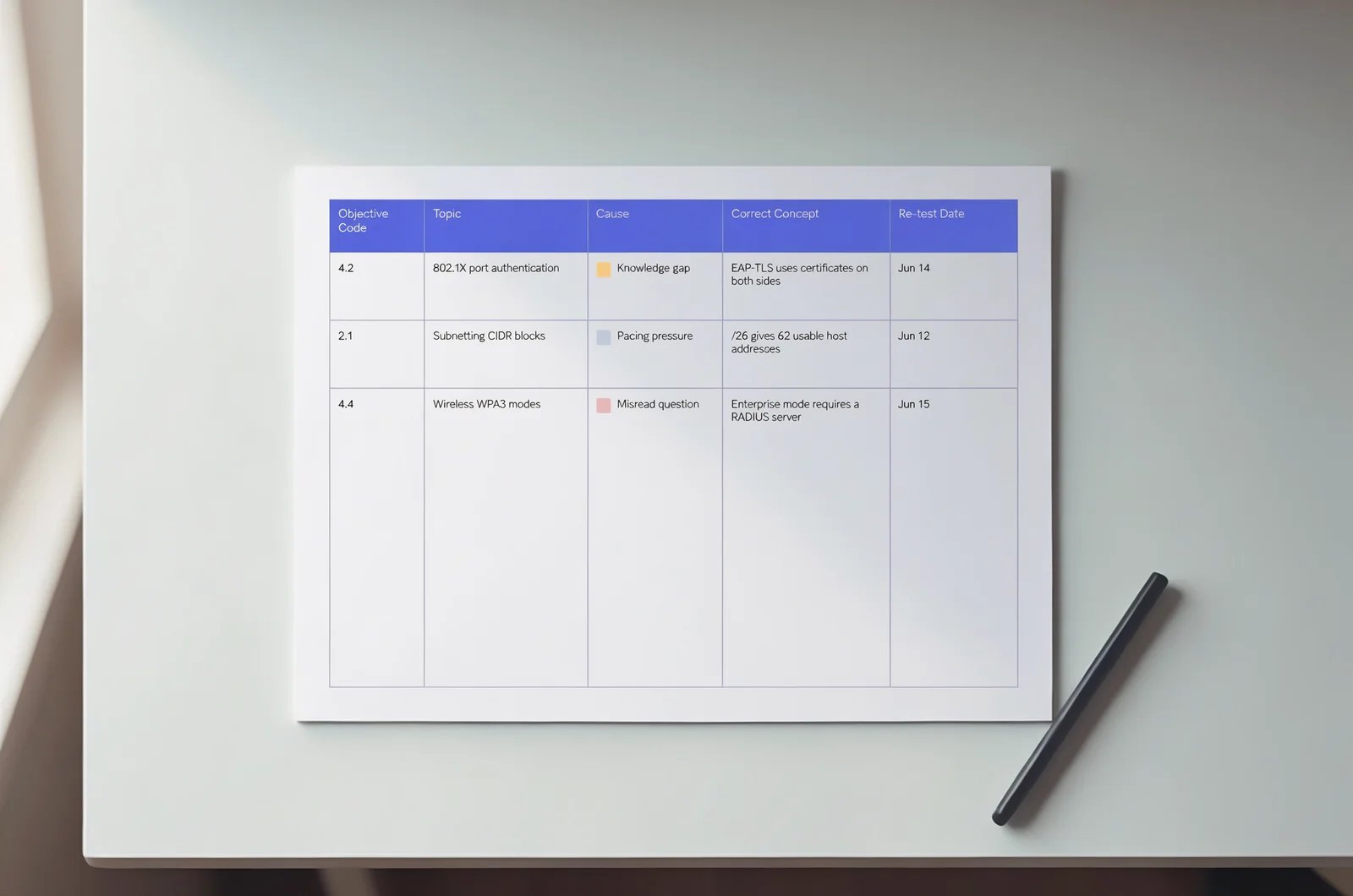
Two rules make the log useful instead of busywork. First, write the concept in your own words. "Missed Q47" is useless three weeks from now. "802.1X port-based authentication: the supplicant authenticates before the port opens for traffic" is something you can drill. Second, tag the cause honestly. If you narrowed a question to two options and picked the wrong one, that is not a knowledge gap. That is a discrimination problem, and the fix is reading explanations on why the distractor was wrong, not re-reading the chapter.
If your simulator saves progress across sessions, lean on that. In PrepHoot's simulator, missed questions stay in your history, so you can pull them straight into flashcard mode and re-drill exactly the set you missed rather than rebuilding the list by hand. Either way, the log only earns its keep if you schedule the re-test. A miss you never revisit is a miss you'll repeat on exam day.
Separate knowledge gaps from pacing mistakes
This is the split that changes how you study, so give it its own pass. Go through your log and sort every miss into one of two buckets.
Knowledge gaps are misses where you didn't know the material. You read the question, recognized the topic vaguely, and guessed. The fix is content study: documentation, a course section, hands-on lab time, then targeted question practice on that objective.
Pacing and process mistakes are misses where you knew the material and still lost the point. You misread "which is NOT" as "which is." You ran out of time and bubbled the last ten questions at random. You second-guessed a correct first instinct. The fix here is not more content. It's reps under time pressure plus a stricter question routine: read the last sentence of the question first, answer before looking at the options, flag and move when you're stuck past 90 seconds.
Testbook's guide on reviewing practice test mistakes makes the same distinction and notes that candidates routinely mislabel process errors as knowledge gaps, which sends them back to re-study material they already command. Check your simulator's timing data before you classify anything. If you answered a question in twelve seconds and missed it, that's almost never a knowledge gap. If you spent four minutes and missed it, you were working from uncertainty the whole time.
A useful ratio: if more than half your misses are process errors, your next study block should be timed question sets, not reading. If more than half are knowledge gaps concentrated in one or two domains, book no more practice exams until you've done content work on those domains.
Read your timing data like a coach
Timed mode is the feature that separates a simulator from a static question bank, and its timing data is the most underused part of a performance review. After each attempt, look at three numbers.
The first is average seconds per question compared to what the real exam allows. CompTIA gives you roughly 70 to 80 seconds per question on most of its exams; the PMP gives you about 80 seconds across 180 questions in 230 minutes. If your average is well under the limit but your score is low, you're rushing. If your average is near the limit and you left questions blank or guessed at the end, you have a pacing problem on long scenario items.
The second is the slow-question list. Any question that took more than twice your average is a candidate for the error log even if you got it right. Slow-and-correct on exam day still costs you, because that time comes out of other questions. Usually a slow question means the scenario format is unfamiliar, not that the content is unknown, so the fix is more scenario-style practice rather than more theory.
The third is end-of-exam accuracy. If your hit rate collapses in the final quarter of the attempt, you're looking at stamina or time-budget failure. The correction is full-length timed runs, done under real conditions: no pausing, no phone, same time of day you plan to sit the real exam. One full simulation every week or two builds that endurance; daily 20-question sprints do not.
Score by domain, not by feel
Vendor exam blueprints weight domains unevenly, and your review should weight them the same way. On SY0-701, for example, "Security Operations" carries more weight than "General Security Concepts," so a 60% in the heavy domain costs you far more real points than a 60% in the light one. When you group your error log by objective code, sort it by the vendor's domain weight, not just by raw miss count.
Domain-level scoring also protects you from a common trap: the comfortable domain. Candidates re-practice what they're already good at because it feels good. If your report shows 90% on networking fundamentals and 55% on automation and programmability, the next hour belongs to automation, full stop. PrepHoot's timed mode breaks results down by exam objective for exactly this reason, and the explanations attached to each answer let you confirm whether a domain miss was a concept problem or a distractor problem before you commit study hours to it.
Set a per-domain readiness bar before exam day. Something like 80% or better on your two weakest domains across two consecutive timed attempts is a reasonable gate for booking the real thing. A single good overall score with a 50% domain hiding inside it is not readiness. It's luck that hasn't been punished yet.
Turn the review into the next two weeks of study
The review ends with a fix list, not a feeling. Three to five actions, each one checkable, each one tied to evidence from the audit. A good fix list looks like this: complete the vendor's official documentation section on identity federation and do 40 targeted questions on it; drill the missed-question set in flashcard mode three times this week; run one full-length timed attempt on Saturday with a hard 90-second flag rule; re-test the error log items from the last two attempts before the next simulation.
Notice what isn't on the list: "study more," "review networking," "work on timing." Those aren't actions. If a fix doesn't name a domain, a question set, or a habit with a date attached, rewrite it until it does.
Then close the loop. After the next timed attempt, run this same audit again and compare the error logs. Misses that disappear are fixed. Misses that repeat after targeted study mean the study method for that topic isn't working, so change the method: switch from reading to labs, or from labs to teaching the concept out loud. Candidates who track this across three or four attempts can see their readiness trend in actual data instead of hoping. That's the real payoff of the whole process.
Questions candidates ask after a bad practice score
How many times should I retake the same practice exam? Once, after a full review and at least one study block, and only if your question bank is large enough that you won't recognize items from memory. Recognizing questions inflates your score and hides gaps. If the exam feels familiar, switch to fresh questions on the same objectives.
My practice scores are stuck around the same number. What's wrong? Usually the review step, not the study step. If you take test after test without logging and categorizing misses, you keep paying for the same two or three weak domains. Do one deep audit before you buy another attempt at anything.
Should I review questions I got right? The flagged ones, yes. A correct guess is a miss that didn't get caught. Anything you answered confidently and correctly can be left alone.
How close to my target score should I be before booking? Consistently at or above the passing score across at least two full-length timed attempts, with no domain below your personal bar. One outlier high score isn't a trend.
Keep building your exam-day routine
- Flashcards vs Timed Exams: Train Recall and Pacing Differently
- 050-733 Practice Tests Ranked by Exam Realism and Cost
- What Cisco'S 2026 Exam Changes Mean For CCNA Subnetting Practice
Try the free sample questions, then create a free account or purchase full access or a membership for the exam they are preparing for. Get started |  |