Section 2 Exam Questions: How to Practice Without Wasting Hours
By PrepHoot Editorial Team· (updated Oct 10, 2026)

If you’re searching for section-2 exam questions, first identify the exam and resource behind that label. Section 2 can describe a test section, a part of a preparation manual, or a question group inside a course. Once you confirm its meaning, you can build a practice routine that fits an evening after work: answer a small set, diagnose mistakes, repair the weak concept, and check it again under appropriate timing.
I recommend starting with your exam’s current objectives, matching practice questions, answer explanations, and a simple error log. The set sizes below are suggested study defaults. Use your exam’s published instructions for question formats, timing, navigation, and scoring.
Identify what Section 2 means for your exam
Connect the section label to a full exam name before choosing questions. A search result containing those two words alone cannot establish what you need to study.
For example, the Texas educator certification program’s Principal as Instructional Leader manual labels its preparation guidance as Section 2. That page covers approaches to answering questions. The number identifies a part of the manual.
Write down these details:
- The exam name and code, if it has one.
- The version or objectives document you’re studying against.
- The full heading attached to Section 2.
- Whether that heading comes from the exam provider, a course, or a practice platform.
- The skills and question formats included under it.
For an IT certification, match the section’s topics to the provider’s objectives. If your course groups questions differently, preserve the official objective names in your notes.
You should finish this step with a usable description, such as “the troubleshooting objectives grouped in my course’s second section.” If you still have only a number, return to the original resource and read the surrounding headings.
Build a small practice set you can review tonight
Choose questions that match the confirmed section and leave enough time to examine your answers. Start with about 8–12 objective questions. Reduce that number when prompts require substantial reading, calculations, or hands-on work.
Inspect the explanations before committing to a question bank. A useful explanation should identify the deciding fact and explain why competing answers fail. Check a few against the relevant official documentation. Set aside questions whose wording, version, or answer rationale you cannot resolve.
For an IT exam listed in PrepHoot’s catalog, its free sample questions can provide a starting set. Match those questions to your objectives yourself; a sample’s coverage may differ from your course’s section grouping.
Choose the practice action that suits the confirmed format:
- For single-answer questions, explain why one choice best satisfies the prompt.
- For multiple-response questions, judge each option separately and follow the selection instructions.
- For scenario questions, identify the requested decision and its constraints.
- For written or practical tasks, use the applicable rubric or completion criteria.
If you’re preparing for Salesforce administrator certification, the guide to Salesforce scenario practice provides a relevant companion topic.
Reserve some unseen questions for later checks. Record which ones you’ve already attempted.
Work through an untimed set before chasing speed
Answer your first Section 2 practice set without a countdown. This gives you room to separate missing knowledge from hurried reading.
Keep the explanations hidden until you commit to an answer. For each question, follow this sequence:
- Identify what the prompt asks you to decide, calculate, configure, or explain.
- Mark constraints such as sequence, cost, permissions, or allowable disruption.
- Choose an answer and write one sentence explaining your reasoning.
- Record your confidence as confident, uncertain, or guessed.
- Reveal the explanation and compare its reasoning with yours.
This creates a baseline you can inspect. A correct guess still needs review. A confident wrong answer deserves attention because your reasoning led you firmly toward the wrong choice.
PrepHoot’s study mode and answer explanations can support this sequence for a matching IT exam. Pause at each explanation long enough to identify the deciding fact, then record it in your own words.
For a written response, commit to an outline or complete answer before consulting the rubric. For a practical task, record the steps you chose and check the result against the stated requirements.
Before ending the set, explain one missed question without looking at its answer choices. If you can only remember the option’s position or wording, keep that concept in your review queue.
Turn missed answers into a short repair task
Use each missed or uncertain answer to choose a specific study action. Copying the explanation into a notebook gives you a record, but you still need a way to check your understanding.
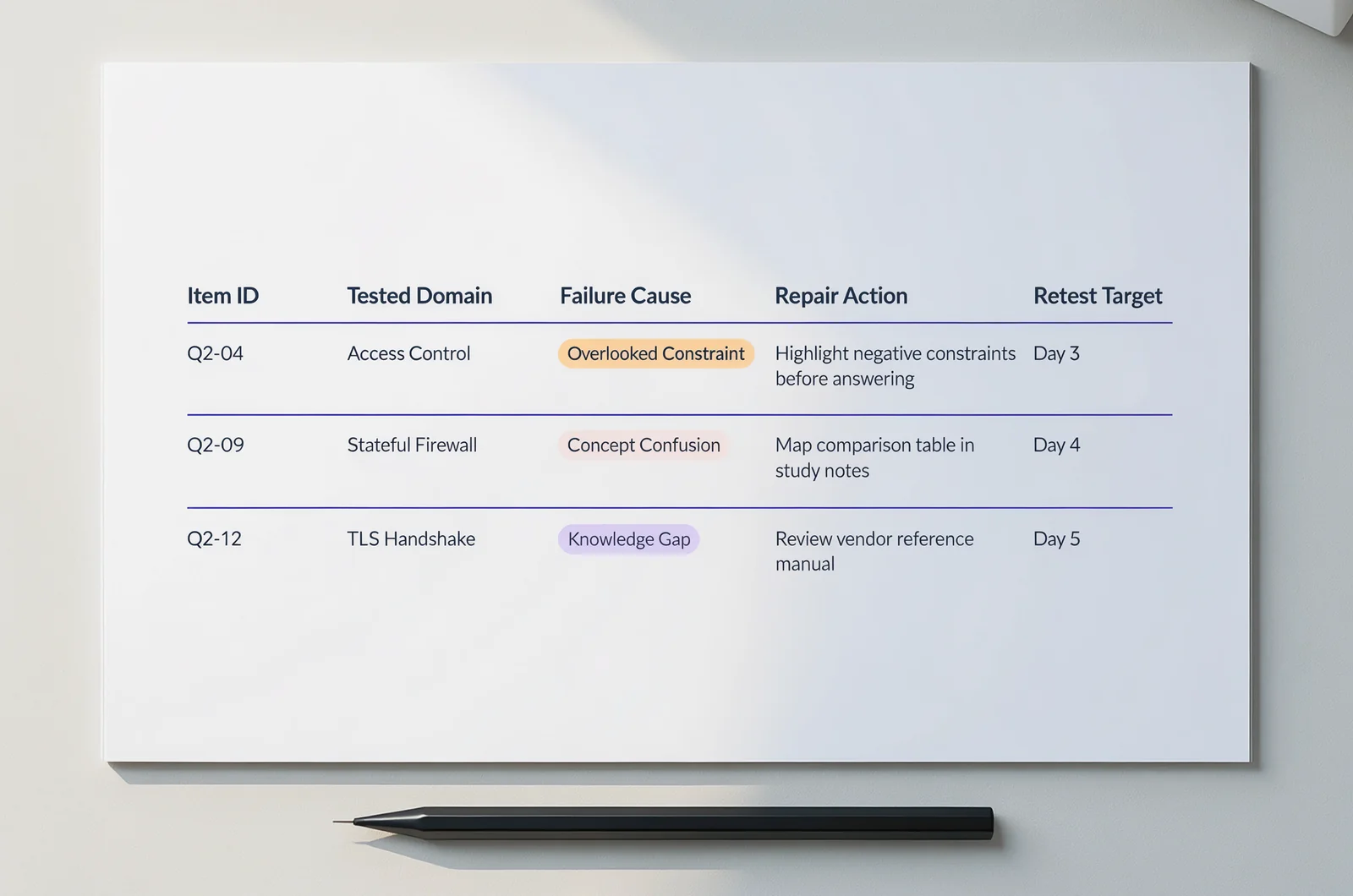
Name the reason your answer failed
Assign each reviewed question a main cause:
- You didn’t know the underlying concept.
- You confused two similar concepts.
- You overlooked an instruction or constraint.
- You knew the topic but applied it incorrectly.
- You ran out of time before completing the reasoning.
Keep the log brief. Record the question identifier, objective, cause, correction, and a date for another attempt.
For a hypothetical troubleshooting question, suppose you selected a broad configuration change when the prompt required minimal disruption. Your correction might be: “Identify the affected scope before choosing a change.”
That note tells you what to do on another question. “Read more carefully” leaves the task undefined.
If the explanation itself seems questionable, mark the item as unresolved. Check the disputed point against official documentation before turning it into a study note.
Check the concept in a different form
Choose a repair that fits the error. Review a definition for a knowledge gap. Compare two concepts side by side when you confuse them. Work through the missing calculation step when your process failed.
Then close the material and explain the correction from memory.
Continue the hypothetical example by changing the constraint: would your answer differ if wider disruption were allowed? Explain why. This checks whether you understand the decision rather than recognize the original sentence.
Use a short flashcard for a compact distinction or rule. Keep longer scenarios in the question practice queue. The guide to flashcards and timed exams explores that division between recall practice and pacing practice.
Retry the concept during a later session, preferably through a different question. Record whether the same error returned.
Add timing after you can explain the answers
Introduce a timer when you can work through a small set with clear reasoning and understand the remaining misses. Keep the timing consistent with the confirmed exam format.
Set a budget that matches the task
Find the official time allowance and any rules about separate sections, review, or returning to earlier questions. If the exam uses one shared clock, a course’s Section 2 may have no separate time allowance.
For a uniform practice set, divide your chosen working time by the number of questions. Treat the result as an average checkpoint. Longer scenarios may need more time than short recall questions.
As a hypothetical example, a 10-question set with 15 minutes allows an average of 90 seconds per question. That calculation describes the practice set alone.
Where review is permitted, allocate some of the practice block to returning to flagged questions. Where it isn’t permitted, rehearse the actual forward-only process.
Write your time budget and navigation rules at the top of the session log.
Diagnose what happened under the clock
Use PrepHoot’s timed simulator for a matching IT exam to practice answering within a fixed session. Confirm the settings against your exam’s instructions before treating the session as a rehearsal.
Afterward, inspect accuracy, completion, and confidence together. Note whether you rushed late questions, spent too long on one item, or repeatedly reopened decisions.
If accuracy falls under timing, compare the errors with your untimed log. A new cluster of missed constraints suggests a reading problem. The same concept errors suggest that the repair needs more work.
For written or practical tasks, time the whole response process. Include planning, execution, and checking within the allowed conditions.
Change one behavior in the next timed set, such as checking elapsed time at a midpoint. Keep the other conditions stable so you can assess that change.
Fit the routine into four after-work sessions
Give your Section 2 work a repeatable place in the week. A suggested 30-minute block can include a brief recall check, a small question set, and answer review.
Use this four-session sequence:
- Establish the baseline. Answer 8–12 matching questions untimed. Record confidence before revealing explanations. Finish with an error log that identifies the objectives requiring attention.
- Repair the largest gap. Review the concept behind a repeated error, then answer a smaller fresh set on that topic. Check whether you can explain the deciding rule without notes.
- Mix reviewed and fresh material. Retry selected misses alongside unseen questions from the confirmed section. Record repeated-question performance separately so familiarity doesn’t inflate your estimate.
- Run a timed check. Use a fresh set with a documented time budget. Compare the results with your untimed work and choose one issue for the following week.
Leave room for review by reducing the set when explanations take longer than expected. If you answered ten questions but examined only two misses, start the next session with those unfinished repairs.
On a tired evening, use the block for reviewing and retrying a few logged errors. Keep unfamiliar timed questions for a session when you can complete the planned conditions.
Before closing your notes, write the objective and task for your next session.
Check readiness with unfamiliar questions
Assess progress with fresh Section 2 questions that match the objectives and confirmed formats. Keep notes and explanations closed during the attempt.
Look for evidence you can inspect:
- You can explain why your answer satisfies the prompt.
- Previously logged errors occur less often in new questions.
- You complete the set within its documented budget.
- Your confidence broadly matches the quality of your reasoning.
- You can handle a changed constraint without relying on memorized wording.
Treat a small practice percentage as a limited observation. Ten questions cover less material than a broader assessment, and repeated items give you a different kind of evidence from unseen ones. A practice score also doesn’t establish the provider’s passing standard.
If Section 2 represents an objective domain, check how it fits into the full exam. For CISA candidates, the article on CISA domain weights is a relevant companion; confirm applicable weights in the provider’s objectives.
A useful interactive practice planner would accept available minutes, question format, and recent error categories, then suggest a set size with protected review time.
For your next readiness check, record the objectives covered, whether the questions were unseen, and the conditions used.
Questions that change your Section 2 practice plan
Adjust the routine when your question supply, results, or confirmed format requires a different approach.
How many questions should I do each evening?
Start with the suggested 8–12 objective questions only if you can review them within your study block. Use fewer for long scenarios or practical tasks.
Set the next session’s size from the previous session’s review workload. If several explanations remained unread, reduce the number of new questions. Finish the outstanding repairs before expanding the set.
What if I score well on questions I’ve already seen?
Separate those results from fresh-question results. Repeated questions can check whether you remember a correction, while unseen questions give you another opportunity to apply it.
Choose a new prompt on the same objective. Before answering, state the rule you expect to use. If you recognize an option but cannot explain the decision, return that concept to the error log.
What if my section requires essays or hands-on work?
Keep the answer, review, repair, and retry sequence, but replace the multiple-choice set with matching tasks.
For essays, compare your response with the applicable rubric and identify a specific weakness to revise. For hands-on work, check the required end state and review the steps that produced it.
Reserve a fresh prompt or task for the next attempt, and repeat it under the published conditions.
Practice timing for Security+
Try the free sample questions, then create a free account or purchase full access or a membership for the exam they are preparing for. Get started |  |