AZ-104 Exam Domains: The Practice Split Most Candidates Get Wrong
By PrepHoot Editorial Team· (updated Oct 2, 2026)

If you're studying for AZ-104 after work, you probably have six to ten real hours a week, and the clock is always ticking. The most common mistake I see candidates make isn't picking the wrong book or the wrong video course. It's splitting their practice evenly across all five AZ-104 exam domains, as if each one carried the same weight on the score report. It doesn't. A sound az-104 exam domain practice strategy starts with the published domain weights, converts them into an hours-per-week plan, and then rebalances that plan the moment your practice results show a gap. That's what this article builds, step by step, using the skills outline Microsoft last updated on April 17, 2026.
What the five AZ-104 domains actually cover and weigh
Microsoft publishes the official skill areas and percentage ranges in its study guide for Exam AZ-104, and the skills-measured PDF mirrors the same structure. As of the April 17, 2026 update, the five domains break down like this:
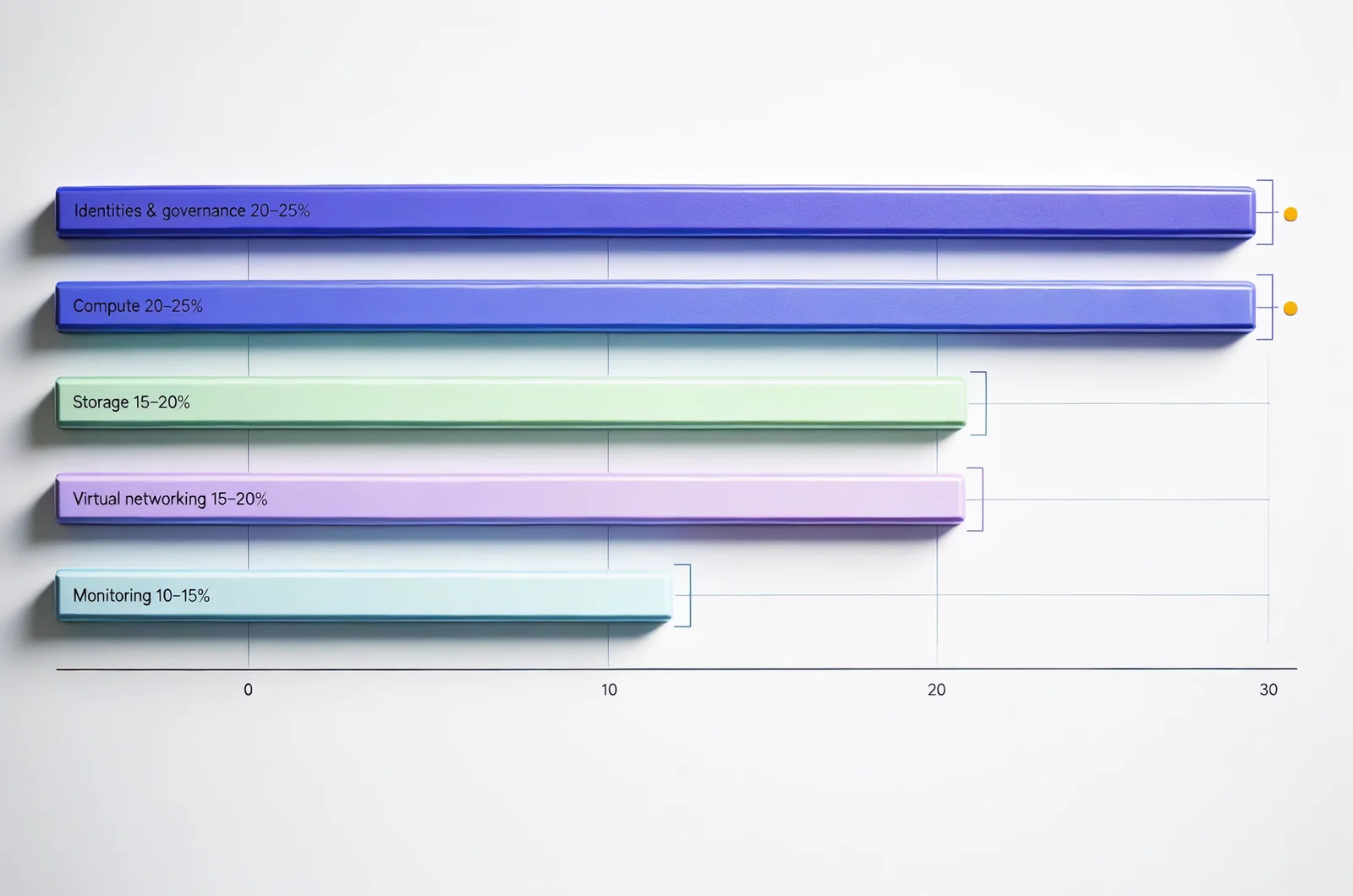
| Domain | Published weight | Rough share of a 60-question exam |
|---|---|---|
| Manage Azure identities and governance | 20–25% | 12–15 questions |
| Implement and manage storage | 15–20% | 9–12 questions |
| Deploy and manage Azure compute resources | 20–25% | 12–15 questions |
| Implement and manage virtual networking | 15–20% | 9–12 questions |
| Monitor and maintain Azure resources | 10–15% | 6–9 questions |
Question counts on the live exam vary (Microsoft typically delivers 40–60 questions in about 100 minutes), but the weight ratios hold. Identity and compute sit at the top. Monitoring sits at the bottom. That ordering matters more than most study plans admit.
Each domain also carries a different kind of question load:
- Identities and governance leans on Microsoft Entra ID, RBAC role assignments, Azure Policy, management groups, and cost management. These are scenario-heavy questions where several answers look plausible and the "most correct" one depends on scope and least-privilege reasoning.
- Compute spans VMs, VM scale sets, App Service, containers (including Azure Container Apps, which the 2026 refresh pushed harder), and ARM templates or Bicep for deployment. It rewards hands-on familiarity more than memorization.
- Storage covers storage accounts, blob tiers, Azure Files, redundancy options, and data security like SAS tokens and encryption.
- Virtual networking is the most configuration-dense domain: VNets, subnets, NSGs, peering, load balancers, DNS, VPN gateways, and Azure Bastion.
- Monitoring and maintenance is the smallest but sneaks in Azure Monitor, Log Analytics, alerts, backup, and site recovery.
Notice the asymmetry. Identity plus compute can represent half your score. Storage, networking, and monitoring share the other half. An even 20% time split across five domains is a plan that misallocates your scarcest resource.
Why an even split quietly under-serves your score
Here's the mechanism most candidates miss. Exam weights describe expected question frequency, and question frequency is what your score is made of. If 22% of your exam is identity and governance, then identity mastery moves your score roughly twice as much as monitoring mastery at 10–15%. Every hour of practice has a marginal value, and that value tracks the domain weight.
The second mechanism is less obvious: domains differ in how much a single practice hour actually fixes. RBAC and policy questions punish shallow familiarity. You can read about role assignments and feel fine, then miss four scenario questions in a row because you didn't practice the logic of scope inheritance. Compute is similar for deployment and Bicep questions. By contrast, monitoring and backup questions are more fact-recall driven, so flashcard-style repetition converts to correct answers faster per hour.
So the real cost of an even split is double. You under-rep the heavy domains and you over-spend hours on domains where cheap recall reps already do the job. Candidates who fail AZ-104 by 30 or 40 points often show exactly this pattern on their score report: strong on storage and monitoring, weak on identity and compute. The weights were published the whole time.
Converting the weights into an hours-per-week plan
Let's build the split concretely. Say you can give AZ-104 eight hours of practice per week, which is realistic for someone working full-time with a weekend block.
A weight-proportional starting allocation, using the midpoint of each range, looks like this:
| Domain | Midpoint weight | Hours per 8-hour week |
|---|---|---|
| Identities and governance | 22.5% | ~2.0 hours |
| Compute resources | 22.5% | ~2.0 hours |
| Storage | 17.5% | ~1.5 hours |
| Virtual networking | 17.5% | ~1.5 hours |
| Monitoring and maintenance | 12.5% | ~1.0 hour |
Two adjustments make this plan work in practice rather than on paper.
First, skew slightly more toward identity and compute than the raw midpoint suggests, because those domains have the deepest scenario logic and the steepest learning curve per topic. Shaving 30 minutes from monitoring and giving it to identity is a defensible trade, especially early in your prep. Third-party breakdowns of the AZ-104 syllabus make the same point: the top two domains contain the densest subtopic lists.
Second, don't run this split from day one to exam day unchanged. It works as phases. In the first half of your prep, roughly follow the weighted split while you learn material. In the second half, flip the logic: let your practice results, not the syllabus, drive allocation. More on that in a moment.
A useful tool idea here: a simple practice-allocation calculator where you enter your available weekly hours, your days-until-exam, and your per-domain accuracy, and it outputs a rebalanced hours split. Until someone builds one, a spreadsheet with the midpoint table above does the job in five minutes.
Match the practice mode to the domain type
The hours split only pays off if you spend those hours in the right mode. Different domains respond to different training, which is the core insight behind how recall and pacing training differ from each other.
Scenario domains: identity, compute, networking
For these three, untimed study-mode questions with full explanations do the heavy lifting. Read the question, commit to an answer before peeking, then read the explanation for every option, including the ones you correctly eliminated. The reasoning is the rep. RBAC scope questions, Bicep versus portal deployment decisions, NSG rule priority conflicts: these need slow, deliberate reps where you interrogate why the wrong answers are wrong. PrepHoot's AZ-104 question bank is built for exactly this kind of pass, since every answer carries an explanation rather than a bare letter.
Recall domains: storage and monitoring
Storage tiers, redundancy acronyms (LRS, ZRS, GRS, GZRS), backup retention behavior, alert action groups: these are vocabulary-plus-fact domains. Flashcard sessions and short mixed quizzes convert fastest here. Your one weekly monitoring hour goes further as three 20-minute flashcard bursts than as one long sitting.
Pacing: one timed block per week
Reserve part of your weekend session for a timed, mixed-domain set in exam conditions. AZ-104 gives you around 100 minutes for up to 60 questions, and case-study sections can eat time fast. A timed simulator that mirrors the real interface trains the pacing judgment you can't get from untimed study mode, and it's the only reliable way to defuse exam-day anxiety before it costs you points.
Rebalance when your practice data shows a gap
The weighted split is your starting hypothesis. Your practice results are the evidence that overrides it. This is where most az-104 exam domain practice strategy falls apart: candidates set a plan in week one and never audit it again.
Run this check every two weeks, or after every 100 questions answered:
- Pull your accuracy by domain. Anything below roughly 70% is a gap domain, regardless of how few questions it represents on the exam.
- Look at why misses cluster. Missing RBAC questions because you confuse Contributor with User Access Administrator is a knowledge gap. Missing networking questions because you ran out of time is a pacing problem with a different fix.
- Shift hours, not just attention. If storage sits at 85% and identity sits at 60%, move an hour from storage to identity next week. Keep at least a maintenance trickle (15–20 minutes of flashcards) in every domain so nothing decays.
The review method matters as much as the rebalancing. Missed questions only stick as fixed knowledge if you revisit them deliberately, and a structured practice test result review turns a flat percentage into a concrete list of subtopics to attack. In PrepHoot's simulator, progress is saved across sessions, so repeating your missed questions before exam day is a built-in habit rather than extra admin work.
One warning sign worth checking before you rebalance anything: make sure your question source is current. The April 2026 refresh expanded coverage of Microsoft Entra ID, Azure Container Apps, and hybrid management scenarios. A question bank still asking about "Azure Active Directory" by that name throughout is stale, and stale banks produce misleading domain-accuracy numbers. Free sample questions, like the ones PrepHoot publishes for every exam in its catalog, are a low-cost way to sanity-check a bank's freshness before you commit hours to it.
Mistakes that waste domain-weighted hours
Even with a good split, a few habits quietly burn your budget:
- Watching videos and calling it practice. Video courses teach; they don't test. If your identity hours are 90% video and 10% questions, you're studying the syllabus, not the exam.
- Grinding your strongest domain because it feels good. Storage at 88% accuracy is done. Every extra hour there is an hour identity needed more.
- Ignoring the ranges. Microsoft gives 20–25%, not 23%. Don't over-optimize to a fake exact number; the midpoints are planning anchors, not promises. The Azure Administrator Associate certification page points back to the same living study guide, which is why checking the official outline for updates matters more than any static plan.
- Never practicing under time pressure. Candidates routinely know the material and still fail on pacing. One timed block a week is the minimum insurance.
- Rebalancing on one bad session. A single 55% score in networking after a rough Tuesday night is noise. Two weeks of data is signal.
Questions candidates ask about AZ-104 domain weighting
Which AZ-104 domain should I study first? Start with identities and governance. It's the joint-heaviest domain, its RBAC and policy logic underpins later topics, and it has the longest ramp-up. Compute is a reasonable alternative if you already work with Entra ID daily.
Is monitoring worth studying at all, at only 10–15%? Yes, but cheaply. Six to nine questions can still be the difference between 680 and 720. Cover it with flashcard-style recall reps and a small weekly time slice rather than deep scenario work.
How close to the real exam are practice exam domain percentages? A well-built practice exam mirrors the published weights, so your timed sets should feel roughly like the table above. If your simulator's mix looks wildly different, check whether it's configurable or simply outdated.
How often does Microsoft change the domain weights? Weights shift only with official skills-outline updates, not continuously. The most recent update landed April 17, 2026, and it adjusted emphasis and topics more than the headline percentages. Recheck the official study guide if your materials predate it.
The plan, in one line: weight your hours by the published percentages, bias toward identity and compute, train scenario domains slowly and recall domains quickly, and let your own accuracy data rewrite the split every two weeks. Do that for six to eight weeks and the score report stops being a surprise.
Keep building your AZ-104 prep
- How to Review Practice Test Results Before You Retake the Exam
- Flashcards vs Timed Exams Train Recall and Pacing Differently
- How to Review CISA Practice Tests So Missed Questions Stick
Try the free sample questions, then create a free account or purchase full access or a membership for the exam they are preparing for. Get started |  |