Check These 1Z0-083 Sample Questions Before You Book the Exam
By PrepHoot Editorial Team· (updated Oct 19, 2026)

Your first set of 1z0 083 sample questions should help you decide what needs work before you book Oracle Database Administration II. A score becomes useful when you can explain your choices, connect the questions to verified objectives, and finish unfamiliar items within a realistic time budget. This checklist helps you examine those signals without spending every evening repeating the same quiz.
I’d start with a small, fresh set and keep the answers hidden until you finish. Record your reasoning alongside each response. You’ll use those notes to judge both the practice material and your readiness.
Match the samples to the exam you intend to book
A useful 1Z0-083 sample set needs a clear connection to the exam you plan to schedule. Begin with Oracle’s official exam listing and confirm the code, published objectives, availability, and certification requirements that apply to your plan.
Save the date you checked those details. A provider’s recent update label gives you a reason to investigate its material; the questions still need to match the objectives themselves.
Build an objective map from the questions
Copy the verified objective headings into a study document. Beside each heading, record the sample questions that address it and what each question asks you to do.
Distinguish between recognizing a term, interpreting output, choosing an administrative action, and explaining a sequence. Several questions about the same definition provide different evidence from several questions that require independent decisions.
You can use PrepHoot’s free samples to examine wording and explanation quality through this process. Judge the visible sample on what it contains, then identify which objectives require additional practice.
Keep uncovered topics visible
A short sample cannot establish broad readiness by itself. Leave an objective marked “unassessed” when you haven’t answered a relevant question or completed a suitable exercise.
Also record whether you needed a hint. A correct answer after opening your notes belongs in your learning record, but it shouldn’t carry the same weight as an independent response.
Finish this check with an objective map that separates demonstrated understanding, uncertain understanding, and missing evidence. Choose one unassessed objective for your next study session.
Make the explanation earn its answer
For 1Z0-083 preparation, answer explanations should help you reconstruct the decision after the options disappear. Pick a question you answered incorrectly and examine whether its explanation gives you enough information to do that.
Look for the condition that decides the answer
A useful explanation identifies the relevant condition, connects that condition to the selected action, and addresses plausible alternatives. It should help you describe why the answer fits this particular scenario.
For a command-based item, check whether the explanation accounts for the stated environment and required outcome. For an output question, check whether it shows how the displayed information supports the answer.
An explanation that merely repeats the selected option leaves work unfinished. Write down the missing reasoning before accepting the item as reliable study material.
Review correct guesses with the same care
Suppose you chose an answer because you recognized a command name, but you couldn’t explain its role. Record that response as uncertain even if the quiz awarded full credit.
Then hide the choices and explain the decision in a few sentences. State the condition that matters, the action it supports, and what would make a competing option more appropriate.
The article on practice question review strategies can support this review routine when your study time is limited.
Your finished state is a short explanation you can reproduce independently. If the supplied rationale remains unclear, flag the question and verify the disputed point before using it to guide further practice.
Check whether the scenarios contain enough information
A useful administration scenario gives you enough facts to choose an action and explain its consequences. Examine your samples for meaningful conditions, readable SQL or command output, and a clear requested outcome.
The following original study illustrations show how to audit question quality. Use the objectives you verified to decide which technical topics belong in your preparation.
Check what a SQL result actually establishes
Consider this hypothetical practice item:
A question displays the result of an administrative SQL query. Its proposed answer recommends changing a setting in a named database. The stem doesn’t identify which database produced the output. What should you check before accepting the answer?
The missing connection is whether the displayed result describes the database named in the proposed action. The scenario needs to establish that relationship before the output can support the decision.
This is a question-quality check. When you encounter SQL in a sample, identify what the query examines, which environment it describes, and what conclusion the result supports.
If the explanation makes an assumption that the stem never states, record it. A question that depends on missing context shouldn’t become the basis for memorizing a technical rule.
Check the outcome behind an administrative action
Now consider a second hypothetical item:
A maintenance scenario requires a database to be available by a stated deadline. Two answer choices describe different procedures, but the question gives no information about their duration or availability effects. Can the deadline distinguish the answers?
The supplied facts don’t establish which procedure meets that requirement. A complete explanation would need the relevant timing or availability conditions.
Apply that same test to recovery, maintenance, and configuration scenarios in your material. Identify the starting state, requested outcome, restrictions, and proposed sequence.
Then change one stated condition as a study exercise. Ask whether your reasoning still holds. If you can only repeat the original answer, return to the underlying concept.
Finish this check by separating technically supported questions from ambiguous items that need clarification.
Measure pacing with fresh questions
Timing your 1Z0-083 practice is useful only when the session resembles the task you’re trying to assess. Repeated questions and frequent pauses can make a session easier than an unfamiliar, uninterrupted set.
Confirm the published exam duration and question count directly with Oracle before choosing your practice settings. Check delivery and review rules separately rather than assuming your simulator reproduces them.
Set a practice budget you can explain
For a fresh mixed set, divide your chosen working time by the number of questions. Treat the result as a planning average.
For example, suppose you allocate 30 minutes to 20 practice questions. Your average budget is 90 seconds per question. Those are hypothetical practice settings, not published 1Z0-083 specifications.
Some questions will take longer. Watch whether those longer decisions leave enough time for the rest of the set and any review you planned.
Record when you start rushing. A session that ends on time can still reveal a pacing problem if you guessed through the final questions.
Match the practice mode to the task
PrepHoot’s study, timed, and flashcard modes can fit different study tasks. Use explanations during learning sessions, reserve fresh questions for timed assessment, and use flashcards for concise recall prompts.
Keep those results separate in your notes. A flashcard response and a timed scenario answer tell you different things about your preparation.
The guide to timed exam pacing practice explains how to think about that distinction.
Finish this check with a record of accuracy, uncertainty, and time use from an uninterrupted session. Preserve questions you haven’t seen for the next assessment.
Turn each miss into a short study task
Your 1Z0-083 error record should tell you what to study after work. “Review administration” is too broad to guide a limited evening session.
Record the objective, the decision you missed, why you missed it, and what evidence would show improvement. Include uncertain correct answers so lucky guesses remain visible.
Separate knowledge gaps from reading errors
A knowledge gap means you couldn’t explain the relevant behavior or choose an action from the stated conditions. Your follow-up might involve documentation, a lab exercise, or a different explanation.
A reading error needs a more specific correction. Perhaps you missed the requested number of answers, overlooked a restriction, or answered a different question from the one asked.
Write the exact missed condition beside the item. During the next session, identify the requested outcome and restrictions before inspecting the choices.
Give every repair a finish line
Define a task you can complete and assess. For example: explain a command sequence without the answer choices, interpret a different output example, or solve another scenario on the same verified objective.
Schedule that task before opening another large question set. After the repair, use a fresh item to assess whether the understanding transfers.
For a short evening session, you might spend ten minutes reviewing one concept, fifteen applying it, and five recording the result. Adjust those suggested intervals to your available time.
Close the session with a written result: resolved, still uncertain, or needing a different explanation. Carry unresolved items into the next session.
Use a booking check you can actually finish
Your decision to book 1Z0-083 should rest on evidence you can inspect. Run this short checklist after a fresh mixed session, with your objective map and error record beside you.
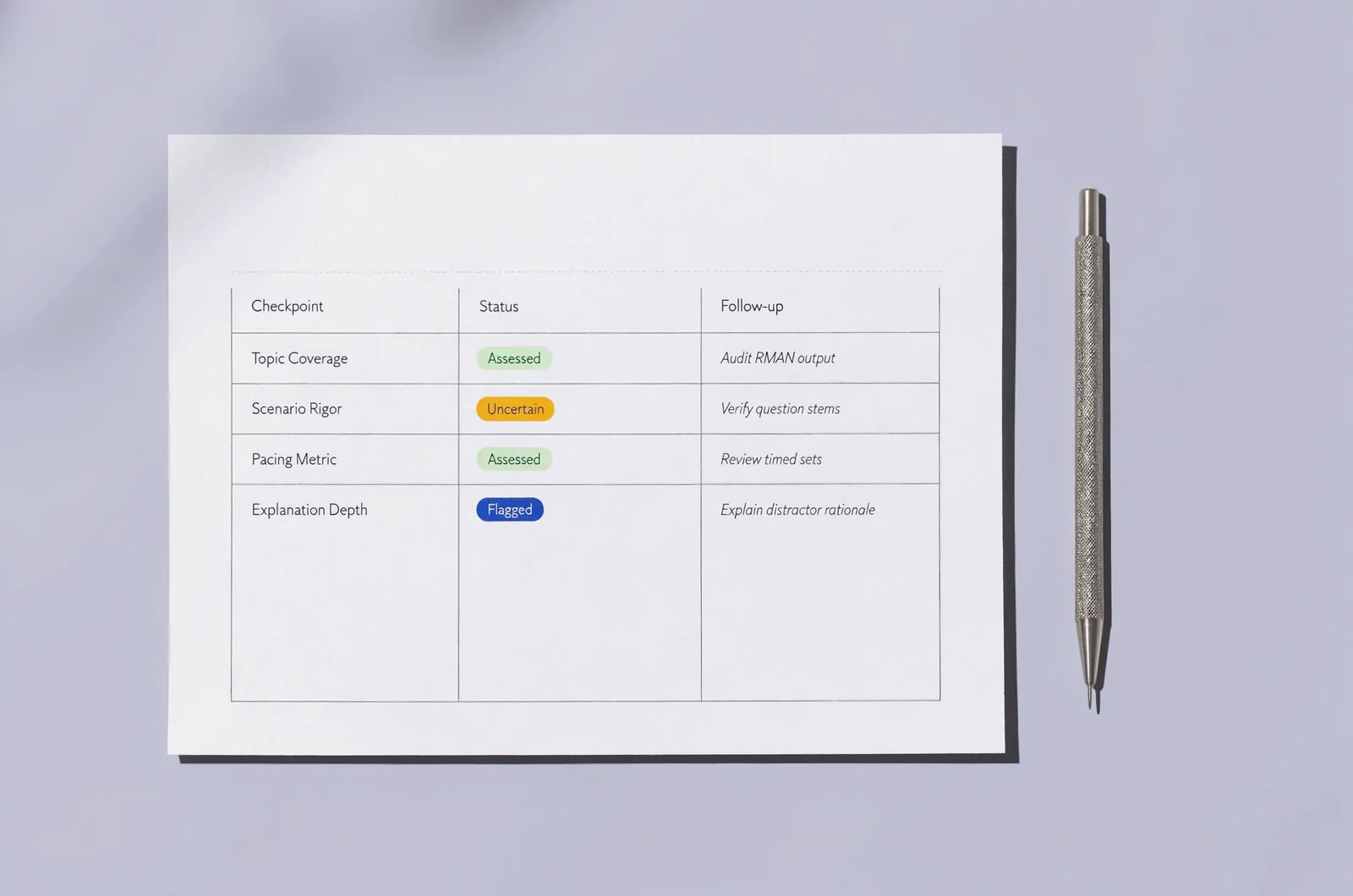
- Confirm the exam code, availability, objectives, and registration requirements against Oracle’s current information.
- Mark each verified objective as assessed, uncertain, or unassessed.
- Explain missed answers and correct guesses without copying the supplied rationale.
- Identify the starting conditions and requested outcome in unfamiliar scenarios.
- Complete fresh timed practice with a deliberate budget for longer questions and review.
- Give every remaining weakness a specific study task and a realistic completion date.
Each item needs a visible result. A saved objective map, an independent explanation, or a completed timed session gives you something concrete to review.
Decide what the remaining gaps mean
Booking may be reasonable when your coverage is broad, your reasoning holds on unfamiliar items, and the remaining work fits the time available. Treat that as a personal planning judgment rather than a prediction of your result.
An unassessed objective or unresolved technical misunderstanding needs attention before a reassuring overall score can settle the decision. Choose another practice session if the evidence is still thin.
A useful interactive readiness checklist would store objective status, uncertainty, timing notes, and the next study task. It could highlight unfinished checks without estimating a probability of passing.
If you already have a date, work backward from it. Assign remaining tasks to actual study sessions and confirm that each task has time for both learning and reassessment.
Resolve the remaining 1Z0-083 booking doubts
These questions help clarify what your sample results can support before you commit to an exam date.
How many samples establish readiness?
Use coverage and independence to judge the evidence. A sample set is useful when it reveals how you handle the objectives it actually addresses.
Continue with additional material where coverage is missing. Repeated versions of one narrow question type won’t resolve an unassessed objective elsewhere in your plan.
What if you recognize nearly every answer?
Set those items aside for learning and use unseen questions for assessment. Before viewing choices, state the likely action and explain what condition supports it.
If fresh items are limited, vary a stated condition as an exercise and check your reasoning against appropriate documentation. Record those exercises separately from fresh-question scores.
Do you need a perfect practice score?
A perfect score isn’t a requirement proposed by this checklist. Examine the mistakes behind your result and the conditions under which you achieved it.
Repeated misses on one objective call for targeted work. Uncertain answers deserve review even when they receive credit. Use your next session to resolve the weakest part of the record.
Can a free sample set support a booking decision?
It can contribute evidence about the questions it contains and the quality of their explanations. Its value depends on coverage, difficulty, and whether the answers were unfamiliar.
Finish your decision with the objective map, fresh practice results, and completed repair tasks available for review.
Apply the readiness checks to Security+ study
Try the free sample questions, then create a free account or purchase full access or a membership for the exam they are preparing for. Get started |  |