Free Security+ Practice Test by Domain: Checks Before You Book
By PrepHoot Editorial Team· (updated Oct 3, 2026)

You don't need another 40-hour video course to know whether you're ready for SY0-701. You need a security+ practice test domain breakdown that tells you, with numbers, where you stand in each of the five exam domains before you spend $425 on a voucher. This checklist walks you through that audit using free, domain-filtered practice sets: how many questions to run per sitting, what to expect from performance-based questions, how to pace a timed session, and the score band that says it's time to schedule the real exam.
The five SY0-701 domains and what their weights mean for your practice time
Everything in this audit hangs on the official domain weights, so start here. SY0-701 has been the live exam since November 2023, and its five domains carry these shares of the scored content:
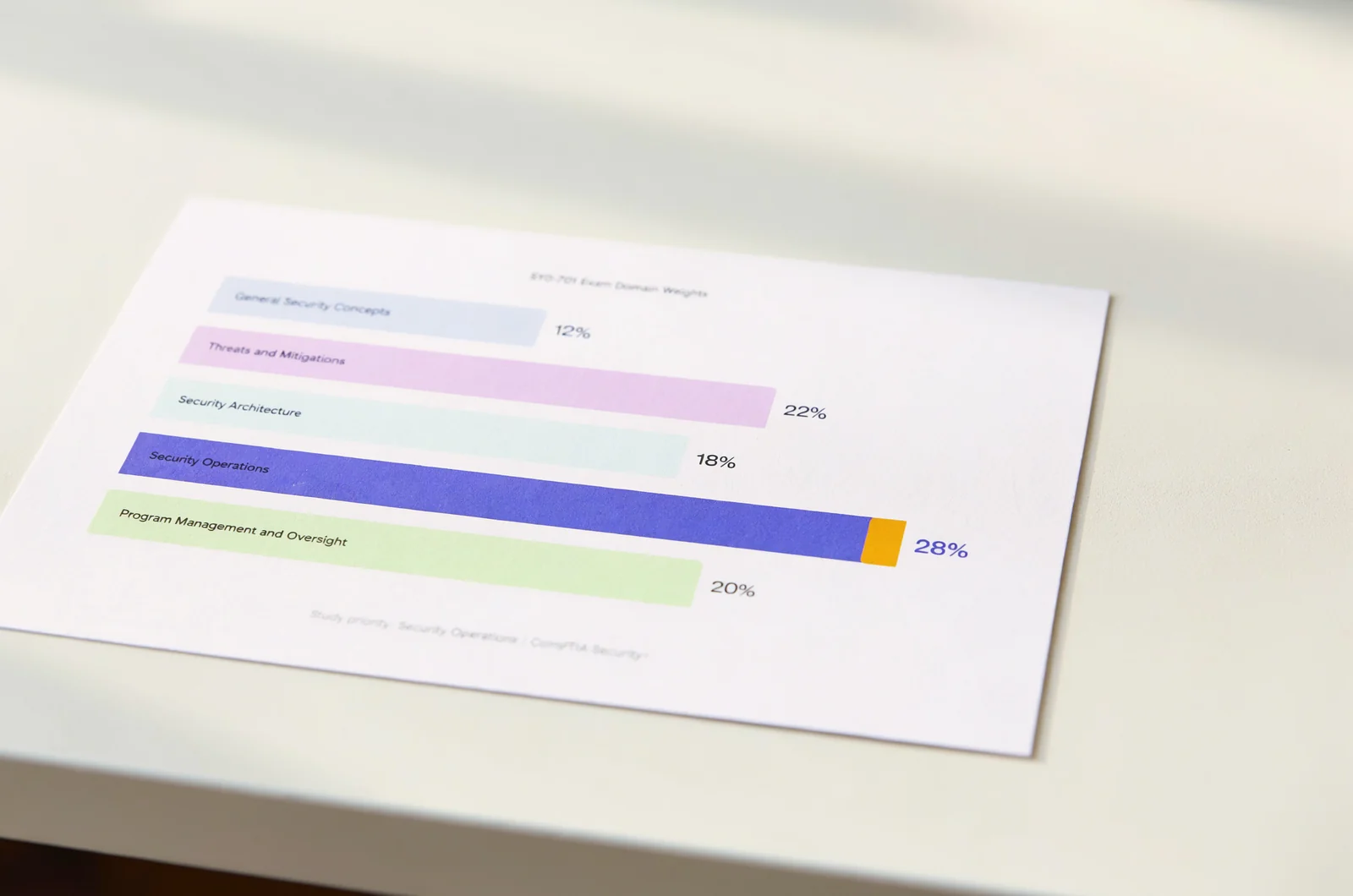
| Domain | Name | Weight |
|---|---|---|
| 1.0 | General Security Concepts | 12% |
| 2.0 | Threats, Vulnerabilities, and Mitigations | 22% |
| 3.0 | Security Architecture | 18% |
| 4.0 | Security Operations | 28% |
| 5.0 | Security Program Management and Oversight | 20% |
The exam itself allows a maximum of 90 questions in 90 minutes, mixing multiple-choice items with performance-based questions, and the passing score is 750 on a 100–900 scale, as summarized in Training Camp's free SY0-701 practice test guide.
Two implications matter for practice. First, Domains 4 and 2 together account for half the exam. If your study hours don't reflect that split, your practice scores will flatter you. Second, Domain 1 at 12% is the classic over-study trap. It sits at the front of every textbook, so it feels safe, but grinding CIA triad definitions past competence buys you almost nothing on exam day. A FlashGenius practice resource that organizes more than 1,100 free SY0-701 questions by these same five domains is a good example of how weighting-aware question banks are structured, and it's the structure your own routine should copy.
A rough time allocation that mirrors the weights: for every 10 practice hours, spend about 3 on Security Operations, 2 each on Threats and Program Management, just under 2 on Architecture, and 1 on General Security Concepts. Adjust only after your practice data says otherwise.
Check that your question source actually matches SY0-701
Before you trust any score, audit the question bank itself. Plenty of free sets floating around were written for SY0-601 or earlier, and their scores are misleading because the blueprints differ. Run these checks once, before your first timed session:
- Confirm the set says SY0-701 explicitly, not just "Security+ 2026" or "latest version." Current material should map to the five domains above, including Program Management and Oversight, which didn't exist as a standalone domain in older versions.
- Spot-check ten questions against the official objective list. If you see legacy topics like telecom PBX hardening or outdated acronyms treated as core content, walk away.
- Verify every answer has an explanation that covers why the wrong options are wrong. An answer key without reasoning trains pattern-matching, not judgment.
- Confirm the set lets you filter by domain. A random 100-question shuffle can't tell you that you're at 85% in Architecture and 55% in Operations, and that gap is the whole point of this exercise.
- Check that performance-based question practice exists somewhere in your materials, even if the free multiple-choice set doesn't include it.
Exception note: a small free diagnostic that isn't domain-filtered still has value as a cold baseline on day one. Take it once, record the raw score, then switch to filtered sets for everything after.
Run the per-domain audit
This is the core of the checklist. Work through the domains one at a time, in any order, and treat each as its own mini-exam. Finished state for this section: you have five domain scores, all taken within the same week, under similar conditions.
How many questions per sitting
Aim for 20 to 30 questions per domain session. Fewer than 15 and one lucky guess swings your percentage too much; more than 40 and fatigue starts contaminating the data, especially if you're studying after work. If a domain feels weak, split it into two 20-question sessions on different days rather than one marathon. Two consistent scores beat one heroic one.
For Domain 4 (Security Operations), go heavier because of its 28% weight: two or three sessions totaling 50 to 60 questions before you trust the number. Domain 1 can honestly be cleared with a single 20-question set if you score well.
How to record results
Log three things per session: domain, raw percentage, and the topic of every missed question. That third item matters more than the score. A 70% in Security Architecture where all misses cluster on zero trust segmentation is a fixable problem. A 70% with misses scattered everywhere means the domain needs a full review pass, not a patch.
Keep the log simple. A spreadsheet with date, domain, score, and miss topics is enough, and it becomes your re-test queue in the week before the exam. If you want structure for this step, our guide on practice test result review walks through how to read these numbers before committing to a date.
On PrepHoot, the free sample questions for the Security+ exam are available without payment, and the simulator tags results so you can see per-domain performance instead of a single blended score. Whatever platform you use, per-domain visibility is the feature that makes this audit possible.
Don't skip the performance-based questions
PBQs are where prepared candidates lose points they didn't expect to lose. These items drop you into a simulated environment and ask you to configure a firewall rule, match log entries to attack types, or drag controls into the right architectural zone. They typically appear at the start of the exam, they take longer than multiple-choice items, and partial credit is possible.
Your readiness check here is binary and simple: have you completed at least five PBQ-style exercises under time pressure in the past two weeks? If yes, move on. If no, find them before you do anything else. Reading about PBQs doesn't transfer; the format itself is the skill, because the interface and the partial-credit scoring punish hesitation.
Practical tip that most candidates learn the hard way: if a PBQ looks like it will eat five minutes, flag it, answer the multiple-choice section first, and come back. Practicing that skip-and-return decision is part of pacing, and you can only rehearse it in a simulator that behaves like the real thing.
Prove your pacing with one timed simulation
Domain scores tell you what you know. A timed session tells you whether you can show it in 90 minutes. With up to 90 questions, you have roughly one minute per item, and PBQs will steal several of those minutes.
Run one full-length timed simulation before booking. The finished state looks like this: 90 questions (or the closest your question bank offers), 90 minutes, no pausing, no notes, phone in another room. You're checking two numbers: your score, and your time per question in the final third of the exam. If your accuracy collapses in the last 25 questions, that's a pacing problem, not a knowledge problem, and it's fixable with two or three more timed runs.
PrepHoot's timed mode exists for exactly this rehearsal, and progress saves between sessions so you can resume an interrupted run after work. The distinction between recall training and pacing training matters here too: flashcards build one, timed exams build the other, and conflating them is why some candidates ace every quiz but freeze on exam day. Our piece on flashcards vs timed exams breaks down when to use each mode.
A useful tool idea if you like numbers: a simple readiness estimator that takes your five domain scores, multiplies each by its official weight, and outputs a weighted projected score. Ten minutes in a spreadsheet, and it turns this whole checklist into one defensible number.
The score band that says it's time to schedule
Here's the decision rule. The passing bar is 750 out of 900, which works out to roughly 83% on scored content, though CompTIA's scaled scoring means raw percentages are an approximation.
- Every domain at 80% or higher across at least two separate sessions, plus one timed simulation at 85% or above: book the exam. You're ready, and further grinding has diminishing returns.
- One domain between 65% and 79% with the rest above 80%: two weeks of targeted work on that domain, re-test it twice, then book if it clears 80%.
- Any domain below 65%, or a timed score below 75%: not yet. Book nothing. Go back to the per-domain audit for the weak areas and rebuild.
- Inconsistent scores (88% one day, 66% the next on the same domain): your sample is too small or you're recognizing questions. Use fresh questions you haven't seen before.
One caveat on repeats: re-taking the same 25 questions until you hit 95% measures memorization of that set, not readiness. Rotate question sources, or at minimum wait a week before re-running a set. If you're comparing how candidates split practice time across weighted domains, our article on domain practice split mistakes makes the same case for AZ-104, and the pattern is identical here.
Questions candidates ask before booking
How many total practice questions should I complete before the exam? There's no magic count, but 400 to 600 unique questions across all five domains, plus at least one timed full simulation, is a defensible range for most intermediate candidates. Quality of review beats raw volume.
Is a 75% average on practice tests enough? Probably not. Because 750/900 approximates to the low 80s, you want a buffer for exam-day nerves and unfamiliar question phrasing. Treat 80% per domain as the floor, not the average.
Do free practice tests reflect the real difficulty? Some do, many don't. The checks in the source-audit section above are how you tell the difference. A free set that's current, explained, and domain-filtered can carry you most of the way; the paid layer mainly adds volume and a realistic simulator.
When should I take the timed simulation? Once you're scoring above 75% in every domain untimed. Running it earlier just measures anxiety, not knowledge.
How far in advance should I book? Book when you hit the ready band, and pick a date two to four weeks out. That window is long enough for a final review cycle and short enough that skills don't decay.
Keep building your exam routine
- How to Review Practice Test Results Before You Retake the Exam
- Flashcards vs Timed Exams Train Recall and Pacing Differently
- How to Review CISA Practice Tests So Missed Questions Stick
Try the free sample questions, then create a free account or purchase full access or a membership for the exam they are preparing for. Get started |  |