Free and Paid ACH-815 Practice Test Picks Ranked by Realism
By PrepHoot Editorial Team· (updated Oct 20, 2026)

You've got ACH-815 on the calendar, an hour or two each evening to study, and a search page full of practice tests that run from free and thin to paid and polished. This guide helps you decide which kinds of practice material deserve your time and money. I score each one on four things: how closely the questions match the real exam, whether the explanations teach you anything, how faithfully the timer and interface copy test day, and what it costs. My usual pairing is one free source to calibrate and one paid, timed bank to rehearse. The sections below show how to pick both.
The four-part score behind these picks
Every option below can earn up to 12 points, three for each criterion. I weight them equally because a cheap bank with sloppy questions and a polished bank you can't afford both waste your evenings.
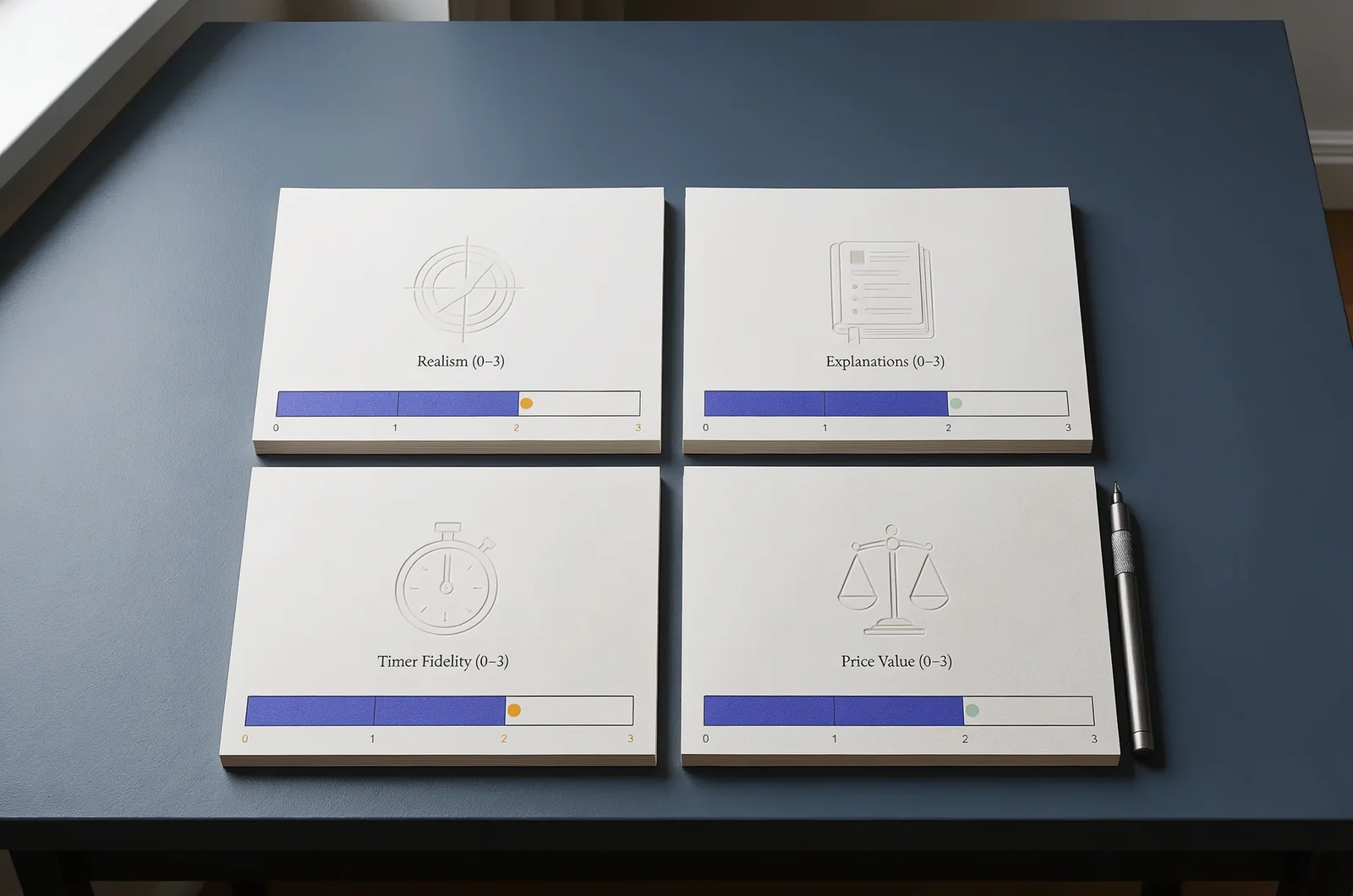
What earns each point
Question realism comes first. An option earns a 3 when its items follow the current objective list, use the same formats as the live exam (single answer, multiple response, scenario-based), and match its difficulty. It earns a 0 when the questions look recycled from an older exam version.
Explanation quality is next. A 3 means every answer says why the right option is right and why each wrong option fails. A 0 means an answer key and nothing else. Wrong-answer reasoning is what turns a missed question into a closed gap.
Timed-mode fidelity measures pacing practice. A 3 means a full-length attempt at the real question count and time limit, with pausing and hints disabled and a flag-and-review screen if the sponsor's exam has one. This breakdown of timed practice exam simulations explains why pacing needs its own practice, separate from flashcard recall.
Price is scored on cost per attempt rather than sticker price. A 3 means a full-length attempt costs little and access lasts long enough to cover a retake.
Two ground rules above the points
First, an option has to rest on original or properly licensed questions. Sites that republish copied live-exam questions are out, because many sponsors prohibit that content in their candidate agreements and the copies tend to trail the current exam version.
Second, I can only score what's public. As of October 2026, I don't have a confirmed objective list for ACH-815 or a verified catalog listing from each publisher named below. The cards therefore describe what each type of option is built to deliver, and the checks that decide whether it earns its points here. Pull the objective list from the exam sponsor's page and keep it open while you judge anything.
Five kinds of practice material, ordered by realism ceiling
The order reflects the highest realism score each type can plausibly reach. It says nothing about any single product. Individual products land lower, and a few land higher than their type suggests, which is why the fifteen-minute check further down exists.
Official practice exam from the exam sponsor
This fits a candidate who wants the closest read on question wording and difficulty and can afford a premium. Official practice exams and training tend to cost more than third-party banks, and cost is a common reason candidates skip them. The standout feature is provenance: the sponsor owns the objective list, so its sample items are the reference every other option gets judged against. The limitation is volume. An official set can be short enough that one or two sittings use it up, so check the question count before paying. My verdict: if the sponsor sells one for this exam, buy it late, three to five days out, as a dress rehearsal rather than your only source.
Paid publisher tests from MeasureUp and Boson
This fits a candidate who wants a dedicated, exam-specific bank and plans to use timed mode seriously. Both publishers sell by the exam, so the cost signal is a per-product price, and cost per full-length attempt is the number to compare. MeasureUp's public listings include Microsoft SC-300 and Cisco 200-301 CCNA practice tests, grouped under vendors such as Cisco, CompTIA, and AWS. Boson's public listings show its ExSim-Max practice exams for exams such as Cisco 200-301 and CISSP, next to its NetSim network simulator.
None of those listings is for this exam, so coverage is the limitation. Both catalogs lean toward networking, security, and cloud certifications, and an exam outside those lists may have no product at all. Search each catalog by exam code before you pay anything. My verdict: if either one lists your exam, price it first among the paid options, because a per-exam product is built for exactly the realism and timer checks above. Ask for a demo or sample before checkout.
Free sample questions from a full question bank
This fits anyone who hasn't bought anything yet, which is the right place to start. The cost is zero up front; the full bank usually sits behind a purchase. The standout feature is that a sample lets you test explanation quality before spending: do the answers explain every wrong option, or only reveal a letter? The limitation is size. A sample is a small slice that can't show how a bank covers every domain, and it says nothing about the timer unless the sample itself runs in a timed mode. Some sites also blur answers or lock explanations behind sign-up, so judge a bank on whether you can read a full explanation for free. For a worked example of reviewing samples before booking, see these 1Z0-083 sample questions. My verdict: always start here, and take samples from at least two banks before you buy from either.
Marketplace practice tests from independent instructors
This fits a candidate on a tight budget who likes hearing an instructor talk through answers. Udemy shows up in search results for practice-test queries, and instructors set their own course prices, so weigh price against question count rather than headline cost. The standout feature is range: some instructors explain at length, and many courses let you preview before buying. The limitation is that nothing enforces a realism standard, so two courses with similar titles can differ wildly. For evidence, check three public signals on the course page: the last-updated date against the current exam version, the number of full-length tests, and whether a preview shows a real explanation. My verdict: a reasonable second source, risky as your only one.
Community question threads
This fits a candidate who wants to see how other people reason through an ambiguous item. ExamTopics is one example, and its pages are organized by vendor and exam, with numbered question threads that members comment on. The cost signal is low, but the real price is the time spent sorting good answers from bad ones. The limitation is trust: a popular comment can be wrong, nothing on the page flags it, and you can't tell where a given question came from. There's also no timer, so pacing practice scores a 0. Treat any thread claiming to hold live exam content as off-limits. My verdict: use these threads after you've read the objective list, as a supplement for debating hard items.
Red flags that cost a bank its realism points
Spot these on a product page and take a point off before you ever open a question:
- No exam version or last-updated date anywhere on the page. If a bank can't say which objective list it follows, assume an old one.
- Questions that test trivia the objective list never mentions, such as exact version numbers or menu paths.
- An answer key with no reasoning, or explanations that only restate the correct option.
- Marketing that promises a pass rate or claims to hold actual exam questions.
- Sloppy item writing, such as a choose-two prompt that accepts only one answer.
Two red flags on the same page is enough to cap a bank's realism score at a 1.
A fifteen-minute test drive before you pay
Run this check on any practice test for this exam, free samples included. It takes about a quarter of an hour.
- Open the sponsor's objective list and write down each domain with its weight, if the sponsor publishes weights.
- Answer ten sample questions and tag each one to a domain. If most land in a single domain, or the mix ignores the published weights, take a point off realism.
- Read the explanations for two questions you got right and two you got wrong. Score a 3 only if every wrong option gets explained.
- Find the timed mode on the product page. Does it set the real question count and time limit, and block pausing? If the page doesn't say, ask the publisher, or leave the score at a 1.
- Divide the price by the number of full-length attempts you can fit before your exam date. That is your cost per attempt.
Add the four scores. My cutoffs: 10 or more is a strong buy, 7 to 9 works as a supplement, and anything under 7 means keep looking.
Say Bank A scores 3 for realism, 2 for explanations, 1 for timer fidelity, and 3 for price, which totals 9. Bank B scores 2, 3, 3, and 1, which also totals 9. When totals tie, break the tie with your biggest risk. If pacing worries you, take the bank with the better timer; if you keep missing the same concepts, take the one with the better explanations.
A cost-per-attempt estimator would speed up step five. You'd enter the price, your exam date, and how many evenings a week you can study, and it would return the number of full-length attempts you can realistically fit and the cost of each.
Building an evening study order from these picks
A six-week order for after-work study
Say you have six weeks and five evenings a week, a hypothetical but common shape for someone working full time. Week one goes to the objective list and free samples from two banks. Weeks two through four go to study mode on one bank, repeating every missed question until you can explain the wrong options out loud. Weeks five and six switch to timed full-length attempts, and the official practice exam, if one exists, lands three to five days before the real one.
Pacing math is simple. Say an exam gives you 90 minutes for 60 questions. That is 90 seconds a question, and your timed attempts will show which question types blow the budget. Retakers can compress the plan: skip to timed attempts, then spend study mode only on the domains your score report flags, if the sponsor's report breaks results down by domain.
If a second exam is on your list, this companion roundup ranks free Salesforce Admin practice exam scenarios by realism too.
One more free-sample source to check
Disclosure: PrepHoot publishes this guide. Its catalog puts free sample questions on every exam page without blurring, its full banks carry explanations on every answer, and access is either a one-time purchase for a single exam or a monthly membership covering several exam slots, which helps when your focus shifts between certifications. It deserves the same fifteen-minute check as everything above. Search the catalog by exam code and see what the sample shows.
Questions candidates ask before paying
Is a free practice test enough?
For learning the format and spotting weak domains, yes. For pacing, only if the free tool runs a timed mode at the real question count. Use free material in week one, then add a paid timed bank when you need full-length rehearsal.
How many practice tests should I use?
Two sources: one for learning in study mode and one for timed rehearsal. A third source tends to add wording you start recognizing instead of concepts you understand.
Do I need timed mode if I already know the material?
Probably yes. Knowing the content and finishing on time are separate skills, and anxiety can push you to rush the second half. One timed attempt a week for the last three weeks shows you where your minutes go.
What score means I'm ready?
No universal number exists, and a third-party score doesn't map onto the sponsor's scoring scale. My rule of thumb is three timed attempts in a row above the sponsor's published passing mark, if there is one, with no domain far behind the rest. No practice test can promise a pass.
Should I trust a site that says it has the real exam questions?
No. Many sponsors forbid sharing live exam content in their candidate agreements, copied sets drift out of date, and they rarely explain answers. A bank built from original questions mapped to the objective list is the safer way to practice.
More guides on practice tests and exam formats
- Everything the 040-444 exam requires: eligibility, fees, and format
- AHM 510 exam questions and answers candidates miss most
- Timed Practice Exam Simulations
Try the free sample questions, then create a free account or purchase full access or a membership for the exam they are preparing for. Get started |  |