Level 1 Certification Requirements: Eligibility and Exam Rules
By PrepHoot Editorial Team· (updated Oct 11, 2026)

A level-1 certification has no universal eligibility requirements, exam length, passing score, or retake policy. Those rules belong to the organization issuing the credential. For an IT professional studying after work, the first task is identifying the exact program: a personal certification exam, a course certificate, an accredited education pathway, or an organizational assessment. This guide explains those differences, gives concrete examples, and shows which requirements to confirm before spending money or booking time off.
Why the Level 1 label needs a full credential name
Level 1 describes a position within a particular program. It doesn’t establish a shared standard across cybersecurity, education, coaching, fitness, and bookkeeping.
Start with the full credential name and issuer. Then identify who receives the result. An individual might earn a certification or course certificate. An education provider might receive accreditation. An organization might complete a security assessment.
These distinctions change the preparation you need. Personal exams call for subject knowledge and the ability to answer questions or complete tasks. Course certificates can add attendance requirements. Accreditation and organizational assessments involve requirements that extend beyond one candidate’s exam performance.
PrepHoot’s catalog spans 145 vendors, which makes the full exam name and code useful search filters. A broad catalog also makes it easy to encounter credentials with similar tier labels. Match the practice material to the actual credential before treating two programs as equivalent.
I’d identify the issuing organization, qualification name, exam code where applicable, and policy version before comparing difficulty or cost. Keep those details together in your study notes. A page that says only “Level 1 requirements” leaves too much unresolved.
What different Level 1 programs require
The programs below show why eligibility and exam rules must stay attached to a named credential. Each example answers a different part of the requirements question.
Google Certified Educator Level 1
Google’s credential concerns using Google tools in an educational setting. Its certification page directs candidates toward an exam guide, task cards, and preparation covering basic use of Google Workspace for Education Fundamentals. Google lists the credential as valid for three years. These details appear on its educator certification page.
Google Certified Educator Level 1 website screenshot for level-1
That subject boundary matters for an IT candidate. Classroom use of Google tools is a different study target from administering an enterprise environment. Confirm the current exam instructions through the registration process before assuming a particular duration, passing score, or retake schedule.
Blue Team Level 1
Centri’s Blue Team Level 1, or BTL1, targets practical defensive cybersecurity skills. Centri states that there are no exam entry requirements; its recommendation of zero to two years of experience describes the intended audience.
Blue Team Level 1 website screenshot for level-1
The package includes a 24-hour practical incident response exam and one free exam resit voucher. Centri also lists four months of access to the training material. These terms appear in its BTL1 requirements and inclusions.
Open entry therefore answers the eligibility question, while the practical assessment answers the preparation question. Plan lab work and an uninterrupted assessment window. Confirm the exam voucher’s deadline separately from the training access period.
IAB LCCI Level 1 Certificate in Bookkeeping
The IAB’s January 2026 specification states that this qualification has no formal entry requirements. Its assessment is a two-hour online examination taken under controlled conditions at approved centers or assessment venues.
IAB LCCI Level 1 Certificate in Bookkeeping website screenshot for level-1
The exam contains 30 questions worth 100 marks. Formats include account preparation, table completion, short written responses, and multiple-choice questions. A pass begins at 60%; merit begins at 75%, and distinction at 90%. The specification permits resits and advises candidates to wait for their previous results before registering again. See the bookkeeping qualification specification.
This is a UK-regulated qualification with international availability through accredited centers. US candidates should confirm local access rather than assume they can book it through their usual IT testing provider.
CrossFit Level 1 Trainer Certificate
CrossFit’s program requires full attendance at its two-day course, passing the test, completing the required agreements, and paying the course and test fees.
CrossFit Level 1 Trainer Certificate website screenshot for level-1
Its course page states that, effective April 1, 2025, the test moved online after the course. The initial test must be completed within eight days following attendance. Candidates who fail have one year from course attendance or two retests, whichever comes first, under the stated retest policy. CrossFit describes these conditions on its course requirements and policies.
The attendance requirement belongs in the booking decision. Passing a test alone would leave part of this certificate’s requirements incomplete.
ICF Level 1 coaching education accreditation
The International Coaching Federation’s Level 1 accreditation applies to a coaching education program. Its requirements include 60–124 coach-specific contact learning hours, observation and written feedback on five coaching sessions, and ten hours of mentor coaching over at least three months.
ICF Level 1 coaching education accreditation website screenshot for level-1
The program must also include a final performance evaluation at the Associate Certified Coach minimum skill level. ICF describes this as a pathway toward the individual ACC credential in its Level 1 accreditation requirements.
A student completing accredited education and a provider obtaining accreditation have different requirements. Identify which outcome you need before interpreting the hours or evaluation rules.
CMMC Level 1 organizational assessment
The Cybersecurity Maturity Model Certification program concerns an organization’s protection of information. The Department of Defense’s Level 1 assessment guide addresses security requirements associated with Federal Contract Information and describes assessment methods that include examining evidence, interviewing people, and testing mechanisms. See the Level 1 assessment guide.
CMMC Level 1 organizational assessment website screenshot for level-1
For an IT employee, the preparation task can involve supporting an organizational assessment. A personal practice-test score cannot establish the organization’s assessment result. Identify the systems and requirements within the assessment scope.
Separate exam eligibility from earning the credential
A candidate can be ready to study while still needing to resolve eligibility or award requirements. Read those conditions separately.
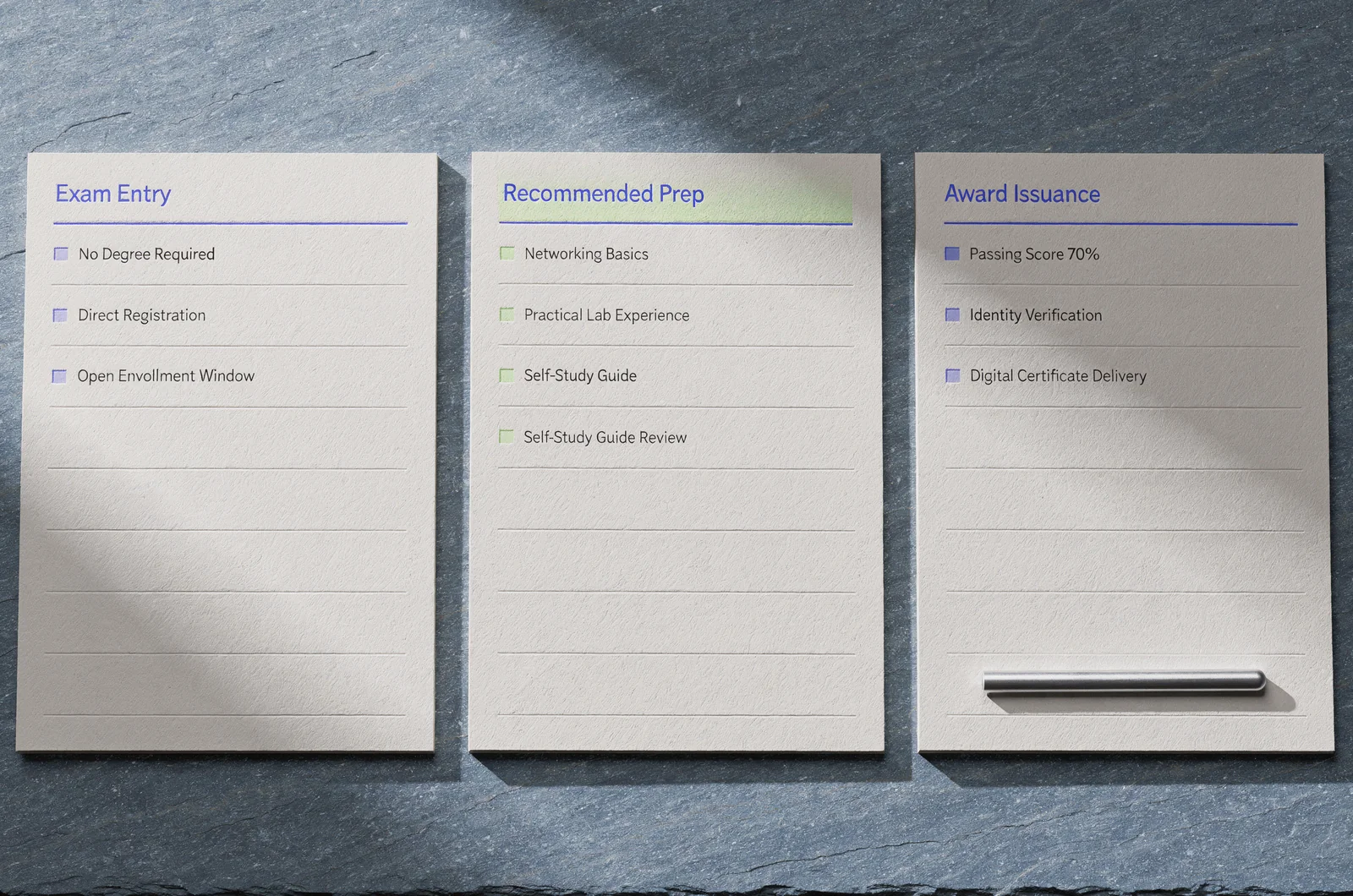
Exam eligibility controls whether you may take the assessment. Credential requirements control whether the issuer will award the qualification. Recommended background helps you judge preparation needs.
The BTL1 example makes the distinction clear: recommended experience and formal entry requirements are separate statements. Treat words such as “recommended,” “required,” and “must submit” precisely.
When reading a program’s rules, establish:
- Whether education, work experience, or an earlier credential is mandatory.
- Whether required training must come from an approved provider.
- Whether experience needs verification or supporting documents.
- Whether requirements must be completed before the exam or before the award.
- Whether your enrollment covers the assessment and credential application.
Use the issuer’s candidate handbook or qualification specification to resolve those questions. A course description can help you understand the intended audience, but it may leave application details unanswered.
For a career changer, “no formal entry requirements” resolves one concern. It doesn’t measure readiness. You still need to compare the assessed tasks with what you can currently do.
If a requirement depends on another person’s approval, allow time for that response. Keep written confirmation with your registration records before paying a nonrefundable fee.
Read the exam clock alongside the question format
The assessment format determines how to practice and how much time to reserve. Duration alone gives an incomplete picture.
The appointment and answering time can differ
Confirm what the published duration includes. Ask whether it covers check-in, instructions, a tutorial, breaks, answering time, or submission.
For a practical assessment, establish when the clock starts and what must be submitted before it expires. For a scheduled exam, check the appointment time zone and arrival instructions. For a post-course test, distinguish the access deadline from the time allowed once you begin.
The Security+ timing discussion provides a separate reading path for candidates preparing for SY0-701. Apply its discussion to that named exam rather than transferring its timing assumptions to every foundational credential.
Questions and practical tasks need different pacing
Practice the response the assessment requires. Multiple-choice questions call for reading, interpreting constraints, and selecting an answer. Written calculations require a method you can complete accurately. Practical investigations require finding and interpreting evidence.
Consider a hypothetical exam with 60 questions and 90 minutes of answering time. The average is 90 seconds per question. That calculation gives a planning baseline; longer tasks will still need a larger share of the time.
For a practical exam, build checkpoints around the work: understanding the task, collecting evidence, checking conclusions, and submitting answers. Confirm whether returning to earlier tasks is allowed.
Use timed practice to discover where your plan breaks down. Record whether you lost time reading, calculating, navigating tools, or reconsidering an answer.
Understand what the passing score measures
The passing rule determines how the issuer judges an assessment. Your practice percentage needs to be interpreted alongside that rule.
For example, the IAB specification gives both a question count and a total mark value. Those figures describe different things. Knowing how many questions you answered correctly won’t necessarily tell you how many marks you earned.
Check whether the handbook describes a percentage of available marks, a scaled score, a performance standard, or separate requirements for different components.
If it uses a scaled score, follow the issuer’s explanation of that scale. Dividing the reported score by the highest displayed number may not produce the percentage of questions answered correctly.
Also establish whether the published threshold applies to the whole assessment or whether particular components must be passed independently. Don’t infer a section requirement from a domain breakdown alone.
A practice result has a narrower purpose: it helps identify weaknesses and measure performance on that practice set. Familiar questions can make the result less informative.
I’d track incorrect answers, uncertain correct answers, and tasks that took too long. For each one, write the reason behind the result. That gives your next study session a specific purpose.
Before setting a readiness target, locate the official passing rule and keep its wording beside your practice results.
Plan retakes, access deadlines, and total cost together
Retake terms affect both your budget and your booking date. Read them before the first attempt.
Separate the waiting period between attempts, the number of permitted attempts, and the deadline for using them. A free resit answers a pricing question. It may leave scheduling and eligibility conditions to another policy.
Training access, lab access, exam vouchers, and retake eligibility can also have separate expiration dates. Put each deadline on your calendar under its own name.
CrossFit’s example shows why this matters: its stated retest limit combines an elapsed period with a maximum number of retests. Centri’s included BTL1 resit is a different arrangement. Neither establishes a universal rule for first-tier credentials.
Build a budget around the actual package. Include mandatory instruction, the initial assessment, any separate application fee, travel where necessary, and a possible retake.
For a hypothetical budget, an exam priced at $150 plus required training priced at $200 creates a $350 starting cost. If another attempt costs $150, the two-attempt total becomes $500. These are illustrative figures, not prices for a named program.
Also check cancellation, rescheduling, and result-release terms. If an employer needs the credential by a particular date, allow time for results and any remaining award requirements.
Save the terms attached to your purchase confirmation.
Build a study plan that matches the requirement
Once eligibility and assessment rules are clear, preparation can focus on the tasks you need to perform.
Use questions to diagnose knowledge gaps
Start with the official objectives or qualification content. Connect each topic to a task you should be able to complete, explain, calculate, or recognize.
For an exam listed in PrepHoot’s catalog, its free sample questions and answer explanations can help identify gaps. Study mode supports reviewing reasoning; timed mode helps assess pacing; flashcards support shorter recall sessions. Choose the mode that addresses the problem your previous session exposed.
The domain readiness checks provide a focused reading path for Security+ candidates. Keep readiness judgments attached to the relevant objectives.
Rehearse the assessed task
Question practice should sit alongside whatever work the assessment demands. For a practical investigation, rehearse finding evidence and explaining your conclusion. For account preparation, complete calculations and review your entries.
If your chosen credential uses scenarios, practice identifying the requirement that controls the answer. The discussion of Salesforce Admin scenario practice is useful for that specific preparation path. Its inclusion here doesn’t classify Salesforce Administrator as a formally numbered Level 1 credential.
An interactive requirements checklist could help candidates keep the administrative work organized. It would record the issuer, exam version, eligibility conditions, assessment format, passing rule, and deadlines, then flag unanswered fields before booking.
Use your available study hours to choose a realistic date. If the plan leaves no time to address the weaknesses found during practice, move the date before committing to the appointment.
Questions candidates ask before choosing a Level 1 exam
The remaining booking questions depend on the named program and the outcome you need.
Can I qualify without a college degree?
Check the formal entry requirements. BTL1 and the cited IAB bookkeeping qualification state that they have no exam entry or formal qualification entry requirements, respectively. Other programs need their own review.
Does passing the exam complete every requirement?
Check the award conditions. CrossFit’s Trainer Certificate also requires course attendance, agreements, and payment. Keep any outstanding conditions visible until the issuer confirms the award.
Do I need Level 1 before taking Level 2?
Read the Level 2 eligibility policy. A numbered sequence alone doesn’t establish a prerequisite. Confirm whether the earlier credential is required, recommended, or one of several accepted routes.
How long should I study?
Base the schedule on the assessed work, your current knowledge, and your available hours. Include review after timed practice. Set the booking date after estimating that work and checking the relevant access deadlines.
Practice exam sections between study sessions
Try the free sample questions, then create a free account or purchase full access or a membership for the exam they are preparing for. Get started |  |