What Does the Section 1 Exam Format Look Like on Test Day?
By PrepHoot Editorial Team· (updated Oct 23, 2026)

The section-1 label alone doesn't establish a question count, time limit, or test-day interface. Those details need a full exam name, provider, and version. If you're preparing around a full-time job, that distinction matters: you need practice settings that match your actual appointment. Below, I'll explain which format details need confirmation, how to interpret them, and how to turn confirmed rules into a workable pacing plan. Any numerical example is hypothetical, rather than a statement about your exam.
Which exam does Section 1 identify?
Section 1 identifies a position within an assessment or study resource; the label alone doesn't identify the assessment itself.
Start with your booking confirmation or exam registration record. Find the full exam title, its provider, and any exam code or version. Then establish whether “Section 1” appears in the provider's exam description or only in your preparation material.
That distinction changes what you should practice. A question bank's first section could be an organizational category. It doesn't establish that your booked exam has a separately timed opening section.
I'd record these details together:
- The full exam name and code.
- The version or syllabus attached to your booking.
- The provider's name for the first section.
- Whether that section has its own timer and submission boundary.
Keep eligibility separate from format. A requirement to qualify for an assessment doesn't tell you how its questions appear on screen.
If your preparation resource and booking use different names, resolve that mismatch before building a timed practice session. Ask the provider which instructions apply to your exact exam code.
How many questions will I answer?
The question total can't be confirmed without identifying the exam and its applicable format rules.
Look for wording that distinguishes a fixed count from a range or maximum. “Up to” a stated number doesn't mean every candidate receives that exact number. Also check whether the figure covers the entire exam or just its first section.
A practice bank's size answers a different question: how much practice material you can access. It doesn't establish the number of questions you'll encounter during your appointment.
For preparation, write down both the confirmed count and its scope. For example, a hypothetical description might give a total for the whole assessment while describing its sections separately. You couldn't safely assign the entire total to the opening section.
Avoid estimating question count from the number of syllabus topics. A content outline describes what to study; it needs an explicit format statement to establish how many items appear.
If the provider gives a range, rehearse more than one count within that confirmed range. Keep the time limit consistent with the instructions attached to each practice setup.
How long does the first section last?
The usable answering time depends on whether the exam assigns a separate section timer or shares time across the assessment.
Confirm that distinction before calculating a per-question allowance. A total appointment duration isn't enough to establish how long you'll have for questions.
Check what the published duration includes. Look for separate instructions covering check-in, tutorials, agreements, breaks, and answering time. Don't subtract or add minutes based on another certification's rules.
If the opening section has its own timer, plan within that boundary. Finishing it early doesn't establish that unused minutes transfer elsewhere. If the exam uses a shared timer, your first-section pace needs to leave enough time for the remaining work.
I'd keep a short timing note beside the exam details:
- The answering time available.
- Whether the timer applies to one section or the whole exam.
- What happens when it reaches zero.
- Whether any permitted break affects that timer.
Use those confirmed values in practice. If you still can't distinguish appointment length from answering time, ask the provider specifically which duration the on-screen countdown represents.
Will I take the exam online or at a testing center?
Your booking and the provider's delivery instructions determine where and how you'll take the exam.
A browser-based practice session doesn't establish that the real assessment supports remote delivery. Likewise, an exam title alone doesn't confirm that a particular delivery option is available for your appointment.
For a remote booking, check the stated device, software, workspace, identification, and check-in requirements. Follow the provider's instructions for any equipment check. Don't assume a work laptop permits the required software.
For a testing-center booking, confirm the location, arrival instructions, identification requirements, and rules for personal belongings. Save the appointment details somewhere you can access during travel.
Delivery also shapes your rehearsal environment. If your confirmed rules prohibit personal notes or a second screen, practice without those aids. Use only tools the instructions explicitly permit.
Keep access problems separate from question strategy. Identify the provider's approved support process before the appointment so you know how to report a connection, software, or workstation issue.
What kinds of questions should I prepare to handle?
Prepare for the item types listed for your exact exam; no particular mix is established by the Section 1 label.
Read the response instructions as carefully as the subject matter. Knowing a concept won't help if you submit the wrong number of selections or overlook a required interaction.
Your rehearsal should reflect each confirmed item type:
- For single-answer questions, practice choosing one response that satisfies the stated requirement.
- For multiple-response questions, check whether the instructions specify a selection count.
- For matching or ordering tasks, practice the required relationships or sequence.
- For scenarios or practical tasks, identify the requested outcome before working through the details.
These are conditional preparation examples, rather than a confirmed inventory for your exam.
A long question also deserves a different reading approach from a short definition. In a scenario, identify the task, constraints, and relevant evidence before weighing the answers. Avoid importing assumptions that the question doesn't provide.
Use provider-issued examples, when available, to establish the expected interaction. Record any format you haven't practiced so your next session addresses that specific gap.
Can I skip questions, change answers, or return to earlier screens?
You can rely on those actions only when the exam's navigation rules explicitly permit them.
Treat navigation as part of preparation. A flag button, review screen, or back button in a practice tool doesn't establish that the real assessment includes the same control.
Confirm whether you can:
- Leave a question unanswered and continue.
- Change a response before submission.
- Return to an earlier question within the section.
- Reopen a section after leaving it.
- Review flagged or unanswered items before finishing.
Each answer affects pacing. If returning is permitted, you can rehearse an initial attempt followed by targeted review. If movement is forward-only, practice making a complete decision before advancing.
Submission boundaries deserve particular attention. Read any message that says you are finishing a section or submitting the assessment. Don't treat it as another routine navigation screen.
Before a timed rehearsal, write a simple navigation rule above your notes, such as “review within this section only,” if that matches the confirmed instructions. Then follow it throughout the session.
If you're unsure whether a control saves an answer, advances the screen, or submits work permanently, resolve that question through the official instructions or approved support channel.
How should I divide my time per question?
Calculate an average from the confirmed answering time and question count, then adjust it for the permitted review process.
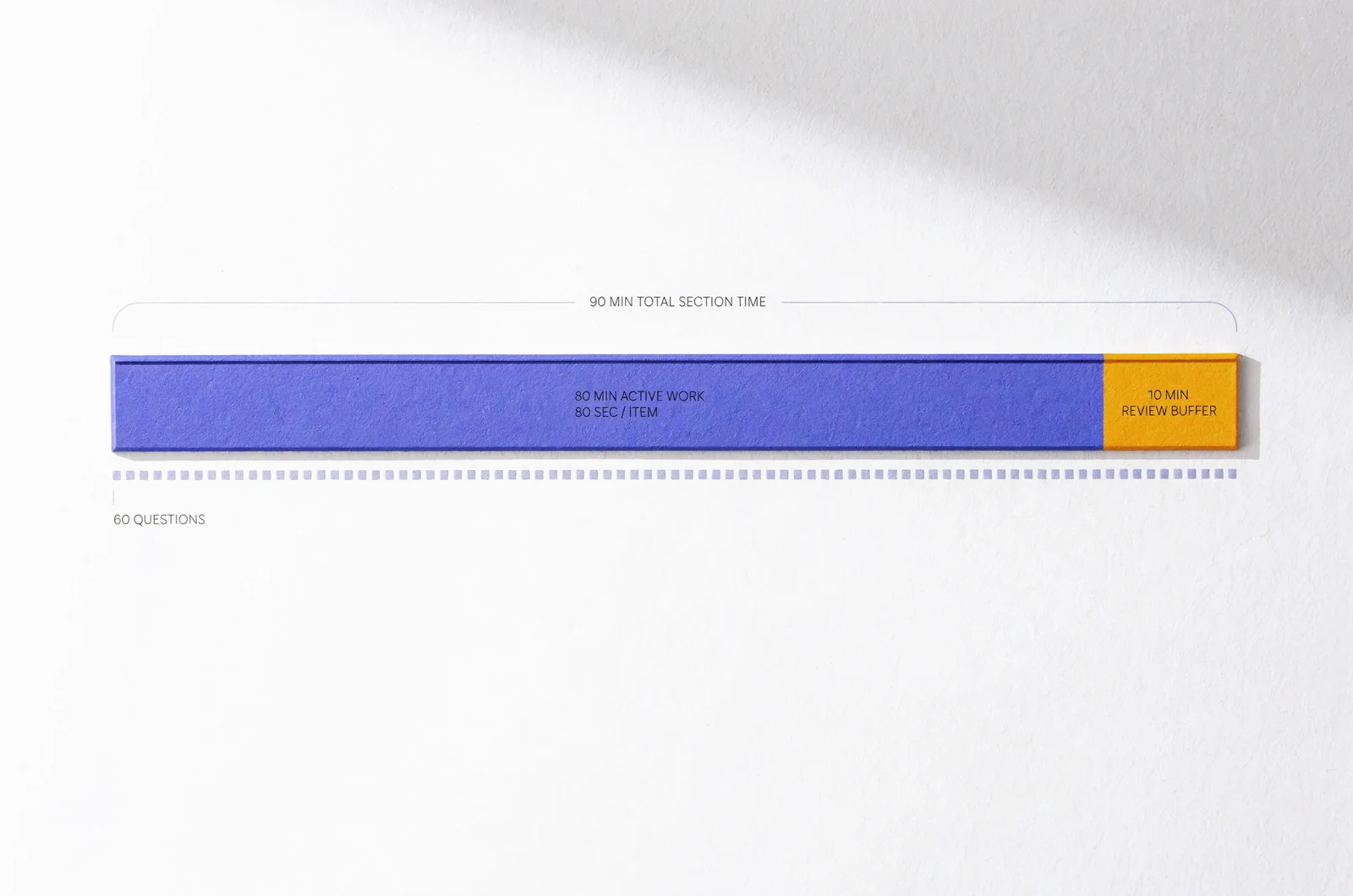
A useful starting formula is:
Working seconds per question = (answering minutes − review minutes) × 60 ÷ question count
For a hypothetical section with 60 questions, 90 answering minutes, and a 10-minute review allowance, you'd have 80 working minutes. That equals an average of 80 seconds per question.
Those figures illustrate the calculation. They aren't confirmed exam specifications.
Use the average as a checkpoint rather than a deadline for every item. In that hypothetical session, reaching question 30 after about 40 working minutes would put you near the planned pace.
Some questions may take less time; others may need more. Watch whether a difficult item consumes time without producing a clearer decision. Apply your skip-and-review strategy only if returning is allowed.
If the exam prevents returning, allocate all usable time according to that restriction. A review reserve you cannot use would distort the plan.
A useful pacing calculator would accept question count, answering minutes, review allowance, and return permissions, then generate progress checkpoints.
For more practice context, compare flashcards and timed exams when deciding whether a session should train recall or sustained answering speed.
How closely should a simulator match the real exam screen?
Match the simulator's timing and interaction rules to the confirmed exam requirements wherever its settings permit.
Visual familiarity can help you rehearse controls, but appearance alone doesn't establish that a practice interface reproduces the official assessment.
PrepHoot has study, timed, and flashcard modes. Those modes support different practice tasks: working through explanations, rehearsing under a timer, and reviewing recall. Their availability doesn't confirm the real exam's navigation or delivery rules.
For a useful rehearsal, check the settings that affect your decisions:
- The number of questions in the session.
- The time available to answer them.
- Whether explanations appear during answering.
- Whether you permit yourself to revisit items.
- Which notes or aids you allow yourself.
If a simulator permits an action your exam prohibits, impose the real restriction yourself. For example, stop using the back control during a rehearsal for a confirmed forward-only format.
Don't estimate your official score from interface similarity. Keep a practice score attached to its session settings, and use it to identify material or timing decisions that need another attempt.
What happens when the first section ends?
The transition depends on the exam's submission, break, and progression rules, so confirm what leaving the section actually does.
Look for instructions that answer three separate questions: does the section close permanently, does the timer continue, and can you take a break at that point?
Don't assume that an end-of-section screen grants permission to leave your seat. A progress message and an authorized break are different instructions.
Also establish what happens to incomplete work. Follow the provider's stated scoring and submission rules rather than general advice about guessing. Without those rules, you can't reliably judge the consequences of an unanswered item.
During practice, rehearse the transition as well as the questions. If the official format includes a final review screen, practice checking the information it makes available. If returning is prohibited, finish your decision before crossing the boundary.
Results are another detail to confirm separately. Completing a section doesn't establish that you'll immediately see a score or explanation.
Write down the action that ends the section and the consequences attached to it. Read that note before your next full-format rehearsal.
How can I rehearse the format after work?
Use short sessions with a defined purpose, then schedule a longer rehearsal when you have enough uninterrupted time.
A hypothetical 30-minute session could include 10 minutes of untimed reasoning, 15 minutes of timed questions, and five minutes of review. That allocation is a study example, rather than a recommended exam timing rule.
During untimed work, explain why your selected answer meets the question's requirement. During timed work, apply the navigation and aid restrictions you've confirmed. Keep explanations closed until that timed portion ends.
PrepHoot's answer explanations can support the review portion. Use them to examine your reasoning and identify what to study next.
Separate errors by their cause:
- You didn't know the underlying concept.
- You overlooked a condition in the question.
- You misunderstood the required response.
- You spent too long without reaching a decision.
Choose the next practice activity from that cause. A knowledge gap calls for study; a missed selection instruction calls for closer attention to item wording.
Short sessions let you rehearse individual skills. Reserve a longer session to check whether your pacing remains workable across the confirmed section length.
Which format details should be settled before test day?
You should have a written record of the exam identity, question format, timing, delivery, and navigation rules.
Keep it brief enough to review without reopening every preparation resource. Include the provider's instructions or booking record beside each detail so you can resolve conflicting information.
Your record should answer these questions:
- Which exam code and version am I taking?
- Is the first section separately timed?
- What question count or range applies?
- Which item types are confirmed?
- Can I skip, revisit, or change responses?
- What happens when I submit the section?
- Which breaks and aids are permitted?
- How do I report a technical problem?
Leave an unresolved field visibly marked rather than filling it with an assumption. Prioritize questions that change your rehearsal settings, such as whether returning to earlier items is allowed.
Use your final practice session to follow those confirmed rules from start to finish. Afterward, adjust one specific behavior that caused difficulty, such as repeated rereading or excessive time on an uncertain answer.
Before the appointment, recheck the instructions attached to your booking for any format detail that remains unresolved.
What about Level 1 requirements and Section 2 practice?
Try the free sample questions, then create a free account or purchase full access or a membership for the exam they are preparing for. Get started |  |