DES-1241 Free Practice Test Picks Compared by Question Depth
By PrepHoot Editorial Team· (updated Oct 22, 2026)
A DES-1241 free practice test should help you understand the reasoning behind a storage decision. For an administrator studying around a full-time job, the useful choices are short recall quizzes, explained scenario sets, and timed practice. Each addresses a different problem. If you're studying PowerStore implementation material, question depth deserves particular attention: can you explain why an answer fits the stated requirements? I’d choose a practice format around that question before considering the size of a paid bank.
Match the sample to the exam you plan to take
A free storage practice set earns consideration only after its stated coverage matches your intended exam.
Start with the exact exam code and the current certification information from the exam owner. Compare that information with the practice page’s description. Confirm availability before making a study purchase or setting an exam date.
A familiar product name provides too little detail by itself. A sample might discuss storage administration broadly while giving you little evidence about the particular assessment you intend to take.
Look for enough information to answer these questions:
- Which exam and version does the resource identify?
- Does it explain which objectives its questions address?
- Can you inspect complete questions and explanations?
- Does it distinguish sample access from the full product?
- Can you identify a publication date or meaningful update history?
An update date deserves a closer look. Read the sample for terminology, assumptions, and references that match the material you’re studying. A recently changed page date alone cannot establish that its questions were revised.
Current availability and question quality for individual providers aren’t established here. The picks below therefore compare practice formats and the evidence each should provide. Treat any claim of complete coverage as something to verify against the current objectives.
Three free practice formats compared by depth
The strongest free practice choice depends on whether your immediate gap is recall, reasoning, or pacing.
Use this table to match the sample’s design with your study need. These are format recommendations; individual resources may combine several formats.
| Practice format | What to inspect | Best fit | Main limitation |
|---|---|---|---|
| Short recall quiz | Precise wording, clear answers, identifiable topics | Finding terminology and concept gaps | Gives limited evidence about implementation reasoning |
| Explained scenario set | Relevant constraints, plausible alternatives, useful rationales | Practicing storage decisions | A small sample cannot establish broad coverage |
| Timed mixed-question set | Answer visibility, session controls, review process | Rehearsing pace and question handling | Timing reveals little about explanation quality |
Short recall quizzes for finding knowledge gaps
Choose a short recall quiz when you need to identify concepts that require review.
Questions about a term, component, or stated requirement can help you organize a study session. Their value is diagnostic: an incorrect answer gives you a topic to revisit.
Inspect the wording carefully. A question should contain enough information to support its answer. If two choices could reasonably fit, the explanation should identify the condition that separates them.
The limitation is depth. Recognizing a definition gives you limited evidence about whether you can apply it during an implementation scenario. Repeating a familiar quiz also makes its score harder to interpret.
For this format, I’d favor a small set with clear wording and useful explanations over a larger answer-only list. After answering, explain the concept without looking at the choices. If you can only remember the answer’s position, record the topic for further study.
Explained scenario sets for practicing storage decisions
Choose an explained scenario set when your main difficulty is deciding what to do with the information in a question.
A useful scenario gives you a situation, relevant constraints, and a specific decision. The explanation then connects those details to the answer.
For implementation practice, inspect whether the question makes its assumptions clear. Does the task concern planning, configuration, validation, or troubleshooting? Does the proposed answer belong at that stage?
Plausible alternatives matter. Several choices may sound reasonable in general, while only one addresses the requirement in the scenario. The explanation should resolve that distinction.
The limitation is coverage. A handful of thoughtful questions can demonstrate writing quality, but it cannot establish the balance or depth of an entire bank.
This is the strongest format to prioritize when you know the terminology but struggle to justify an answer. Select it when the free sample explains both the chosen response and the closest alternative.
Timed mixed-question sets for rehearsing pace
Choose a timed set when you want to observe how you handle questions within a fixed session.
Inspect the controls before judging realism. Can you move between questions? Is feedback hidden until review? Can you inspect missed questions afterward? Check each function directly rather than inferring it from a simulator label.
A countdown alone provides a narrow form of practice. Question quality, feedback timing, and review controls affect what you can learn from the session.
Avoid assuming that a practice interface reproduces the actual exam interface. That requires specific evidence.
The limitation is diagnostic detail. A total score may combine knowledge gaps, misreading, and unfinished questions. You need a review process to separate them.
The distinction between flashcards and timed exams can help you choose between recall work and pacing practice. Use a timed set when you have a clear plan for reviewing the result.
An explanation should resolve the storage tradeoff
Question depth becomes easier to compare when you inspect what the explanation teaches after an incorrect answer.
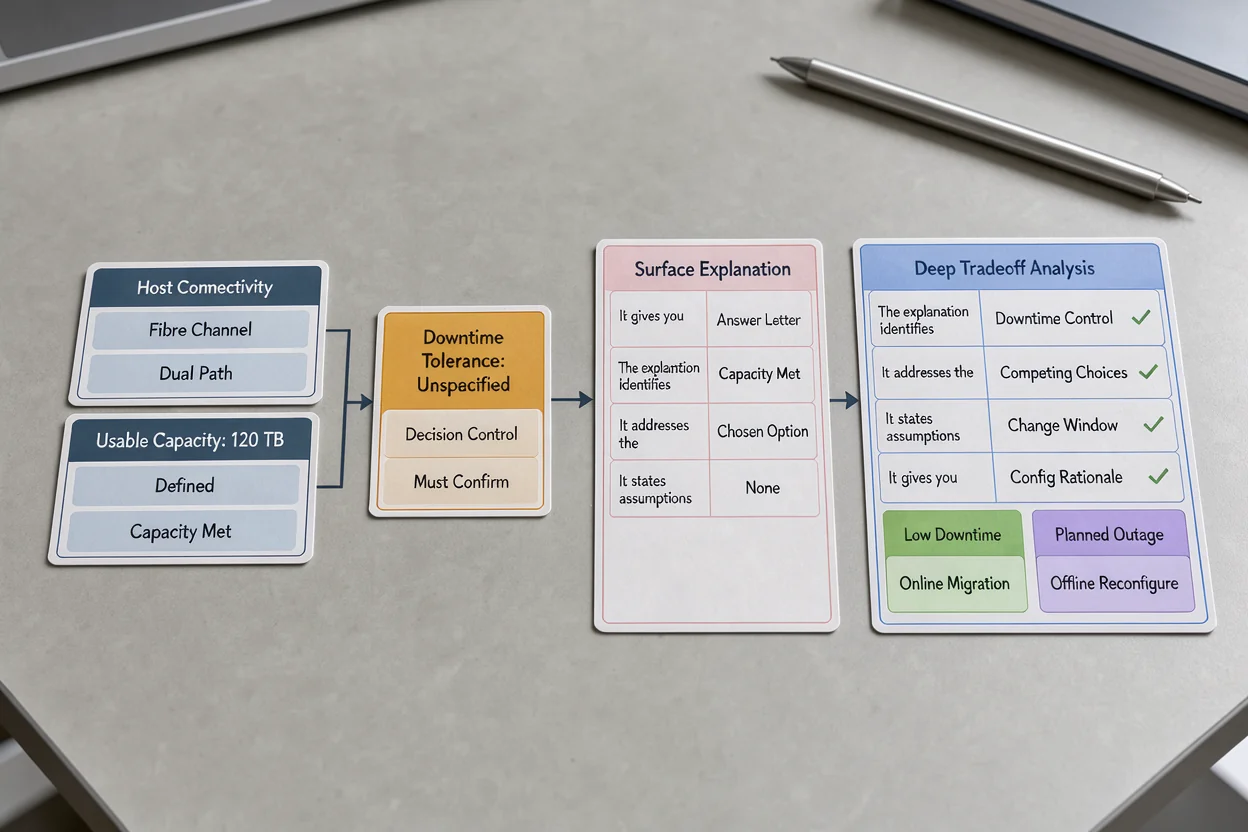
An answer letter gives you a result. A useful rationale shows which requirement controls the decision and why another plausible response falls short.
Compare two versions of a hypothetical implementation question
Imagine an application team preparing for a storage change. It has supplied capacity estimates and host information, but its acceptable downtime has not been agreed.
A shallow question could ask you to identify a configuration term. That might reveal a vocabulary gap, but it leaves the planning decision untouched.
A deeper version could ask what needs clarification before the implementation plan is finalized. Its explanation should connect the missing downtime requirement with the decision the administrator must make.
The alternatives should be credible. Completing an inventory or drafting a configuration plan may be reasonable tasks. The rationale needs to explain why the unresolved requirement takes priority in this particular situation.
This is a hypothetical illustration of question design, not an official exam item. It demonstrates what to inspect: relevant facts, a defined task, and reasoning that connects them.
Look for reasoning that survives a changed scenario
A strong explanation should help you answer a nearby question with different conditions.
After reading a rationale, change one detail mentally. Suppose the missing requirement is now confirmed. Would the same answer still fit? What information would become decisive?
You don’t need to invent another full question. Identify the condition that would make a competing answer appropriate.
Compare samples using these checks:
- The explanation identifies the requirement that determines the answer.
- It addresses the closest competing choice.
- It states assumptions that affect the decision.
- It gives you a specific concept or procedure to review.
These question practice strategies provide a useful structure for reviewing difficult items. For each miss, write down the overlooked condition and the reason your chosen answer failed.
Free access and exam rehearsal are separate checks
A free sample can demonstrate question quality without giving you enough material or controls for a full rehearsal.
Compare those two benefits separately. Otherwise, a polished interface can influence your judgment before you have examined the explanations.
Establish what you can inspect without paying
Check whether the free portion includes complete questions, answer choices, and explanations. A preview that hides the rationale leaves a major part of the product unexamined.
Also establish what happens after you finish. Can you review your answers? Does another attempt repeat the same set? Is an account required to save progress?
These details affect the sample’s usefulness during short evening sessions. Repeated access may be convenient, but repeated questions also become familiar.
Keep your judgment proportionate to what you can see. A complete free sample supports a judgment about those items. The quality of the remaining bank remains a separate question.
Before considering payment, identify which parts of the learning experience you have actually inspected.
Check whether the session supports your pacing goal
If pacing is your concern, inspect how the session handles time and feedback.
Decide what you want to observe: time spent interpreting a scenario, hesitation between two choices, or the effect of returning to skipped questions. Then check whether the platform supports that activity.
Keep the practice duration separate from the official exam duration. Use confirmed exam information when planning a full rehearsal.
A useful tool idea is a practice-format selector with three inputs: difficulty recalling concepts, difficulty explaining decisions, and difficulty finishing sessions. Its output could recommend recall review, explained scenarios, or timed practice. It should state that these recommendations concern study format and cannot predict an exam result.
For your next session, choose one pacing behavior to observe and record it alongside the score.
Spend according to the gap in your preparation
The free-versus-paid decision should follow a specific learning need that the free material cannot meet.
A larger bank may be useful, but question count alone gives you little basis for choosing it. Compare the paid capability with the problem you need to solve.
Continue with free material while it answers your questions
Staying with a free sample is reasonable when it still exposes concepts you need to study and provides explanations you can use.
Work through an item, review the relevant material, and explain the decision again without the answer choices. That creates a concrete task from each mistake.
The sample becomes less useful as an assessment once you remember its wording and answers. You may still use it for review, but treat later scores as performance on familiar material.
If your budget is tight, identify the unresolved gap before adding another resource. It might be broader topic coverage, unfamiliar scenarios, saved review history, or a suitable timed mode.
Write that gap down before comparing purchase options.
Require the paid option to address that gap
PrepHoot is a later option to consider for this comparison. Its platform includes free sample questions, answer explanations, and study, timed, and flashcard modes.
Those platform details do not establish the depth or current coverage of a particular exam bank. Inspect the exact sample and confirm the relevant listing before treating it as a suitable choice.
Apply the same standard to every platform. If you need better explanations, additional answer-only questions leave the original problem unresolved. If you need pacing practice, check the session controls before purchasing.
The broader discussion of exam preparation budgets can help frame the spending decision, although another exam’s costs do not establish costs for this one.
Choose paid access only after naming the capability you need and confirming that the product includes it.
Questions to settle before trusting a practice score
A storage practice score becomes more useful when you know which questions were unfamiliar and why errors occurred.
Use these questions to decide what the result can reasonably tell you.
Is a short free sample enough to assess readiness?
A short sample provides limited evidence about readiness.
It can reveal confusing concepts, weak explanations, or difficulty interpreting a scenario. It cannot establish broad coverage simply because you answered every item correctly.
Separate your first attempt from later attempts. Then compare the topics represented in the sample with the objectives you need to study. Record gaps in coverage as unknowns rather than assuming they are strengths.
Should a high score outweigh weak explanations?
Weak explanations make the score harder to use.
You may have selected the expected answer through reasoning, recognition, elimination, or a guess. Without a useful rationale, resolving that uncertainty takes additional work.
For an item you answered correctly, explain why the closest alternative fails. If you cannot do that, mark the topic for review despite the correct answer.
Can timed practice replace scenario review?
Timed practice and scenario review answer different questions.
A timed session lets you observe completion and question handling. Reviewing a scenario lets you examine the reasoning behind a choice.
If you finish comfortably but struggle to explain answers, prioritize detailed review. If you can explain the decisions but leave items unfinished, examine where time goes during an unfamiliar set.
After each session, classify your misses as a knowledge gap, an overlooked condition, or a pacing problem. Choose the next practice format from that record.
Compare question design across other certifications
- Free and paid ACH-815 practice test picks ranked by realism
- Free Salesforce Admin practice exam scenarios ranked by realism
- Timed Exam Simulators
Try the free sample questions, then create a free account or purchase full access or a membership for the exam they are preparing for. Get started |  |