Review Practice Test Results and Turn Misses Into a Study Plan
By PrepHoot Editorial Team· (updated Nov 10, 2026)

If you're working out how to review practice test results before your first certification attempt, start with the answers you couldn't explain. This walkthrough turns one finished practice test into an error log, a ranked list of weak objectives, and a study schedule for the next seven days.
Keep your results, question explanations, and the official objectives for your exact exam code and version nearby. Use a spreadsheet or notebook to capture the review. Export results if your practice platform supports it; otherwise, record the details manually.
Work through the steps below before starting another full test. Your finished plan should connect each priority weakness to a specific study task, a calendar block, and a way to check improvement. If you're short on time tonight, save the results and mark uncertain answers first. Continue the detailed review in your next session.
This guide focuses on preparing for a first attempt. If you've already taken the certification exam unsuccessfully, use the retake review guide for that situation.
1. Save the score and the conditions behind it
Record enough context to understand what your practice score represents. A result from an interrupted session needs different interpretation from a completed, timed attempt.
Before changing modes or starting another attempt, capture:
- The practice test name, exam code, version, and completion date.
- Correct answers, total questions, and unanswered items.
- Domain results, including question counts where available.
- Time allowed, time used, and any pauses or interruptions.
- Whether you checked notes, explanations, or other resources.
- Whether you recognized questions from earlier practice.
Keep reported results separate from your own observations. For example, a domain percentage belongs in the results column. Your note that you rushed the final questions belongs in a conditions column.
If your platform shows only an overall percentage, work from the individual questions you can review. Leave unavailable domain totals blank. A blank field is more useful than an invented estimate.
Save a copy of the report or write down the totals. Then confirm that the objective document matches the exam version you're preparing for. If the versions differ, resolve that mismatch before using the results to allocate study time.
2. Separate solid answers from lucky guesses
Review correct answers as well as misses. Your study plan needs to account for answers you selected without understanding the reason.
Assign each reviewed question to one of three groups:
- Correct with a clear explanation: you can identify the deciding detail and explain your choice.
- Correct but uncertain: you guessed, recognized wording, or couldn't distinguish the final two options.
- Incorrect or unanswered: your selection was wrong, or you left the item incomplete.
I recommend keeping guessed correct answers visible throughout the review. They earned points on this attempt, but they still need a follow-up check.
Try explaining your choice before opening the answer explanation. State which detail in the question mattered and why the closest alternative didn't fit. If you can only recall the answer's position, mark the item uncertain.
Don't invent a precise confidence rating after the fact. If you can't remember whether you guessed, write confidence unknown. Review the explanation and check the concept with a different question later.
Your working list should now contain every incorrect item, every unanswered item, and every uncertain correct answer. Keep the original score unchanged. Add uncertainty as a separate measure so you can distinguish practice accuracy from the knowledge you still need to verify.
3. Map each uncertain answer to an exam objective
Attach each review item to the official skill it tests. This turns a collection of missed questions into a list of study topics.
Start with the broad domain, then find the most specific matching objective. Record its number when the guide provides one, along with a short description. Use the objective wording rather than creating broad labels such as cloud or security.
Read the question's actual task before assigning it. A scenario can mention several technologies while asking you to make one particular decision. Tag the skill required to answer that decision.
If two objectives seem relevant, choose a primary objective and add a secondary note. Keep the question counted once in your domain totals. Otherwise, one mistake can distort several domain results.
Candidates preparing for AZ-104 can use the AZ-104 domain weighting discussion as an exam-specific companion. Copy applicable weights from the official guide for your version.
When a question doesn't fit any listed objective, mark it for verification. Check whether it belongs to a different version or needs clarification.
Finish this step with a domain and objective beside each review item. For unresolved items, write a specific follow-up task, such as checking which objective covers the question's requested action.
4. Explain why the answer went wrong
Give each review item a cause before choosing a study activity. The cause determines whether your next block needs reading, hands-on work, recall practice, or pacing practice.
Choose a cause you can act on
Use these categories as working labels:
- A knowledge gap means you couldn't explain the concept or rule. Revisit that objective and write a short explanation from memory.
- A distinction gap means you confused plausible alternatives. Compare their purposes and identify the detail that separates them.
- An application gap means you knew the terms but couldn't use them in the scenario. Work through a fresh example.
- A reading error means you overlooked a constraint or qualifier. Mark the detail that should have changed your answer.
- A pacing problem means you rushed, stalled, or left the item unanswered. Record what happened before assigning timed practice.
Choose the earliest cause that explains the mistake. If unfamiliar terminology caused you to stall, schedule concept work before adding a speed drill.
Close the explanation and rebuild it
Use PrepHoot's answer explanations to examine the reasoning behind your selection. Then close the explanation and describe the answer in your own words.
Include the deciding clue, the correct principle, and why your chosen alternative failed. Keep the note short enough to review later.
For an exam-specific application, the CISA practice test review guide covers missed-question review.
Before moving on, make sure each logged error has a repair task. Replace vague entries such as study networking with an action you can complete and check.
5. Rank weak domains by exam weight and error rate
Combine exam coverage with your practice results to choose where the next study blocks should go. Use the ranking as a planning aid, then inspect the questions behind it.
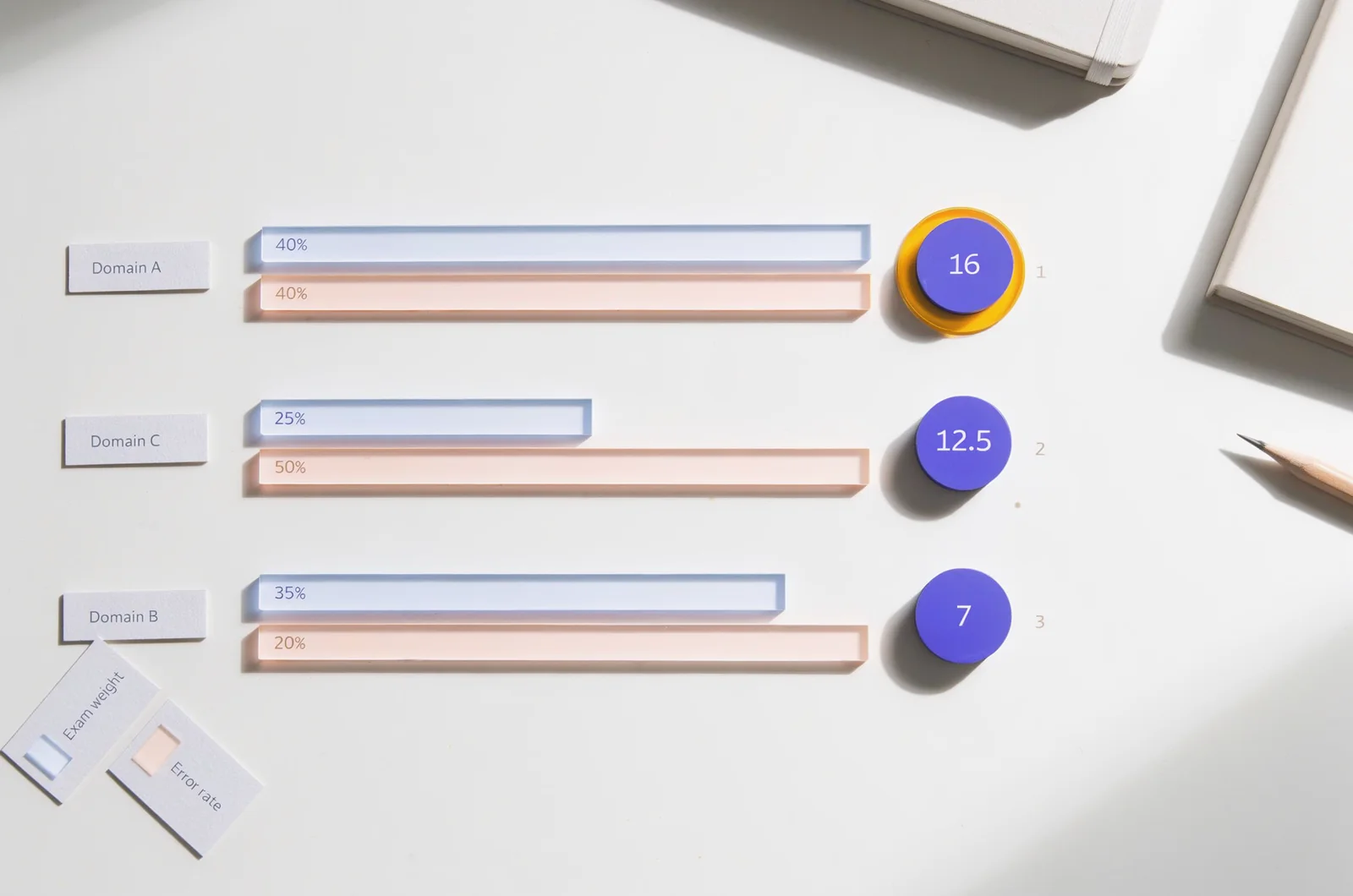
Calculate a simple study priority
For each domain, calculate:
Miss rate = incorrect or unanswered items ÷ total items in that domain
Then calculate a planning index:
Priority index = domain weight as a percentage × miss rate as a decimal
Consider a fictional exam with three domains. These numbers are illustrative and do not describe a real certification.
| Fictional domain | Exam weight | Missed/total | Miss rate | Priority index |
|---|---|---|---|---|
| Domain A | 40% | 8/20 | 40% | 16 |
| Domain B | 35% | 4/20 | 20% | 7 |
| Domain C | 25% | 5/10 | 50% | 12.5 |
Domain C has the highest miss rate. Domain A receives the first study block because its combination of weight and misses produces the highest index.
Keep guessed correct answers beside this calculation. Review a domain with several uncertain answers even when its miss rate looks low.
Check the sample before trusting the ranking
Look at how many questions produced each result. One miss out of two questions gives you less detail about a domain than a review of twenty questions.
Check whether the errors repeat across several objectives or cluster around one concept. In the fictional example, Domain A might need one targeted repair rather than a complete domain review.
If the official guide gives weight ranges, use a clearly labeled approximation for planning. If weights are unavailable, rank by recurring objective gaps and uncertainty; leave the weight field blank.
A useful interactive planner would accept domain weights, question counts, misses, and uncertain answers. It could calculate this index and flag small samples. Keep the underlying counts visible in any planner you use.
6. Put the repair work into seven days of study
Turn the ranked objectives into calendar appointments with defined outputs. For a busy working week, choose blocks you can complete even after a demanding day.
The following example uses 230 minutes: five 30-minute weekday sessions, 60 minutes on Saturday, and 20 minutes on Sunday. Adjust the duration to your schedule.
Give each block one repair task
Using the fictional ranking above, assign most of the repair work to Domains A and C:
- Monday, 30 minutes: review the highest-priority objective in Domain A. Finish with a written explanation of the rule you missed.
- Tuesday, 30 minutes: work through a different scenario for that objective. Identify the deciding condition before checking the explanation.
- Wednesday, 30 minutes: repair the main gap in Domain C. Reconstruct the process or decision sequence from memory.
- Thursday, 30 minutes: answer fresh questions covering the repaired objectives. Log any recurring cause of error.
- Friday, 30 minutes: check Domain B and revisit uncertain correct answers. Add repair tasks only where the answers reveal gaps.
- Saturday, 60 minutes: complete hands-on work or longer scenarios for the application gaps that remain.
- Sunday, 20 minutes: attempt a short mixed set, review the results, and assign the following week's first two blocks.
Put these appointments into your calendar with the objective and expected output in the title or notes.
Match the practice mode to the task
Use PrepHoot's study mode during explanation-focused blocks. Pause to work through the reasoning before continuing to the next question.
For facts that need recall practice, write prompts that require an answer before you turn the card over. For pacing, reserve a timed block. The flashcards versus timed exams guide explains that choice in more detail.
If you miss a session, move its unfinished repair task to the next available block. Preserve the objective and verification check when shortening the schedule.
7. Verify the repair with fresh questions
Check the repaired skill with questions you haven't memorized. Repeating the original item can confirm that you remember its explanation; a different scenario gives you another way to examine the objective.
Start with a small set covering the repaired objectives. Keep explanations closed until you've committed to each answer. Record correctness, uncertainty, and any repeated error cause.
For each response, explain the deciding detail before reading the rationale. If you can answer correctly but still can't distinguish the alternatives, leave that objective in the review queue.
After the targeted check, use PrepHoot's timed mode for a mixed practice block. Record whether you finished, where you stalled, and which items you rushed. Compare those observations with the conditions saved from your starting attempt.
Keep the comparison specific. Note that you can now explain a previously confused distinction, or that unanswered items still appear near the end. Different question sets and domain mixes can make overall percentages difficult to compare directly.
Take another full practice test when your plan needs a broader check of coverage and pacing. Allow time afterward to review it. If the same objective fails again, change the repair activity before repeating another large set.
Update the error log with the new evidence and move unresolved objectives into the next week's calendar.
When your results leave you unsure
Use the unresolved parts of your review to decide whether you need more evidence, a smaller task, or a different study activity.
What if the overall score is high but confidence is low?
Keep guessed correct answers in the plan. Choose fresh questions for those objectives and explain your selections before checking them. Use the resulting log to decide which gaps remain. Avoid choosing an exam date from one practice percentage alone; include objective coverage and pacing in that decision.
How much review should fit into one evening?
Choose a stopping point you can verify. Save the report, classify uncertain answers, and fully analyze one cluster of related misses. Leave a written note naming the next objective to review. That gives the following session a defined starting task without forcing you to finish the whole report tonight.
What if the explanation seems wrong or unclear?
Mark the item unresolved and compare the claim with official learning material or product documentation relevant to that objective. Don't copy an uncertain explanation into your study notes as an established rule. Record the exact point that needs checking, then continue with other review items.
Study schedules and objective checks
- Practice Section 2 questions without wasting hours
- Prepare for CSM-001 around a full-time schedule
- Check readiness against Cisco 100-890 exam topics
Try the free sample questions, then create a free account or purchase full access or a membership for the exam they are preparing for. Get started |  |